Is Microwave Better Than Oven? A Practical Comparison
Explore whether is microwave better than oven for reheating, baking, and everyday cooking. This analytical side-by-side guide weighs speed, texture, energy use, and safety to help home cooks decide which appliance to use in different scenarios.


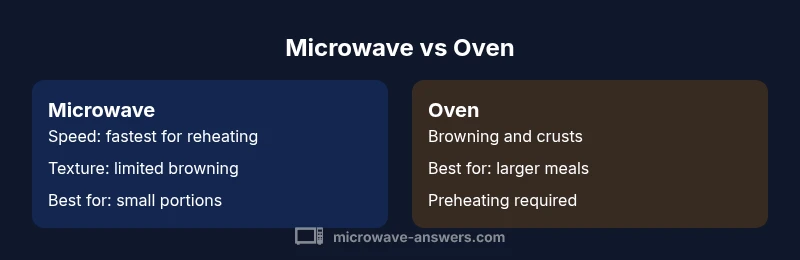
Short answer: is microwave better than oven for everyday tasks? It depends. Microwaves excel at speed, reheating, and small portions, while ovens shine for browning, texture, and larger meals. If you prioritize quick meals and energy efficiency for small portions, the microwave wins. For baking, roasting, and crispy edges, the oven is usually the better tool. In some cases, hybrid approaches work best.
Is microwave better than oven? Defining the comparison
The central question, is microwave better than oven, hinges on context. Microwaves heat food by dielectric energy that vibrates water molecules, delivering rapid temperature rise with minimal preheating. Ovens rely on thermal convection and radiant heat, enabling browning and even cooking through longer exposure. This fundamental difference shapes every practical outcome—speed, texture, and scalability. The Microwave Answers team stresses that the best tool depends on portion size, food type, and texture goals. By unpacking these dynamics, readers move from a binary debate to a nuanced decision.
Key takeaway: the right choice is task-driven rather than appliance-driven. When you need speed and small portions, the microwave shines; for crust, color, and larger batches, the oven often wins.
We will also explore how different features (like convection, inverter power, and sensor tech) affect outcomes, so you can map your typical meals to the most appropriate appliance. Remember that safety and container compatibility matter as much as temperature control.
How microwaves heat food vs how ovens operate
Microwave heating works by exciting polar molecules (primarily water) inside food, which rapidly converts microwave energy into heat. This method is inherently fast but can be uneven if food is dense or unevenly distributed. Conventional ovens heat food through surrounding air and racks, producing a steady surface temperature that promotes Maillard browning and moisture evaporation. The contrast matters: microwaves excel at speed and gentle reheating, while ovens deliver texture and depth of flavor. For the headline question is microwave better than oven, the physics alone suggests distinct strengths for each path, and outcomes depend on the dish.
Speed, convenience, and small meals
In everyday cooking, speed and convenience are often the deciding factors. The microwave is unbeatable for reheating leftovers, softening frozen items, and cooking small portions quickly. When you ask is microwave better than oven for quick meals, the answer is usually yes, because you can reach serving temperature without preheating. However, speed can come at the cost of even heat and texture. The oven, even in its most efficient modes, cannot match microwave speed for tiny portions or rapid reheating. For families who need fast lunches, the microwave is an attractive first option, with the caveat that not all foods reheat evenly.
Texture, browning, and the culinary finish
Texture is a frequent reason people favor ovens. The Maillard reaction—the browning that develops crust and depth—does not occur well in a typical microwave without additional steps. When considering is microwave better than oven, texture emerges as the key differentiator. For foods that benefit from crisp edges, like roasted vegetables, potatoes, and bread, the oven produces superior finish. In many cases, you can optimize texture by finishing microwaved items in a hot oven or toaster oven for a few minutes, effectively combining speed with crust.
Food safety and reheating guidelines
Food safety is essential in any reheating scenario. Regardless of your choice, ensure that reheated dishes reach safe internal temperatures and are served promptly to preserve texture and safety. The microwave can heat unevenly, so stirring and resting are recommended to promote even temperatures. The oven’s slower pace often maintains heat more uniformly, but you must manage preheating times and moisture loss. When evaluating is microwave better than oven for safety, balance immediate temperature goals with the risk of overheating edges or drying foods.
Energy use and long-term costs
Energy consumption is a practical consideration, yet exact costs depend on usage patterns and appliance models. In general, microwaves use less energy per minute for small tasks due to minimal preheating. Ovens, while capable of handling larger meals, consume more energy during preheating and longer cook times. For households focusing on energy efficiency for day-to-day meals, the microwave often provides a meaningful advantage in overall consumption, provided the dish benefits from quick heating rather than browning.
Size, capacity, and kitchen layout
Counter space, cabinet placement, and appliance size influence the practical choice. If you regularly prepare large roasts or casseroles, the oven’s larger capacity and even heat distribution can save time and reduce batch cooking. For compact kitchens or single-serving meals, a microwave preserves countertop space and reduces clutter. If you are deciding whether is microwave better than oven in this dimension, measure your typical dish sizes and plan for future needs. A microwave with a convection option can bridge some of these gaps by enabling both modes in one unit.
The role of technology: convection microwaves and combo appliances
Advances in microwave technology include convection modes, inverter power, and sensor-controlled cooking. Convection microwaves add hot air circulation, improving browning and evenness, which narrows the gap with traditional ovens for certain recipes. Combo appliances combine microwave and conventional oven functions, offering flexibility but sometimes at higher upfront cost and complexity. When evaluating is microwave better than oven, these features matter because they expand your capabilities, especially for multi-task meals and quick weeknight dishes.
Food category breakdown: best uses for each appliance
Certain foods respond better to one appliance than the other. Leftovers and sauces benefit from the microwave’s speed, while grain-based dishes, roasted vegetables, and baked goods often fare best in an oven. Proteins can be rehydrated and warmed in the microwave with careful timing, whereas roasting concentrates flavors in the oven. If you want to apply is microwave better than oven to real-world menus, categorize meals by texture needs, portion size, and time constraints, then map them to the optimal tool.
Decision framework: when to choose microwaves vs ovens
A practical decision framework starts with task type: reheating or cooking from scratch? For quick, single servings, the microwave is often the best starting point. For crust, caramelization, and complex flavors, the oven is usually preferred. If you routinely balance speed and texture, a hybrid approach—microwave for initial heating, then a brief oven finish—offers a pragmatic compromise and aligns with best-practice cooking methods. This framework helps answer is microwave better than oven in a systematic way.
Practical recipe examples that exploit each appliance
To illustrate the distinction, consider simple recipes that leverage each appliance’s strengths. reheated soup or steamed vegetables: microwave. Crispy roasted potatoes or a sheet-pan chicken: oven. A two-step approach—microwave to reduce timing, then oven finish—can deliver speed with texture. When deciding is microwave better than oven in practice, design your meals to align with each device’s strengths and avoid forcing a single method for all tasks.
Tips to optimize performance and extend appliance life
Small adjustments can improve outcomes regardless of the appliance. Use microwave-safe containers, avoid metal, and cover foods to reduce splatter. In ovens, preheat only as long as necessary, rotate trays for even browning, and use proper bakeware to prevent hotspots. Regular cleaning, descaling, and checking seals in both devices help sustain efficiency. If you want to maximize your results when asking is microwave better than oven, tailor your workflow to the dish and time budget, not a one-size-fits-all rule.
Comparison
| Feature | Microwave | Conventional Oven |
|---|---|---|
| Speed and convenience | Very fast for reheating and simple meals | Slower due to preheating and longer cook times |
| Texture and browning | Limited browning; may steam or soften textures | Excellent browning and crust development |
| Energy efficiency | Low energy per minute for small tasks | Higher energy use due to preheating and longer cooking |
| Cooking capacity | Best for single servings or small batches | Better for larger batches and multi-dish meals |
| Versatility | Great for reheating, melting, and simple cooking | Strong for baking, roasting, and complex recipes |
| Ideal use cases | Leftovers, sauces, microwavable meals | Breads, roasts, casseroles, and pastries |
| Costs and maintenance | Lower upfront cost, minimal maintenance | Higher upfront cost, more routine cleaning |
Advantages
- Fast reheating and meal prep for small portions
- Lower energy use per quick task in many cases
- Simple operation and minimal preheating
- Compact options fit small kitchens
Cons
- Microwave browning and even heating can be uneven
- Oven produces much better texture and crusts
- Higher upfront and operating costs for ovens
- Not ideal for large-volume batch cooking
Microwave wins on speed and efficiency for small tasks; oven wins on texture and large meals.
For quick reheating and small dishes, the microwave is typically the better starting point. For baking, roasting, and achieving crust, the oven is superior. A practical approach is to use each device for tasks it handles best, or combine them for speed with final texture enhancement.
Common Questions
Can I cook a full meal in a microwave?
A microwave can handle simple meals, reheating, and some built dishes, but a full meal with multiple components often benefits from oven or stovetop methods for texture and flavor.
You can cook simple meals in a microwave, but for a complete, well-textured plate, you’ll still rely on the oven or stovetop for certain components.
Is it safe to use metal in a microwave?
No, metal in a standard microwave is unsafe and can cause arcing or damage. Some specialized cookware exists for specific models, but generally you should avoid metal.
Avoid metal in a microwave; use microwave-safe containers instead to prevent sparks and damage.
What foods reheat best in a microwave?
Soups, sauces, grains, and vegetables reheat well in a microwave when cut into even pieces and heated in short intervals with stirring. Hearty sauces and gravies should be stirred to prevent hot spots.
Soups and sauces reheat fast in the microwave; stir often to avoid cold spots and splatters.
Is convection microwave worth it vs. a regular microwave?
Convection microwaves add hot air circulation, improving browning and even heating. They can replace a traditional oven for some tasks, but they cost more and require space.
If you bake or want crisper textures, a convection microwave can be worth it; otherwise, a standard microwave may suffice.
How do I compare energy use between devices?
Compare energy use by task: microwaving a single serving typically consumes less energy than preheating an oven for that same amount of food. For long cooking, ovens may consume energy more, but with larger meals the difference balances out.
For quick tasks, the microwave uses less energy; for long baking, the oven's energy cost is higher but offers texture benefits.
What safety tips help when using a microwave?
Use microwave-safe containers, cover foods to prevent splatter, avoid overheating liquids, and let foods stand to finish heating evenly. Keep the door clean and ensure proper venting for safety.
Use safe containers, cover food, and let it rest after heating for even warmth.
Main Points
- Choose speed first for small meals
- Prefer oven for browning and crusts
- Consider a hybrid approach when possible
- Map dishes to the appliance that optimizes texture
- Regularly maintain both devices for best performance