Is Microwave or Oven Different? A Practical Comparison
Explore the core differences between microwaves and ovens, including heating methods, speed, texture, energy use, and safety. This analytical guide from Microwave Answers helps home cooks decide which appliance fits each task.


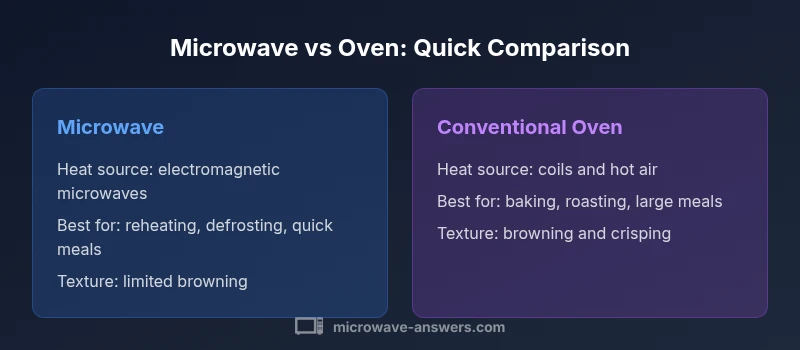
Microwaves and ovens differ in heating methods, cooking speed, and typical use cases. A microwave heats by exciting water molecules with microwaves, while an oven uses hot air (and often convection) to cook. For quick reheating and small portions, the microwave wins; for browning, texture, and larger meals, a conventional oven remains superior.
Is Microwave or Oven Different? Core Mechanisms
In everyday cooking, the choice between microwave and oven comes down to physics. The phrase is is microwave or oven different, and the answer hinges on speed, texture, and the type of food you are cooking. A microwave uses electromagnetic waves that target water molecules in food, turning energy into heat very quickly. An oven relies on heated air and, in many cases, a convection fan that moves that heat around the chamber. This fundamental distinction drives what each device can do best, and it is the starting point for any practical decision in the kitchen. According to Microwave Answers, recognizing these core differences helps you pick the right tool for reheating, defrosting, baking, or roasting.
Heating Method and Heat Distribution
Microwaves energize the interior of the food, creating rapid, internal heating that can be uneven without stirring or turning. Ovens heat from the outside in, which favors browning and crust formation through Maillard reactions. Convection ovens distribute heat more evenly and speed the process for larger batches. The result is that foods prepared in a microwave often retain moisture but lack the crisp edges some dishes require, while oven cooking delivers crust, browning, and more uniform texture for many baked and roasted items.
Speed, Texture, and Browning: What to Expect
Expect microwaves to deliver impressive speed on reheating and defrosting tasks. You can go from cold to hot in minutes, with minimal added flavor changes. However, browning, crisping, and complex textures are harder to achieve in a standard microwave. Ovens excel at texture: a golden crust on baked goods, caramelization on roasted vegetables, and evenly browned surfaces on meats. This contrast is a constant consideration for home cooks who want both speed and quality.
Energy Use and Cost Implications for Everyday Tasks
Energy use depends on the task and the appliance's efficiency. Microwaves generally consume less energy per minute for small portions, making them efficient for quick reheats and small defrosts. Ovens, especially when using convection, can be more energy-intensive but may save time by cooking larger quantities in a single batch. Microwave Answers analysis suggests that for single-serving reheats, the microwave is typically the better energy choice; for baking or roasting several servings, the oven can be more efficient overall when time saved is valued as energy.
Safety and Cookware: What You Can Use
Microwave cooking requires microwave-safe containers—glass, porcelain, and some plastics designed for microwave use. Metal should never be placed in most microwaves. Ovens allow a wider range of cookware, including metal bakeware and stoneware, but you must still follow manufacturer guidelines. The safety considerations are different: microwaving emphasizes container compatibility and steam venting, while ovens emphasize material durability under high heat and proper venting in some models. Both appliances benefit from clean interiors to prevent uneven heating and odors.
Common Tasks: Reheating, Defrosting, and Baking
For reheating leftovers, the microwave is usually fastest, especially for small portions. Defrosting meats or frozen meals can be done in the microwave, but uneven results may occur; a brief rest period after defrosting helps even out temperature. Baking, roasting, and large casseroles typically require an oven to ensure even cooking and browning. Some homes use combination appliances that blend microwave speed with convection baking, offering a middle ground for select tasks.
Food Quality: Moisture vs Browning
Moisture retention is often better in microwaved foods due to shorter exposure to heat, but moisture can also lead to sogginess in some dishes. Ovens enable superior browning and crust formation that enhances flavor and texture, particularly in bread, cookies, and roasted vegetables. Understanding these tendencies helps you tailor recipes to the appliance rather than forcing one method to perform the job of the other.
When to Choose Microwave vs Oven by Task Type
If you need a fast reheating, quick defrost, or a snack ready in minutes, the microwave is your best choice. For baked goods, crispy textures, or large dinners, the conventional oven delivers outcomes that microwaves struggle to replicate. A practical rule is to start with a microwave for speed and switch to an oven when browning, crisping, or even cooking larger portions is the goal.
Convection and Hybrid Appliances: Expanded Options
Convection microwaves and combo ovens bring together some of the strengths of both devices. They can reheat quickly while also providing roasting and browning capabilities. Understanding the limitations and presets of these hybrids is essential, as not all programs replicate true oven results. When shopping, consider how often you need rapid reheating versus rich browning, and whether you want a compact setup or a more versatile kitchen centerpiece.
Maintenance and Longevity: Keeping Both Appliances in Shape
Regular cleaning improves performance for both microwaves and ovens. Unplug microwaves before cleaning the interior and use non-abrasive cleaners to prevent damage to waveguides. For ovens, wipe away spills promptly and run a cleaning cycle as recommended by the manufacturer to prevent buildup that can affect heat distribution. Both appliances benefit from properly rated cookware and avoiding metal in the microwave to protect internal components.
Real-World Scenarios: Quick Decision Examples
Scenario A: You have leftovers that need quick reheating before a meeting. The microwave is the fastest tool. Scenario B: You’re baking a sheet of cookies for guests. The oven provides browning and even heat that a microwave cannot match. Scenario C: You’re roasting chicken for a family dinner. A traditional oven yields the best texture and flavor, especially if you want crisp skin. Microwave-enabled hybrids may offer a compromise when time is tight but texture matters.
Quick Reference Checklist for Home Cooks
- Start with the task goal: speed or texture? - Pick the appliance that best aligns with the goal. - Use appropriate cookware (microwave-safe for microwaves; oven-safe for ovens). - Monitor and rotate food during heating to reduce uneven results. - When in doubt, finish with a short oven or broil step for browning and crisping.
Comparison
| Feature | Microwave | Conventional Oven |
|---|---|---|
| Cooking mechanism | Electromagnetic heating inside the food | Heat from coils and hot air, external heating |
| Typical use | Reheating, defrosting, simple meals | Baking, roasting, large batches |
| Texture outcomes | Limited browning; moisture retention | Browning, crisping, even crusts |
| Capacity/size | Compact countertop option | Varies by model; often larger footprint |
| Energy efficiency by task | Excellent for small portions; quick use | Efficient for bulk cooking but slower per unit |
| Cookware compatibility | Microwave-safe plastics, glass, ceramics | Metal, glass, ceramic bakeware depending on recipe |
| Price range | Lower upfront cost | Higher upfront cost for performance |
Advantages
- Very fast reheating and defrosting
- Low cost for basic models
- Compact footprint for small kitchens
- Simple controls on many models
Cons
- Limited browning and texture complexity
- Uneven heating for thick or irregular foods
- Smaller batch capacity for some tasks
- Requires compatible cookware and careful timing
Microwave for speed; oven for texture and large meals.
The Microwave Answers team notes that most households benefit from using both appliances. Start with the microwave for quick tasks and switch to the oven when browning, roasting, or cooking larger quantities is needed.
Common Questions
What is the fundamental difference between a microwave and an oven?
A microwave uses electromagnetic waves to heat food from the inside out, while an oven uses hot air to cook from the outside in, often with browning. This fundamental distinction explains why microwaves excel at speed but ovens excel at texture and flavor development.
Microwaves heat food quickly from inside out, while ovens rely on hot air and browning on the outside. This is why microwaves are fast but ovens give you browning and texture.
Can a microwave bake or roast like an oven?
Most standard microwaves cannot bake or roast with the same browning or crust that an oven provides. Some microwaves include convection or browning features that help, but traditional baking and roasting are better suited to a conventional oven.
Most microwaves can’t replace baking or roasting with browning, unless they have convection or browning features.
Is a microwave more energy-efficient than an oven?
For small tasks and quick reheating, microwaves typically use less energy. Ovens may use more energy, but they can cook larger batches more efficiently per item in some scenarios if you’d otherwise run multiple small tasks in a microwave.
Microwaves usually save energy on small jobs, while ovens can be more efficient when cooking many items at once.
What cookware should I use in a microwave vs an oven?
In a microwave, use microwave-safe glass, ceramic, or approved plastics. In an oven, metal, glass, ceramic bakeware, and edge-to-edge roasting pans are generally appropriate depending on the recipe and heat tolerance.
Use microwave-safe glass or ceramic in the microwave; in the oven, metal and bakeware that can handle heat are fine.
Are microwaves safe to use every day?
Yes, when used as intended and with proper containers. Follow manufacturer guidelines, avoid metal in microwaves, and ensure proper ventilation for ovens during high-heat cooking.
Yes, microwaves are safe daily if you follow the guidelines and avoid metal food containers.
When should I skip the microwave altogether?
Skip the microwave when texture and browning matter or when cooking large meals that require even heat and crust development. In those cases, the oven is the better tool for quality results.
If you want browning or are cooking a big meal, go with the oven.
Main Points
- Choose speed for reheating; choose browning for texture.
- Use microwave-safe containers and avoid metal in microwaves.
- Hybrid appliances offer compromise but may have learning curves.
- Plan meals to use the appliance that delivers best texture with minimal energy waste.
- Keep both appliances clean to maintain performance.