Is Microwave or Oven the Same? A Practical Comparison
Explore whether microwave and oven are the same, compare heating methods, performance, and use cases with practical guidance for home cooks seeking quick results and even cooking.


Is microwave or oven same? Not exactly. Microwaves heat food quickly by exciting water molecules, often with uneven results, while ovens rely on radiant heat for even cooking and browning. This article compares core differences, debunks myths, and offers practical guidance for home cooks deciding when to use each appliance.
Is Microwave and Oven Fundamentally Different?
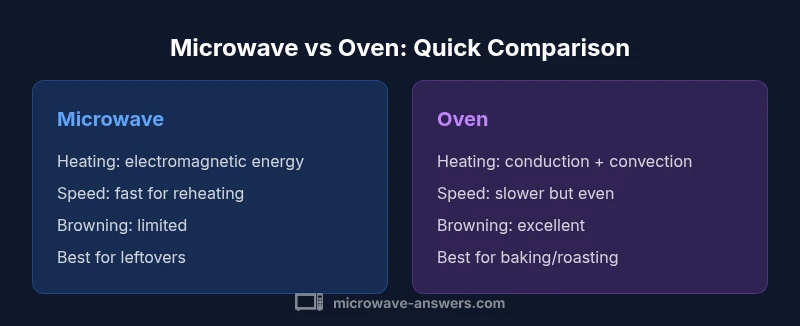
At first glance, the question is often asked: is microwave or oven the same? The simple reality is that they are designed around different heating principles, which leads to very different outcomes in texture, moisture, and timing. According to Microwave Answers, the microwave heats food by emitting electromagnetic energy that agitates water molecules directly inside the food. The result is rapid heating, often with uneven results if portions are thick or layered. By contrast, a conventional oven delivers heat from the outside in, via radiant elements and circulating air, which promotes more uniform cooking, browning, and crust formation. This difference in approach matters for everyday cooking: reheating leftovers, cooking vegetables, baking bread, or roasting meat all respond differently to each appliance. In this article, we’ll unpack these differences, explain how each device is best used, and provide practical tips so home cooks can choose the right tool for the job.
Core Heating Mechanisms: How They Work
Microwave energy is produced by magnetron tubes and delivered into the cooking chamber. The energy frequency interacts with water, fats, and some sugars, causing molecules to vibrate and generate heat. The process heats the interior of the food quickly, often leaving edges cooler if the item is thick. Ovens rely on conduction from heated racks and walls, plus convection fans in many models, which move hot air around the food and promote even temperature distribution. Because heat reaches the food from the outside, you can expect gradual browning as the surface dries and caramelizes. Understanding these mechanics helps explain why microwaves are superb for reheating soups or soft items but less ideal for crispy textures, while ovens excel in roasting, baking, and tasks that require crust. Additionally, the choice of cookware matters: metal is safe in most ovens but dangerous in microwaves; microwave-safe glass, ceramic, and certain plastics are designed to tolerate the environment inside a microwave.
Speed, Texture, and Culinary Outcomes
Speed and texture are the heart of the comparison. Microwaves deliver speed and convenience, making them excellent for reheating leftovers, warming beverages, and cooking soft items rapidly. However, they often struggle with even heating, moisture retention, and browning. Ovens, by contrast, take longer to heat up and cook, but they produce consistent textures, browning, and crusts that many dishes rely on—think roasted vegetables with caramelized edges or a golden-brown crust on a casserole. When selecting between appliances, consider the desired texture, the size of the batch, and whether you need a quick turnaround or a finished, browned finish. Real-world results improve when you understand each appliance’s strengths and tailor techniques accordingly. In this comparison, we reference common consumer use-cases to help readers match meals to the right tool.
Common Myths Debunked
Myth 1: Microwaves destroy nutrients. Reality: nutrient loss is predominantly driven by cooking time and temperature, not the appliance type; microwaving can preserve nutrients when done with minimal water and short times. Myth 2: Microwaves can’t bake. Reality: many microwaves offer convection or combination modes that simulate baking, though results differ from a traditional oven. Myth 3: Metal in a microwave is always dangerous. Reality: metal should never be used in a standard microwave, but certain specialty trays exist for specific models—always follow manufacturer guidance. Myth 4: A microwave replaces a conventional oven. Reality: for browning, crust, and large-batch roasting, the oven still wins. The right approach often combines both appliances. Myth busting helps set reasonable expectations for results and safety.
Practical Guidelines for Everyday Cooking
To maximize results, treat microwaves and ovens as complementary tools. Use microwave-safe covers to reduce moisture loss, stir or flip foods halfway, and allow standing time after cooking to even out temperatures. When you want a quick finish, use a microwave for reheating and a brief oven finish for browning. Preheating is rarely necessary for microwaves, but is often worth it for certain baked dishes in an oven. Selecting appropriate cookware is essential: microwave-safe glass, ceramic, or certain plastics for microwaves; metal and oven-safe pans for ovens. For dense items, cut into even portions to improve uniform heating. Remember to check packaging for guidelines and never microwave metal or aluminum foil unless specified by the manufacturer.
Practical Scenarios: When to Use Which
Leftovers and soups: great in a microwave for speed, with a quick stir to even heat. Rice or grains: microwaving with water or broth can steam more evenly than stove-top reheating. Vegetables: microwaves can retain moisture if covered; ovens roast for a caramelized texture. Meats: microwave for warming small portions; oven-roasting yields better flavor and texture. Baked goods: finish in the oven for crumb and crust; microwave-only baking is limited. Frozen foods: check package directions; many items cook well in a microwave, with ovens providing crispiness for certain products. When in doubt, start in the microwave and finish in the oven for best texture.
Safety, Cookware, and Maintenance
Always follow manufacturer directions. Avoid metal containers in microwaves; use microwave-safe ceramics, glass, or plastics. In ovens, choose cookware labeled oven-safe and suitable for high temperatures. Keep microwaves clean to prevent odor transfer and food staining; wipe after use and avoid letting food boil over. For safety, never heat in plastic containers not rated for high temperatures in the oven, and never use metal in a microwave. Proper maintenance includes routine cleaning, checking seals on ovens, and replacing damaged cookware to avoid uneven results or safety hazards.
Integrating Both Devices for a Busy Kitchen
A practical workflow combines both appliances to maximize speed and quality. For example, preheat the oven for a roast while microwaving the sides or reheating components, then finish in the oven to achieve browning and texture. Plan meals with this approach: use the microwave for rapid prep or short cooking steps, and transition to the oven for depth of flavor and crust. A simple calendar-like approach helps busy households: designate tasks for each appliance and stick to it. This integration reduces total cooking time and improves consistency, while also helping maintain kitchen safety and energy efficiency. The Microwave Answers team emphasizes that the best results often come from using both tools strategically rather than relying on a single appliance for all tasks.
Comparison
| Feature | microwave | conventional oven |
|---|---|---|
| Heating method | Electromagnetic energy exciting water molecules; rapid interior heating (possible unevenness) | Conduction and convection heat from heated walls and airflow; even cooking and browning |
| Speed and efficiency | Very fast for reheating and small portions | Slower overall, but steady and reliable for baking/roasting |
| Browning and texture | Limited browning; texture depends on moisture control | Excellent browning and crust development |
| Suitable foods | Leftovers, soups, beverages, soft textures | Roasted meats, casseroles, baked goods, sheet-pan meals |
| Energy use | Typically lower energy for quick tasks | Often higher energy for longer, larger-batch cooking |
| Capacity/size | Compact countertop footprint; capacity varies by model | Larger interior with variable rack configurations |
| Cookware compatibility | Microwave-safe containers; avoid metal | Oven-safe pans and bakeware; metal is allowed in some ovens |
Advantages
- Very fast reheating and cooking for small portions
- Energy-efficient for quick tasks and small meals
- Compact footprint ideal for small kitchens
- Ovens provide superior browning, crust, and texture for baking and roasting
- Flexible workflows when using both appliances together
Cons
- Microwaves can heat unevenly and moisture can be lost if overcooked
- Ovens require preheating and longer cook times for many tasks
- Ovens typically consume more energy for small tasks
- Microwaves have cookware limitations and safety considerations (avoid metal)
Microwave for speed; Oven for texture.
Use the microwave when speed and convenience matter, especially for reheating and simple cooking. Turn to the oven when you need browning, crust, and even cooking across larger portions. The best approach is to leverage both appliances based on the dish and the desired outcome, not one tool alone.
Common Questions
Do microwaves destroy nutrients?
Microwave cooking preserves nutrients similarly to other quick methods when not overcooked. Shorter cooking times and minimal water help retain vitamins and minerals.
Microwaving preserves nutrients if you avoid overcooking and excessive water.
Can you bake in a microwave?
Most standard microwaves can’t bake like a traditional oven, but many models offer convection or combination modes that mimic baking with varying success. For bread and crispy textures, a conventional oven is often preferred.
Microwaves can bake only if the model has a convection or combo mode; otherwise, use the oven for baking.
Is metal safe in a microwave?
Never place metal in a standard microwave; it can cause arcing and damage. Some specialty cookware is designed for limited use in specific models—always follow the manufacturer’s guidance.
Never put metal in a microwave; use microwave-safe containers only.
What foods heat best in a microwave vs oven?
Microwaves excel with leftovers, soups, and soft foods that don’t require browning. Ovens excel in baking, roasting, and foods that benefit from crust and caramelization.
Leftovers heat very well in a microwave; for baking and roasting, the oven shines.
How do you prevent uneven heating in a microwave?
Stir foods midway, use a cover to trap steam, and let standing time finish the cooking. For crisp textures, finish with a brief oven step if needed.
Stir, cover, and let stand for even microwaving; finish in the oven for crispness if desired.
Main Points
- Use microwave for rapid reheating and small portions
- Reserve oven for browning, roasting, and baking
- Texture is influenced by heating method—plan accordingly
- Choose cookware appropriate for each appliance
- Combine both tools for busy kitchens to optimize time and results