Is Microwave and Convection Oven the Same? A Practical Comparison
A detailed guide clarifying whether a microwave and convection oven are the same, how each works, and how to choose between them for home cooks.


The question 'is microwave and convection oven same' is commonly asked. They are not the same: microwaves heat food via electromagnetic waves, while convection relies on heated air circulated by a fan for browning and even cooking. Some models combine both functions, but a true microwave and a true convection oven remain distinct appliances with different strengths and limits.
Is Microwave and Convection Oven the Same?
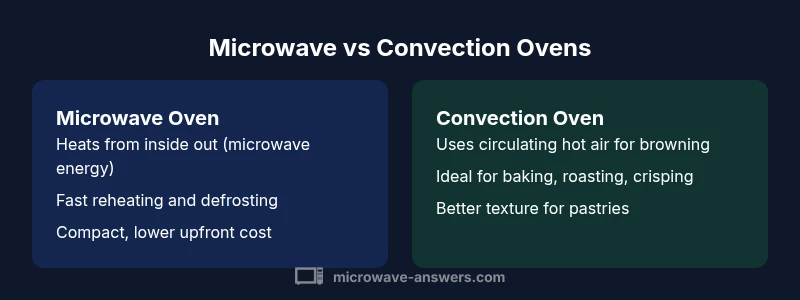
The simple answer to the question is no, they are not the same device or cooking method. A microwave oven uses electromagnetic waves to vibrate water molecules and heat food from the inside out, often very quickly and with minimal preheating. A convection oven, on the other hand, uses a heating element (usually at the top or bottom) and a fan to circulate hot air around the food for even cooking and browning. In practice, many kitchens pair these two tools because they perform different tasks better than one another. If you search for 'is microwave and convection oven same,' you’ll see the common misconception that one appliance can replace the other. The truth is that each appliance excels at different jobs, and only some models combine the two functions into a single unit, offering limited parity with dedicated appliances.
Comparison
| Feature | Microwave Oven | Convection Oven |
|---|---|---|
| Heating Method | Microwave radiation heats water molecules for rapid heating | Hot air circulated by a fan heats and browns food |
| Best For | Quick reheating, defrosting, and small portions | Baking, roasting, and achieving browning and crispiness |
| Typical Cooking Times | Very fast for reheating and defrosting | Longer but more even and browning-focused |
| Energy Efficiency | Efficient for small tasks and immediate heating | Efficient for larger batches and high-temp cooking |
| Upfront Cost/Footprint | Low to mid price; compact size common | Mid to high price; larger footprint often required |
Advantages
- Fast reheating and defrosting with minimal prep
- Compact footprint and generally lower upfront cost
- Simple controls and quick maintenance
- Wide availability and good energy efficiency for small tasks
- Versatility when paired with other cooking tools
Cons
- Limited browning and texture compared to a true oven
- Cannot fully replace a traditional oven for large roasts or multi-dish meals
- Smaller capacity and power constraints can limit performance
Not the same—each appliance serves distinct cooking tasks; hybrids exist but rarely match dedicated devices in their core strengths.
Microwave vs convection is a question of function, not form alone. If your priority is speed, microwave wins for small tasks; if you need browning and large-batch cooking, a convection oven shines. A hybrid can bridge the gap, but choose based on your top daily tasks and space.
Common Questions
Is a microwave the same as a convection oven?
No. Microwave ovens heat food with electromagnetic waves and are excellent for speed, defrosting, and small portions. Convection ovens use a fan to circulate hot air for browning and even cooking, especially for baking. They serve different cooking needs, though some models combine both features.
No—microwaves and convection ovens operate differently and excel at different tasks; hybrids exist but are not identical to dedicated units.
Can I bake in a microwave or convection setting?
Microwaves can simulate some baking tasks in certain presets, but browning and texture are limited. Convection baking is the preferred method for true baking with crust and even browning. For best results, use convection when you need a proper bake and reserve microwave for reheating or quick prep.
Microwaves aren't true bakers; use convection for baking to get browning and texture.
Do convection ovens use more energy than microwaves?
In general, microwaves are more energy-efficient for small, quick tasks, while convection ovens become more energy-efficient when cooking larger quantities or at higher temperatures. The real difference is task-based rather than a universal rule.
Microwave tends to be more energy-efficient for small tasks; convection shines for bigger meals.
Are there true microwave-convection ovens?
Yes, there are hybrid or combination microwaves that include both microwave and convection modes. Performance varies by brand and model; they save space but may not match a dedicated microwave or a dedicated convection oven on every task.
Yes, hybrids exist, but check performance for your must-do tasks before buying.
What should I buy for a small apartment?
A compact microwave or a microwave-convection combo can offer broad versatility in limited space. If you do any baking or roasting, a separate convection option might still be worth it later. Consider your cooking patterns and whether you expect to replace or supplement multiple appliances.
In a small space, a compact microwave or a combo unit can cover lots of tasks.
How should I upgrade an existing kitchen?
Start by listing your top cooking tasks (reheating, baking, roasting). If you heat and reheat mainly, a microwave-plus-convection strategy makes sense. If you bake often, a standalone convection oven is valuable. A hybrid can be a space-saving compromise, but evaluate performance for your favorite dishes.
Prioritize your top tasks and space; hybrids are convenient but may underperform for specific tasks.
Main Points
- Identify your most frequent tasks before buying
- Microwave = speed; convection = browning and even heating
- Consider a hybrid only if space limits demand compactness
- Plan for capacity and long-term energy use
- Pairing appliances often offers the best overall versatility