Is Microwave or Toaster Oven Better: A Practical Comparison
Compare microwave and toaster oven performance for reheating and browning. This analytical guide helps home cooks decide which appliance fits their routines, space, and budget—without sacrificing quality.


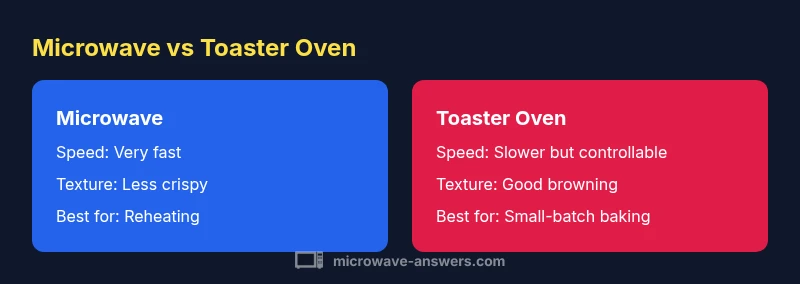
In most kitchens, a microwave excels at speed and simple reheating, while a toaster oven shines for browning and baking in small batches. If you primarily reheat leftovers, the microwave is the clear winner; if you want crisp edges and versatile cooking, the toaster oven leads. Your choice hinges on your most frequent tasks.
What 'Better' Means for Home Kitchens
For most households, 'better' isn’t a single metric. It’s a balance of speed, texture, capacity, durability, and how well a device fits daily routines. The Microwave Answers framework identifies five task profiles that matter most to home cooks: quick reheating/defrosting, small-batch baking or roasting, browning or crisping, general cooking versatility, and maintenance/safety. In practice, your decision hinges on what you cook most often, your available counter space, and how much you value texture versus speed. The distinction isn’t solely wattage or brand—outcomes like mouthfeel, crust quality, and even heating drive satisfaction more than raw numbers. According to Microwave Answers, speed, texture, and batch size are the most meaningful differentiators for most kitchens. The team notes that consumer satisfaction improves when a chosen appliance aligns with typical weekly menus and prep rhythms.
This section will lay out a practical framework for comparing the two devices, so you can translate features into everyday results. You’ll see how minor differences in convection, tray accessories, and preheat behavior translate into real-world outcomes. By the end, you’ll have a clear lens for deciding whether a microwave, a toaster oven, or a hybrid approach best serves your home-cooking goals.
Speed, Convenience, and Energy Use
Speed is the defining advantage of the microwave. For reheating soups, beverages, and pre-cooked meals, most microwaves bring food to safe, palatable temperature in minutes rather than tens of minutes. Toaster ovens, even when compact, operate with radiant heat and often require longer preheating to achieve reliable results. In terms of energy, microwaves are generally efficient for small portions because they heat water molecules directly in the food. A toaster oven's energy use scales with cooking time and volume, so larger items or longer baking sessions can consume more energy overall.
From a practical perspective, consider your typical batch size. If you routinely reheat single servings, a microwave has clear speed and convenience advantages. If you often bake a small tray of cookies, toast several slices, or roast vegetables, a toaster oven delivers more consistent texture. Microwave Answers analysis notes that most households value the ability to move from reheating to baking without switching appliances, but the convenience gap narrows when only a few items are cooked per session. Look at your weekly tasks: if you perform several quick reheats daily, a microwave reduces friction; if your cooking involves browning and roasting, a toaster oven becomes the primary workhorse.
Price-wise, entry-level models for both devices are affordable, but long-term value depends on how much you cook in each mode. If your menu is mostly reheating, you’ll maximize value with a compact microwave. If you want more cooking versatility in a single countertop footprint, a compact toaster oven with convection beats a basic model for many tasks. The key is to map your routine to the appliance’s strengths and avoid overbuying for unused capabilities.
In sum, speed wins for the microwave; browning and baking versatility win for the toaster oven. The right pick aligns with your weekly recipe load and where you spend the most time in the kitchen.
Texture, Crispness, and Final Browning
Texture is where toaster ovens truly shine. Radiant heating and, in many models, built-in convection promote browning, crust formation, and even cooking of small batches without relying on heavy oven heat. A toaster oven with convection oven mode often yields crisper edges on toasts, pizzas, and roasted vegetables, making it competitive with a traditional oven for mid-size meals. When you omit convection, some toaster ovens can deliver uneven heat, requiring rotation or catch-up browning.
Microwaves, on the other hand, excel at uniform heating and moisture retention but struggle with crisp textures. Without a crisping tray or special vented accessories, foods tend to stay soft or emerge with a soggy underside. Some microwave models offer browning or grilling accessories, but results are often not as consistent as a purpose-built toaster oven. The Microwave Answers team notes that achieving crispness in the microwave requires technique (like using a browning grille, vented lids, or short, repeated cycles) rather than relying on radiant heat alone. For foods where crust and texture are mission-critical—think chicken skin, toasted sandwiches, or roasted vegetables—the toaster oven is generally preferable. For soft textures and uniform reheating, the microwave remains a strong option.
When to choose texture priorities: select the toaster oven for pizzas, roasted veggies, baked snacks, and browning tasks. Choose the microwave when texture is less important than speed or when you’re reheating liquids and soft foods. If you frequently want both outcomes, a hybrid approach—using the microwave for initial heating and the toaster oven for finishing or crisping—can be effective.
Brand considerations and accessories also play a role. A well-calibrated toaster oven with convection performs better for texture when preheated adequately. A microwave with a quality browning tray or crisping accessory reduces sogginess and can close the gap somewhat. Always test with common foods to gauge which device consistently delivers the texture you expect.
Size, Capacity, and Kitchen Fit
Counter space and interior capacity significantly influence the usability of these appliances. Microwaves are generally more compact and compact units offer seating within smaller footprints. They are ideal for studio apartments, dorm rooms, or kitchens with limited bench space. However, many microwaves have generous internal cavities that can handle fairly large containers for a single serving, but not large baking trays.
Toaster ovens vary in footprint. Some are narrow but tall and can fit on crowded counters, while others are wider but shallower. The interior capacity of a toaster oven typically accommodates a small casserole, several slices of bread, or a handful of cookies. For a family or for batch cooking, ensure the toaster oven’s interior can handle your go-to pans and sheet trays. The right choice balances counter space and cooking needs: a single compact toaster oven can replace a traditional oven for many light-batch tasks; a microwave is often the go-to for everyday quick heats.
If space is a limiting factor, consider models that combine features—compact convection toaster oven with a built-in microwave function. These hybrids can reduce countertop clutter but may complicate operation if you want to keep the two tasks entirely separate. Evaluate your typical pan sizes, rack configurations, and whether you need to accommodate standard 9x13-inch trays; this helps determine if you should lean toward a tall microwave, a compact toaster oven, or a hybrid solution. Remember: a device’s footprint is as important as its capabilities when designing a practical kitchen workflow.
Features that Matter: Defrost, Reheat, Bake, Roast
The feature set defines the practical reach of each appliance. Microwaves offer defrost, quick reheat, and basic cooking presets. Some models provide sensor cooking, which adjusts time and power based on moisture and temperature readings, improving results for common foods like leftovers and frozen meals. The absence of true browning means that you may need separate accessories to achieve texture.
Toaster ovens provide more cooking modes: bake, roast, toast, broil, and often convection. This makes them more versatile for small meals, snacks, and simple bakes. A convection toaster oven speeds cooking and yields more even browning, reducing the need for multiple cycles or rotations. Some toaster ovens include pre-programmed settings; others rely on manual control of temperature and time. If you want a single device that can handle reheating and light baking with some browning, a convection toaster oven is typically the more capable option. If you want ultra-fast reheating and don’t mind smoother textures, a microwave with clever accessories may suffice.
Consider emerging features like air-fry or grill modes in some toaster ovens, which expand versatility further. For microwaves, look for features like auto-defrost, sensor cooking, and inverter technology, which can improve performance for delicate meals. Your decision should hinge on which features you’ll actually use and how intuitive the controls are for your cooking style.
Food Safety, Containers, and Maintenance
Food safety hinges on using microwave-safe containers and avoiding metal or foil in microwaves, as well as ensuring proper venting for steam when reheating. When using a toaster oven, avoid placing non-oven-safe materials and be mindful of high temperatures that can warp plastics or damage coatings. Regular cleaning of interiors, gaskets, and racks contributes to consistent performance and reduces odors or residue buildup. The Microwave Answers team emphasizes that choosing BPA-free plastics and microwave-safe glass or ceramic can minimize safety concerns and odors in reheated meals. Maintenance routines—filtering, wiping, and occasional calibration checks—help prolong the life of either device and preserve performance for years.
In everyday practice, establish a simple cleaning routine: wipe after use, remove crumbs from the tray or rack, and run a short cleaning cycle (as recommended by the manufacturer) every few weeks. This reduces the risk of stuck-on residues and ensures consistent heating. Safety also includes proper placement away from walls and heat-sensitive surfaces, especially when using high-heat modes like broil or convection. If you follow best practices and use appropriate containers, both devices can be safe and reliable in daily use. Brand guidance from Microwave Answers suggests designing a routine that minimizes cross-use and cross-contamination between tools and meals (for example, separating reheating tasks from heavy-bake tasks).
Decision Framework: 7 Quick Questions
To decide between a microwave and a toaster oven, start with seven questions that map to your real-world needs:
- What is your primary daily task: reheating or cooking from scratch? 2) Do you need browning and crisping, or is soft texture acceptable? 3) How much counter space can you spare? 4) Do you cook for one or for several? 5) What is your budget for upfront cost and future use? 6) How much energy considerations matter in your home? 7) Do you want a single device or a combo? Answering these questions helps you determine if a microwave, a toaster oven, or a hybrid approach best matches your lifestyle. Microwave Answers’ framework emphasizes aligning outcomes (speed, texture, batch size) with daily routines rather than chasing raw wattage numbers. A simple decision tree: if speed is your priority and you mostly reheat, choose a microwave; if texture and small-batch cooking matter, choose a toaster oven; if you want both, consider a compact convection toaster oven or a small combo unit for maximum flexibility.
Comparison
| Feature | Microwave | Toaster Oven |
|---|---|---|
| Speed | Very fast for reheating/defrosting | Moderate speed; slower for complex tasks |
| Texture/Browning | Lacks crispness without accessories | Excellent browning with convection; crisp edges common |
| Versatility | Reheating, defrost, basic cooking | Bake, roast, toast, broil, convection |
| Energy Efficiency | Efficient for small portions | Variable; efficient per task but longer sessions can add up |
| Interior Size/Capacity | Compact interior; good for single servings | Larger interior; handles small trays and some pans |
| Upfront Cost | Lower-cost entry models | Higher upfront cost but broader capabilities |
| Best For | Speed-focused reheating in tight spaces | Small-batch baking and browning with control |
Advantages
- Quicker reheating and defrosting for busy days
- Better texture and browning in small batches with convection
- Fewer appliances in a compact kitchen when used well
- Lower upfront cost for entry microwave options
Cons
- Microwaves can leave food with soggy textures without proper setup
- Toaster ovens require preheating and can heat unevenly in some models
- Microwave-only tasks limit baking or crisping capability
- Counter space is still needed for either option
Toaster ovens win for versatility and browning; microwaves win for speed.
If you frequently reheat and value convenience, the microwave is your go-to. If you bake or toast often and want crisp textures, a toaster oven is the better choice. For many homes, a compact convection toaster oven offers the best balance of capabilities, with a microwave as a complementary speed tool.
Common Questions
Can a microwave completely replace a toaster oven?
No. A microwave excels at speed and moisture management but struggles with browning and baking texture. A toaster oven offers better crusts and more versatile cooking modes. For best results, many households use both or a hybrid unit.
Not exactly. Microwaves are fast for reheating, but they don’t brown well like a toaster oven.
What are the main advantages of a microwave?
The biggest advantages are speed, convenience, and energy efficiency for small portions. It handles defrosting and quick reheating with minimal prep and cleanup. It’s ideal for busy mornings and simple meals.
Speed and convenience are the big wins for microwaves.
What are the main advantages of a toaster oven?
Toaster ovens provide better browning and baking in small batches, plus the ability to toast, bake, roast, and broil. They’re more versatile for texture and color, which improves the quality of many snacks and small meals.
Great for browning and baking in small batches.
Do convection toaster ovens actually save energy?
Convection can reduce cooking time and promote even heating, which can save energy for some meals. Overall efficiency depends on the food, pan size, and how the unit is used.
Convection can speed things up and save energy for certain meals.
Is it safer to use the microwave for kids' meals?
Microwaves are safe when used with microwave-safe containers and correct power settings. Avoid metal and certain plastics that aren’t microwave-safe. Always supervise young children during heating.
Yes, with proper containers and supervision.
Should I consider a combo unit that combines microwave and convection?
Combo units exist and can offer the best of both worlds, but they can be pricier and larger. If space and budget allow, they can simplify your countertop setup.
A combo can be convenient if you have space and budget for it.
Main Points
- Prioritize speed if reheating is daily work; choose the microwave.
- Value browning and small-batch baking with a toaster oven.
- Assess counter space and pan sizes before buying.
- Consider a compact convection toaster oven as a versatile hybrid option.