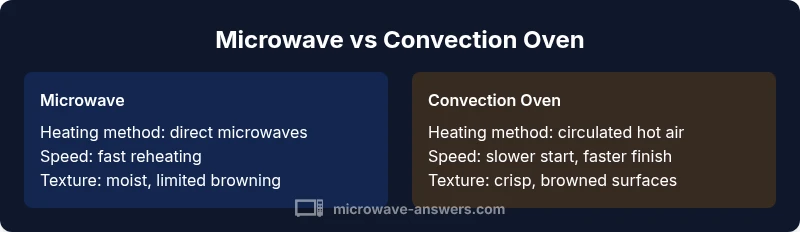
Microwave or Convection Oven: A Practical Comparison
Comprehensive, data-driven comparison of microwave vs convection oven technology, addressing speed, browning, energy use, and best-use scenarios for home cooks and homeowners.


For most homes, a microwave or convection oven offers different strengths: microwaves heat quickly and are ideal for reheating, while convection ovens excel at browning and even baking. If you need fast meals, choose microwave; for crisp textures, choose convection; when space is limited, a combo unit can cover both.
Understanding microwave or convection oven: definitions, scope, and usage
According to Microwave Answers, the choice between a microwave or convection oven hinges on your cooking styles, space, and meal pace. The phrase 'microwave or convection oven' captures two distinct cooking paradigms: one uses electromagnetic waves to excite water molecules for rapid heating, the other uses fans and hot air to bake and roast with browning. In many homes, a single device can handle both scenarios, especially if you opt for a convection microwave or a countertop combo. This article will compare the two in depth, offering practical guidance for home cooks and homeowners. We'll cover performance, energy use, maintenance, and real-world recipes where each shines. Readers seeking to optimize weeknight meals or weekend baking will find a framework to decide which path best fits their kitchen layout, budget, and cooking goals.
Across the home-cooking landscape, microwave or convection oven choices influence meal speed, texture, and cleanup. The Microwave Answers team emphasizes that no single appliance is perfect for every task; the goal is to map tasks to the tool that does them best. In this comparative guide, you’ll see how the two options align with common kitchen workflows, from defrosting and reheating to baking and roasting. Expect a practical framework you can apply immediately, not just a theoretical debate about appliance tech.
Heating mechanisms and how they affect results
Both microwave and convection oven technologies transform cooking time, but they do so through very different heat transfer methods. A microwave uses electromagnetic energy to excite water molecules in food, which makes it incredibly fast for plump, moist reheats and simple defrosting tasks. Convection ovens rely on a fan and an exhaust system to circulate hot air, producing more even browning and crust development. When you ask which is better for a given dish, it’s not about one being superior in all cases—it's about matching the technique to the goal. For delicate reheats, microwaves can preserve moisture, while convection excels at crispy exteriors. The key is to think about texture first, then time, then cleanup. In developments like microwave-convection hybrids, some of the friction between speed and browning is reduced, offering a practical compromise for many households.
Speed, efficiency, and use-case sweet spots
Speed is the most immediate differentiator between these two approaches. A microwave can bring leftovers to a safe serving temperature in minutes, while a convection oven may take longer to reach the desired heat level but will often produce a more appetizing texture. When you’re juggling multiple small portions, the microwave’s rapid response is advantageous. For batch cooking or meals that benefit from browning, convection ovens significantly outperform microwaves. This section outlines typical work patterns: rapid reheats and defrosting favor microwaves; baking, roasting, and plates with crisp crusts favor convection. If space or budget allow, a hybrid unit can reduce compromises by offering both sets of capabilities in one appliance, leveraging the strengths of microwave and convection within a single workflow.
Texture and browning: what your plate actually looks like
Texture is where convection ovens typically outshine microwaves. A convection oven’s circulating air surrounds food, creating even heat transfer that dries moisture at the surface to form a caramelized crust. Microwaves, in contrast, heat mainly from the interior, which helps preserves moisture but can leave surfaces softer. The best texture outcome often depends on the dish: reheating a soup or stew benefits from quick, uniform heating where the microwave preserves moisture; roasting vegetables or finishing a baked chicken with a crust benefits from convection browning. For home cooks seeking both moisture retention and crust, a combined approach or staged cooking can deliver reliable results twice as fast as traditional oven work.
Defrosting, reheating, and leftovers workflow
Defrosting and reheating benefit differently from each appliance. Microwaves excel at defrosting by applying short bursts of energy that thaw without heating the core too quickly, though care is needed to avoid uneven hot spots. Convection ovens can reheat leftovers with better texture when preheated, but the process takes longer. In practical terms, you might defrost in a microwave and finish or crisp in a convection oven. For many households, this two-step approach balances speed and texture while reducing waste. If you frequently reheat bulky meals, consider a microwave with a convection feature to simplify the workflow without sacrificing quality.
Energy use, efficiency, and long-term costs
Energy efficiency depends on task, duration, and appliance efficiency. Microwaves tend to be efficient for short tasks and small portions because they heat directly where needed, with little preheat overhead. Convection ovens can be more energy-intensive during preheat and longer cooking times, but their stronger throughput during browning and roasting can offset the heat used for multiple items. Over time, the decision hinges on your typical cooking load. If you mostly reheat small portions, the microwave shines; if you bake, roast, or cook in larger batches, convection tends to offer better value through quality results and reduced overall cooking time.
Size, layout, and footprint considerations
Countertop space, cabinet clearance, and ventilation all influence how well each option fits in a kitchen. Compact countertop microwaves fit into tight spaces and are easy to relocate, but they usually lack heavy-duty browning capabilities. Convection ovens vary from small countertop models to larger built-in units, which may demand more counter space or a dedicated enclosure. For small kitchens, a combined microwave-convection model can deliver both capabilities without a second appliance. For larger kitchens with abundant counter space, a dedicated convection oven paired with a separate microwave can optimize efficiency and workflow.
Features to look for: what actually matters in practice
When evaluating models, prioritize reliability and the features that impact real-life cooking. For microwaves, look for inverter technology, sensor cooking, defrost settings, and wattage range that suits your typical meals. For convection ovens, focus on preheat time, air circulation quality, rack design, and ease of cleaning. If you need both functions in one unit, assess the user interface, warranty terms, and whether the combo supports simultaneous modes. Keep in mind that higher upfront costs don’t automatically guarantee lower long-term costs; consider your typical load and maintenance habits to estimate total ownership costs.
Practical cooking scenarios: meals, sides, and desserts
In everyday cooking, you’ll often alternate between hot, quick tasks and longer, browning tasks. For instance, you might reheat a plate of leftovers in a microwave, then use the convection oven to crisp a slice of pizza or finish a roasted vegetable medley. For baking enthusiasts, a convection oven enables faster bread crust formation and more even browning on cookies, while a microwave can handle rapid prep stages or small-bite portions. In the end, the best approach is to map your favorite meals to the appliance that can deliver the best texture and timing with minimal handoff between devices. The microwave or convection oven decision should be guided by how you actually cook and what textures you prize most in your meals.
Combos and multi-function units: do you need both in one device?
A growing portion of households opt for microwave-convection hybrids or dual-zone ovens that permit selecting microwave or convection modes (or both simultaneously for certain tasks). These units offer the convenience of one appliance covering multiple functions while reducing countertop clutter. However, the complexity and price can be higher, and a dedicated microwave plus a separate convection oven can still outperform a multi-function unit in capacity or reliability for heavy usage. When choosing, consider your typical meal types, kitchen layout, and willingness to invest in more capable but costlier gear. The trade-off often comes down to flexibility versus specialization.
Common myths and misconceptions that slow decision-making
One common myth is that microwaves are always faster and better for any reheating task. In truth, the quality of reheated food depends on moisture retention and dish type. Another misconception is that convection ovens are always slower than microwaves; while preheat adds time, the overall cooking duration for many tasks is shorter with convection when you factor in browning and even heat distribution. Finally, some think a combo unit eliminates the need for a second appliance; in reality, many cooks find that dedicated microwaves and separate convection ovens perform better for heavy daily use. Debunking these myths helps clarify the real decision: match the tool to the task, and you’ll save time and improve outcomes.
Decision framework: how to choose with confidence
A practical decision framework starts with listing your top tasks—reheating speed, texture, baking ability, and batch size. If speed is paramount for small portions, a microwave is the go-to; if texture and browning matter more, a convection oven wins. If you want a single machine that covers both worlds, a microwave-convection hybrid can provide a balanced solution. Finally, consider your kitchen space and budget. This framework aligns with the core insight from Microwave Answers: there is no one-size-fits-all device; the best choice is the one that consistently meets your most important tasks with the least friction.
Comparison
| Feature | Microwave | Convection Oven |
|---|---|---|
| Heating method | Microwave energy excites water molecules for rapid heating | Hot air circulated by a fan for browning and even cooking |
| Cooking speed for common tasks | Typically faster for reheating and defrosting | Longer preheat and overall cook times, but faster browning once hot |
| Texture outcomes | Moist texture with limited browning | Crisp crusts and even browning across surfaces |
| Best use cases | Reheating single portions, quick defrosting | Baking, roasting, and crisper results for meals and leftovers |
| Size and footprint | Compact options; many models include basic reheating features | Range from compact to large, often occupying more counter space |
| Energy considerations | Efficient for small, quick tasks | Energy use varies with load and preheat; can be higher but faster |
| Price range and value | Lower upfront cost for basic microwaves | Higher upfront cost for full convection capability; long-term value depends on usage |
Advantages
- Fast reheating and defrosting for quick meals
- Compact options fit small kitchens and apartments
- Some models offer combination features for versatile use
- Less heat buildup in warm rooms for short tasks
Cons
- Limited browning and crust formation in basic microwaves
- Convection ovens require preheating and take longer to reach temperature
- Counter space and energy use increase with larger convection units
- Combo units can be more expensive and complex to operate
Convection ovens excel for texture and baking; microwaves win on speed and convenience
Choose microwave if speed and compactness matter most. Choose convection if browning and quality of texture take priority. For flexibility, a microwave-convection hybrid can cover both needs with reasonable efficiency.
Common Questions
What is the main difference between microwave and convection oven technologies?
Microwave technology heats food quickly by exciting water molecules, delivering speed and moisture preservation. Convection ovens use hot air circulating with a fan to brown, roast, and crisp. The choice depends on whether you prioritize speed or texture, with hybrids offering a compromise.
Microwave heats quickly to warm food, while convection ovens brown and crisp with circulating air. Choose based on whether you want speed or texture.
Is a microwave sufficient for everyday meals, or should I consider a convection oven?
For many daily tasks, a microwave handles reheating and quick defrosting well. If you bake, roast, or want crisp textures, a convection oven provides better results. A combo unit can cover both needs but comes at a higher price.
A microwave is great for quick reheats; if you bake or want crisp textures, a convection oven is better. A combo can do both but costs more.
Do convection ovens require preheating, and how does that compare to microwaves?
Convection ovens typically require preheating, which adds time before cooking. Microwaves generally do not require preheating and heat food faster, though browning is limited. The best approach depends on whether you value speed or crust development.
Convection ovens need preheating; microwaves usually don’t. Preheating adds time but helps browning later.
Is it more expensive to run a convection oven over a microwave for everyday use?
Convection ovens can use more energy per cook due to preheating and longer cook times, but their faster browning may reduce overall cooking time for certain meals. Microwaves are typically cheaper to run for small tasks. The total cost depends on usage patterns.
Convection ovens can use more energy per session, but may save time for larger meals. Microwaves usually cost less for quick tasks.
What features matter most when comparing models?
Prioritize reliability, heat distribution, and ease of cleaning. For microwaves, look for inverter tech, sensor cooking, and adequate wattage. For convection ovens, assess preheat time, fan performance, rack design, and ventilation.
Look for reliable heat, good air circulation, and easy cleaning. Check inverter tech and sensor features for microwaves, and preheat and fan quality for convection.
Are there safety concerns when using metal in convection ovens?
Yes. Use of metal is safe in convection ovens; never use metal in consumer microwaves due to arcing. Always follow the manufacturer’s guidance for safe cookware and avoid foil or metal containers in microwaves.
Metal can be used in convection ovens but not in microwaves. Always follow the manual on safe cookware.
Main Points
- Prioritize quick reheating with microwave when speed matters
- Convection is best for browning and baked textures
- Consider a combo unit for versatile cooking in small spaces
- Factor space, energy, and upfront cost into your decision
- Use a simple decision framework to tailor the choice to your meals