Microwave vs Convection Oven: A Practical Guide for Home Cooks
A detailed, evidence-based comparison of microwave versus convection oven, focusing on speed, texture, energy efficiency, and practical use cases to help home cooks decide which appliance fits their kitchen.


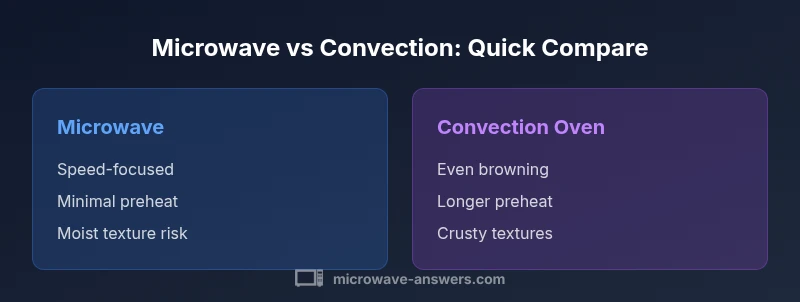
In short, a microwave excels at speed for reheating and simple defrosting, while a convection oven provides browning, crisp texture, and even baking. The choice depends on your typical meals, space, and how much you value texture over speed. This guide compares microwave versus convection oven across speed, texture, energy, and best-use scenarios.
Understanding the microwave versus convection oven: core differences and what they do best
The phrase microwave versus convection oven is more than a label—it frames how you approach speed, texture, and meal variety. At a high level, a microwave uses dielectric heating to excite water molecules, rapidly warming foods with minimal preheat. A convection oven uses a fan and a heated chamber to circulate hot air, promoting browning and uniform cooking. For home cooks, understanding these fundamental physics helps set expectations: microwaves win on quick reheating and defrosting, while convection ovens excel when you want a browned crust, even browning, and a crispy exterior. Microwave Answers notes that most households benefit from having both options available, especially when meal timing matters during busy days.
Speed and workflow in everyday kitchens
In daily cooking tasks, time is a critical factor. The microwave shines for lunch leftovers, defrosting frozen ingredients, and reheating beverages with minimal downtime. A convection oven, even when preheated, can deliver a consistent bake for casseroles, baked chicken, and roasted vegetables. The key distinction is not just time but how heat travels: microwaves heat from within, convection pans heat from the outside, and this difference shapes texture. When evaluating microwave versus convection oven, think about what you cook most and how you want it to feel—soft and moist or crisp and browned.
Texture matters: browning, crusts, and moisture balance
Texture is often the deciding factor. Microwave cooking can leave foods with a moisture-retentive interior but a softer exterior, which is ideal for steaming-like results. Convection cooking promotes surface browning and crust formation because hot air surrounds the food. If you crave a flaky crust on pastries or a seared-looking finish on roasted meat, convection has the upper hand. You can sometimes simulate browning in a microwave by using browning dishes or finishing under a toaster oven, but the native browning capability is a convection feature that many cooks value.
Use-case scenarios: what to reach for in real life
For quick meals, a microwave is unbeatable—think reheating soups, baking vegetables, melting chocolate, or softening butter. For weekend cooking or larger gatherings, a convection oven can handle multiple trays, bake cookies with even color, and roast meats with a crust. Some kitchens opt for a compact convection toaster oven that serves as a second appliance, preserving countertop space while expanding capabilities. In short, microwave versus convection oven is not about replacing one with the other; it’s about pairing them to cover a wider range of recipes.
Accessory compatibility, cookware, and safety basics
A critical practical difference concerns cookware: microwaves require microwave-safe plastics, glass, or ceramics, while convection ovens are compatible with baking sheets, metal pans, and many oven-safe ceramic dishes. Always verify manufacturer guidelines to avoid melting or warping. Safety-wise, avoid covering foods too tightly in the microwave, watch for overheating liquids, and never run a convection oven with empty racks. Microwave Answers emphasizes using proper cookware and staying mindful of heat sources to prevent hot spots and uneven cooking.
Energy use, efficiency, and cost considerations
From an energy perspective, the microwave consumes power primarily during shorter bursts, which can translate into lower energy per task for small items. Convection ovens may consume more energy per minute when fully loaded, but their ability to cook multiple items in parallel can offer efficiency benefits for large meals. When budgeting, consider not only the appliance’s sticker price but also operational costs over time, potential maintenance needs, and the typical load you run through it. The best choice balances your typical cooking tasks with your energy priorities.
Size, capacity, and kitchen layout considerations
Countertop microwaves come in compact forms that fit into small kitchens or apartment setups, while convection ovens range from countertop units to freestanding ranges and built-in options. If you prepare large roasts or bake multiple trays, a larger convection model can provide capacity and airflow advantages. Assess your space: clearance around the unit, accessibility of controls, and how you would store accessories. Remember that the size difference influences not just price but how often you’ll use each appliance.
Preheating, timing, and practical workflow tips
One practical differentiator is preheating: many microwaves do not require preheating, while convection ovens almost always do. This changes how you plan a meal. For example, you can start a dish in the microwave for a quick warm-up and then switch to convection for finishing browning, effectively combining strengths. Build a simple workflow: prep, heat, finish, and serve—all aligned with the device’s heat delivery profile. This approach helps you maximize efficiency without sacrificing texture.
Safety, maintenance, and longevity considerations
Both appliances require routine care: keep the microwave interior clean to avoid microwave energy reflection, and periodically check the convection oven’s seals and fans for debris. Wipe spills promptly to prevent baked-on residues, which can interfere with heat distribution. Consider longevity expectations: a compact microwave may outlive its countertop counterpart if used daily, but convection units with heavy use may need occasional belt replacements or door seal checks. Regular cleaning and mindful use extend appliance life.
Real-world test batch ideas to compare performance
A structured test can reveal the true strengths of each appliance. Try reheating a pizza slice, baking a batch of cookies, and roasting vegetables on two different trays in the convection oven. Compare crust texture, moisture levels, and uniformity. Document heating times in qualitative terms and note any hot spots. This hands-on approach translates general guidance into concrete preferences for your kitchen.
When to upgrade or pair devices for optimal results
If you frequently demand both speed and browning, consider a kitchen setup that includes both a microwave and a convection oven. Some homes opt for a combined microwave-convection unit, while others rely on a separate high-quality convection oven and a reliable microwave for quick tasks. The decision depends on your cooking repertoire, available space, and budget. Microwave Answers suggests mapping your weekly meals to see which appliance handles most tasks best.
Comparison
| Feature | Microwave | Convection Oven |
|---|---|---|
| Primary use | Quick reheating/defrosting | Baking, roasting, browning |
| Texture outcomes | Moist interior, soft exterior risk | Crisp, browned surfaces |
| Preheating required | Often no preheat needed | Typically requires preheating |
| Cook time efficiency | Faster for small items | Longer overall but versatile for batches |
| Cookware compatibility | Microwave-safe plastics/glass | Metal pans allowed in convection with safety |
| Space and footprint | Compact countertop options | Larger footprint, extensive range options |
| Ideal uses | Leftovers and quick meals | Cakes, cookies, roasted proteins |
Advantages
- Speed for reheating and small tasks
- Compact options fit many kitchens
- Convection adds browning and even baking
- Versatile for a range of common recipes
Cons
- Microwave lacks browning without specialized cookware
- Convection requires preheating and more space
- Microwave results can be uneven for some foods
- Convection units cost more upfront for full-size models
Choose based on your primary cooking tasks: microwave for speed; convection for texture and baking.
If speed and convenience top your list, use microwaves. If texture, browning, and batch baking matter more, a convection oven is the better long-term choice.
Common Questions
Can you bake cookies in a microwave or convection oven?
You can bake cookies in a convection oven for even browning and a crisp edge. Microwaves are not ideal for cookies due to uneven heat and lack of browning, though you can use microwave-safe versions of cookie dough for quick results.
Convection ovens are best for cookies because they brown evenly. Microwaves won't give you the same texture, but you can try quick, soft cookies with special cookware.
Is a convection oven faster than a microwave?
In terms of total time for complex dishes, convection can be faster when you need browning and even cooking, but microwaves win for small items and fast reheating. Timing depends on load, food type, and the need for preheating.
For simple reheating, microwave is faster. For cooking and browning, convection saves time overall if you’re cooking multiple items together.
Do you need to preheat a convection oven?
Yes, most convection ovens benefit from preheating to ensure even air circulation and accurate cooking times. Avoid heavy pans during preheat to reduce heat loss and improve efficiency.
Yes, preheating helps convection ovens cook evenly and predictably.
Can I replace a microwave with a convection oven for everyday meals?
You can replace some daily tasks, but it won’t be a complete swap. Use convection for baking and browning; use microwave for quick reheating and defrosting to maintain efficiency in a busy kitchen.
You can’t fully replace a microwave with a convection oven for all tasks, but you can cover many needs with the right workflow.
What foods benefit most from convection cooking?
Foods with moisture loss during cooking, like roasted vegetables, pizzas, pastries, and roasted meats, benefit from convection browning. Moist foods can still be cooked well with proper cheese and pan setup.
Roasted veggies, baked goods, and meats brown beautifully in convection ovens.
Main Points
- Define your cooking priorities first.
- Pair both appliances for flexibility in the kitchen.
- Microwave excels at speed; convection excels at texture.
- Preheat when using convection for consistent results.
- Choose based on space, budget, and meal patterns.