Microwave vs Toaster Oven: A Practical Comparison for Home Cooks
Compare microwave vs toaster oven to decide which appliance fits your tasks, energy use, and space. Practical, evidence-based guidance from Microwave Answers.


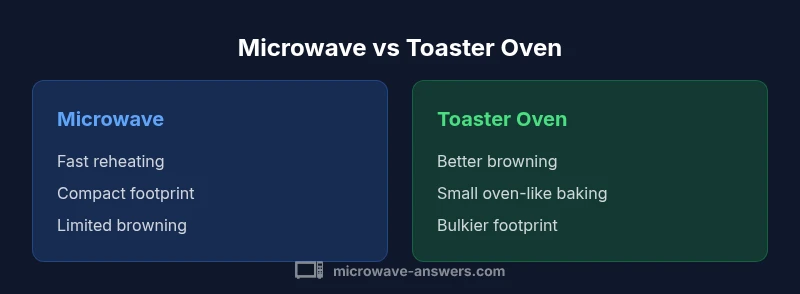
For most households, the microwave offers speed and energy efficiency for reheating and small meals, while a toaster oven delivers baking and browning capabilities. In this comparison, microwave versus toaster oven, the microwave wins for quick tasks; the toaster oven shines with texture for baked goods. Your choice depends on task, space, and cooking style.
Core Differences: Microwave vs Toaster Oven
Microwave ovens and toaster ovens operate on different heating principles, which drives their strengths and trade-offs. A microwave uses electromagnetic radiation to excite water molecules in food, producing rapid warmth with minimal browning. By contrast, a toaster oven is a small convection oven that relies on radiant heat from metal coils and fan-assisted air to bake, crisp, and brown surfaces. This fundamental difference explains why microwaves excel at reheating liquids and soft foods, while toaster ovens shine when you want browning, crust, and more even browning across a loaf, pizza, or sheet-pan dish. This core divergence also helps define which tasks you should assign to each device. In the Microwave Answers analysis, the convection-like behavior of modern toaster ovens makes them versatile for many everyday tasks, but their cooking speed remains slower for certain items. When space is limited, a compact microwave may be sufficient; when texture matters, a toaster oven becomes essential.
For home cooks, the decision is rarely abstract; it depends on what you cook, how often you cook it, and how much counter space you want to allocate. The microwave tends to have shorter cooking cycles and simpler controls, with some models offering basic convection or browning features. The toaster oven's controls can be more nuanced—time, temperature, and, in some models, fan speed—allowing you to simulate a small oven. Recognize that both appliances have safety quirks: microwaving metal containers or foil is dangerous, while toaster ovens pose burn hazards and require careful clearance from walls and textiles. Understanding these core differences sets the stage for a practical decision.
Cooking Performance and Use Cases
In real kitchen life, each appliance shines at particular tasks. The microwave is superb for reheating leftovers, defrosting frozen ingredients, steaming vegetables, and warming beverages in minutes. It’s unbeatable for speed, which matters on rushed mornings or when you’re feeding one or two people. The toaster oven, on the other hand, excels at tasks that require browning, crisping, or baking small batches. From reheated pizza with a crunchy crust to cookies and small sheet-pan dinners, the toaster oven provides texture that a microwave cannot easily imitate. If your cooking style includes sauces, soups, and soft-center dishes, microwave efficiency is a clear advantage; for anything that benefits from a crust or a caramelized surface, the toaster oven is the better tool.
Beyond texture, consider the workload. For quick snacks or reheating journeys, the microwave saves time and avoids heating up a larger oven. For weekend meals where you want a roasted vegetable tray or a small casserole, the toaster oven can replace your conventional oven without heating up the whole kitchen. The balance between speed and result depends on portion size, dish type, and your tolerance for extra cleanup. In this context, a practical strategy is to pair the two: use the microwave for rapid prep and finish with the toaster oven when browning is desirable.
Energy Efficiency and Speed
Energy efficiency and cooking speed are the most obvious differences between these two appliances. For small portions and simple heating tasks, a microwave generally uses less energy because it transfers heat directly to the food rather than heating air in a cavity. This makes it the preferred choice when you’re reheating a single serving or defrosting something from the freezer. A toaster oven consumes energy for a longer period and heats an interior space, so it can be less efficient for tiny tasks but more efficient than firing up a full-size oven for small meals. In practice, the energy burden depends on what you cook and for how long; the microwave tends to win on short tasks, while the toaster oven’s energy cost becomes reasonable when you’re baking or crisping multiple items at once. The overall takeaway is task-driven: choose the tool that minimizes total time and energy for your specific dish.
For a typical weekly menu, you might reheat a cup of soup in minutes on the microwave and bake a small tray of vegetables in the toaster oven. If you frequently prepare single-serving meals, the microwave’s efficiency will compound over time. If your weekly menu includes regular baking or crisping tasks, the toaster oven’s energy use is justified by its texture payoff. The choice should reflect your cooking rhythms rather than a generic rule.
Temperature Control and Features
Temperature control tends to be more straightforward on a toaster oven and more variable on a microwave. Toaster ovens typically offer a wide range of temperatures, precise timer settings, and sometimes convection or fan-assisted modes, which can emulate a larger oven for small batches. This makes it easier to bake bread, roast vegetables, or re-create crispy textures. Microwave controls often focus on power levels and fixed heat settings; newer models add convection, browning elements, or sensor cooking, but the experience remains more limited for long bake times. The choice depends on how much you value precise browning, even cooking, and repeatable results. If you frequently bake cookies or small pizzas, the toaster oven’s feature set will pay off; if you mainly reheat and soften foods, a microwave with smart presets may be sufficient. Always ensure adequate clearance around the unit to prevent overheating in compact kitchens.
For those who want to simulate traditional oven results on a small scale, a microwave with convection or browning options can be a useful compromise. However, if browning and crust are non-negotiable, the toaster oven remains the stronger option. Pay attention to venting, door seals, and even heat distribution when you compare models.
Size, Capacity, and Kitchen Fit
Counter space dictates which appliance makes sense in a compact kitchen. Traditional microwaves tend to be tall and slim, designed to slot into a corner of the counter or above a built-in cavity. Toaster ovens vary widely in footprint and interior space, and many models offer enough room to fit a standard sheet pan or multiple small items side by side. Consider internal capacity in terms of what you commonly cook: microwaves excel with small containers, while toaster ovens support small baking sheets and pans. If you routinely prepare family-sized meals, you’ll likely lean toward appliances with larger interior dimensions or even a full-size oven. For small apartments or dorm rooms, a compact microwave might be the most practical solution, leaving room for a dedicated toaster oven for baking tasks. In any case, measure your counter and plan for ventilation and clearance.
Browning, Crispness, and Texture
One of the biggest differences is texture. The browning, crisping, and caramelization that many cooks crave are naturally associated with hot air and radiant heat—ingredients that a microwave can’t reliably deliver. A toaster oven uses radiant coils and convection to dry the surface of foods and encourage browning, producing crusts on bread, edges on roasted vegetables, and a more appetizing finish on pizza slices. The microwave’s strength lies in steam and moisture transfer; when you use it for meat or vegetables, you often end up with uniform softness rather than a crisp edge. That said, certain models include convection or browning elements that do improve texture somewhat, but they rarely fully replicate the results of a toaster oven for baked pastries or roasted meats. For texture-focused tasks, the toaster oven is the clear winner; for speed and moisture-friendly tasks, the microwave is still very capable.
Maintenance, Cleaning, and Longevity
Maintenance habits can significantly affect performance and longevity. Both devices benefit from regular cleaning of crumbs and splatters, which can affect heating efficiency over time. Wipe the interior after use, remove crumb trays from toaster ovens, and avoid using harsh, abrasive cleaners that can damage coatings. For microwaves, use microwave-safe containers and avoid metal. Keep the door seals clean to maintain efficiency, and periodically check vent openings for blockages. The toaster oven’s heating elements and fan should be inspected if you notice uneven cooking or unusual smells, and you should avoid running it empty. With proper care, either appliance can serve for years in a kitchen that values practical, inexpensive cooking tools. Note that replacing parts or the unit itself is typically more economical when you plan for mid-range models with reliable warranties.
Cost of Ownership and Price Ranges
Price is an important factor, but total cost of ownership matters more. In most markets, entry-level microwaves are cheaper than entry-level toaster ovens, but higher-end toaster ovens with convection and extra features can approach or exceed the cost of mid-range microwaves. When budgeting, consider not only the up-front price but also energy consumption, potential replacement costs, and the need for additional appliances. If you already own a conventional oven, you may value a toaster oven primarily for baking small portions; if you need a fast, no-fuss device for daily reheating, the microwave is likely the better value. Look for models with solid warranties, reliable customer support, and a history of consistent performance. Overall, expect a reasonable price range for basic functionality but stay mindful of feature adds that can push price higher.
Real-World Scenarios and Decision Framework
To make a confident choice, consider your daily routines and space. If you typically reheat coffee, soups, and leftovers in bulk, a microwave will save minutes; if you often bake small cookies, reheat pizza with a crisp crust, or roast vegetables, a toaster oven may deliver better results. A practical framework is to map your most frequent tasks to the appliance that handles them best, then reserve the other for secondary tasks. In a small apartment, you might use a shared microwave for quick tasks and a compact toaster oven for baking. Big households or weekend cooks may benefit from both devices to cover a wider range of cooking styles without turning on a full-size oven. The takeaway is to match your workflow to the appliance’s strengths rather than forcing one tool to do everything.
Common Myths Debunked
Myth 1: A microwave can never bake or brown. Reality: Some microwaves include convection or browning elements, but results vary and are usually better in a toaster oven for texture. Myth 2: Toaster ovens waste energy and space. Reality: For small meals, a toaster oven can be more efficient than heating the full-size oven and can replace a larger slow cooker; it also saves time by eliminating extra steps. Myth 3: You should always preheat a toaster oven. Reality: Some recipes benefit from preheating, while others achieve better results with a shorter or no preheat, depending on the dish. Myth 4: Microwave cooking is unsafe. Reality: When used according to manufacturer instructions and with microwave-safe containers, microwaving is safe for most foods. Finally, Myth 5: Bigger is always better. Reality: A well-chosen compact toaster oven or microwave can meet most daily tasks without occupying excessive counter space.
Energy and Sustainability Considerations
From a sustainability perspective, energy efficiency matters. Energy use is task-dependent; microwaves typically use less energy per minute for simple tasks, while toaster ovens can incur more energy when used for longer periods. However, the overall impact depends on how you cook and how long you run the appliance. If you frequently use both devices, consider models with energy-saving features, such as eco modes or efficient standby settings. In 2026, manufacturers highlight energy-conscious modes and compact designs to reduce standby power. For households aiming to minimize energy use, plan tasks that align with each appliance’s strengths and avoid running both devices simultaneously for the same dish. A layered approach often yields the best energy balance.
Practical Buying Guide: Quick Checklist
- Define top tasks: reheating, defrosting, baking, or browning.
- Check interior dimensions against common cookware.
- Look for convection and browning features if you want oven-like results.
- Compare energy use and heat-up times for your typical meals.
- Verify safety features: door seals, vent cleanliness, and heat-proof placement.
- Consider warranty and customer support.
- Measure counter space and ensure adequate clearance.
- Read user reviews focusing on reliability and temperature consistency.
- Budget for features you actually need; avoid paying extra for bells and whistles you won’t use.
- Think about a two-appliance setup for maximum versatility in smaller kitchens.
Comparison
| Feature | Microwave | Toaster Oven |
|---|---|---|
| Cooking speed | Very fast for reheating/defrosting | Moderate; best for browning and baking small batches |
| Best for | Reheating, defrosting, soft textures | Baking, browning, and crisp textures |
| Texture results | Soft, moist, uniform heating | Crispy, browned surfaces |
| Interior space/shape | Compact interior; flat racks | Sizable interior; multiple small trays |
| Energy use | Low per minute for small tasks | Higher energy for longer baking tasks |
| Maintenance | Easy to wipe; few moving parts | Crumb tray; could be harder to clean interior |
| Price range | $60-$150 (entry to mid) | $70-$250 (entry to mid) |
| Best for small kitchens | Yes, especially microwave models | Yes, but may take more counter space |
Advantages
- Speed for reheating and moisture-friendly tasks
- Crisp texture capabilities (toaster oven)
- Compact options available
- Lower upfront cost for entry models
- Versatile with modern presets
Cons
- Toaster ovens are slower to heat up for simple reheats
- Microwave browning is limited without special features
- Counter space and ventilation needs
- Some models can be bulky for tiny kitchens
Choose based on task: microwave for speed and defrosting, toaster oven for baking and browning when texture matters.
For daily reheating and small meals, the microwave saves time and energy. For crust, browning, and small baking tasks, the toaster oven delivers superior results. A two-appliance setup often offers the best overall flexibility for home cooks.
Common Questions
Can a microwave replace a toaster oven for all baking tasks?
No. Microwaves generally do not brown or crisp like a toaster oven. They can reheat and defrost effectively, but for baking and crusts, a toaster oven provides superior texture.
A microwave can reheat, but for baking and browning, a toaster oven is the better pick.
Is a toaster oven more energy efficient than a microwave?
Energy use depends on the task. For small reheating tasks, microwaves tend to use less energy; for small baking tasks, toaster ovens can be efficient by avoiding a full-size oven.
It depends on the task; microwaves are usually quicker and energy-efficient for reheating, while toaster ovens are efficient for baking small portions.
What features should I look for when buying one?
Consider size, interior capacity, presence of convection, temperature range, ease of cleaning, and warranty. Match features to your typical dishes and kitchen space.
Look for size, capacity, convection, and ease of cleaning.
Can both appliances handle bread, cookies, and pizza?
A toaster oven is generally better for bread and pizza due to browning; microwaves can handle small cookies but lack browning and texture.
To bake bread or pizza with browning, go toaster oven.
Are there safety concerns when using either appliance?
Follow manufacturers’ safety guidelines: keep away from flammable materials, avoid metal in microwaves, and monitor for overheating in toaster ovens.
Follow safety guidelines; never put metal in a microwave.
Should I buy both or swap between tasks?
If you cook across a wide range of tasks, a two-appliance setup offers the most versatility; if space or budget is tight, prioritize the appliance that covers your top tasks.
If you do both baking and reheating, two appliances help; otherwise pick the one that handles your main tasks.
Main Points
- Pair tasks with strengths to maximize results
- Microwave = speed; Toaster oven = texture
- Assess counter space before buying
- A two-appliance setup often beats one
- Choose features you will actually use