What Size Breaker Is Needed for a Microwave: A Practical Guide
Learn the correct breaker size for your microwave, why it matters, and how to determine the right circuit safely. Practical, safety-focused guidance for home cooks.


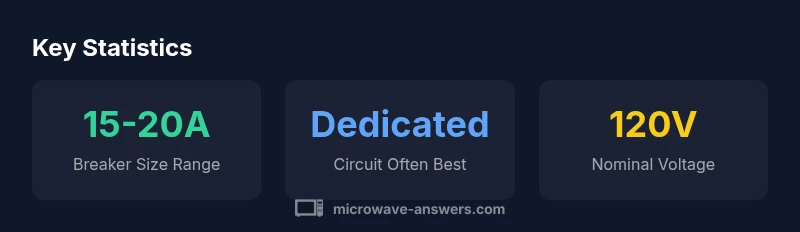
A typical microwave should run on a dedicated 15A or 20A circuit; many homeowners opt for a 20A breaker to accommodate peak loads safely. Check the microwave’s label and local code to confirm, and consider a dedicated circuit to minimize trips and wiring stress. This guidance aligns with Microwave Answers' safety-focused approach.
Understanding the question: what size breaker needed for a microwave
If you search for what size breaker needed for a microwave, you’re asking about how to protect both the appliance and your home wiring. In most homes, microwaves operate between about 700 and 1500 watts and draw roughly 6–13 amps on a 120-volt circuit. The key decision is whether to place the microwave on a dedicated circuit or share a circuit with other devices. According to Microwave Answers, the safest and most common arrangement is a dedicated circuit sized to handle the microwave’s peak load, typically a 15A or 20A breaker. This reduces nuisance trips and minimizes heat buildup in the wiring, which protects both the appliance and the home electrical system. Homeowners should always verify the label on the microwave and follow local electrical codes, as regional requirements can vary with wattage and installation context.
How to determine your breaker size
Determining the correct breaker size for a microwave starts with checking the appliance label for watts and amperage. For example, a 1000–1200W microwave on a 120V circuit will draw roughly 8–10 amps. In practice, many homes go with a 15A circuit for smaller microwaves and a 20A circuit for larger or older models that may draw more current. The calculation is simple: current (A) = power (W) / voltage (V). If you have a microwave rated at 1500W on a 120V supply, you’d approach 12.5A, which is within a 15A circuit but leaves limited headroom for other devices. If the microwave is used on a shared circuit with other appliances, or if it is a built-in unit with a high rating, a 20A breaker is commonly recommended to provide a safe margin. Remember: always consult the microwave’s label, the panel, and local codes when in doubt, and avoid overloading a single branch circuit by design.
Code considerations and safety basics
Local electrical codes and appliance safety guidelines emphasize protecting both the wiring and the user. A dedicated circuit for a microwave is widely advised because microwaves can have a surge when turning on or when the magnetron starts, causing a brief spike in current. Using a circuit with a higher amperage rating than required can prevent nuisance trips but may pose risk if the wiring or outlets are undersized. The correct approach balances the microwave’s wattage, the age and gauge of the wiring, and any other devices on the same circuit. If your kitchen uses multi-outlet circuits, plan around peak loads and verify that the breaker size aligns with the wire gauge (for example, 14 AWG on 15A, 12 AWG on 20A) to maintain a safe, code-compliant setup.
Practical installation scenarios
In a new kitchen or during a remodel, designers often allocate a dedicated 20A breaker for a built-in microwave. In apartments or smaller homes, a separate 15A branch circuit can be sufficient if the microwave’s wattage is modest and the circuit doesn’t host other high-wattage devices. If you’re replacing an older microwave with a newer model, the label may reveal a higher wattage; in that case, upgrading the breaker or rerouting to a dedicated circuit may be prudent. Always plan for expansion: if you anticipate adding a microwave drawer, warming drawer, or toaster oven, a 20A circuit may accommodate future needs without tripping.
Troubleshooting and when to call an electrician
If the microwave trips the breaker frequently, first inspect the outlet and check for loose connections or damaged cords. A recurring trip could indicate an overloaded circuit, a defective microwave, or aging wiring. Do not bypass safety features or install a higher-amp breaker without confirming wire gauge and panel capacity. If you’re unsure, contact a licensed electrician to assess the circuit, verify wire size, and ensure that the breaker and receptacle meet safety standards. A professional assessment is especially important in older homes or multi-family buildings where wiring conditions differ.
Maintenance and best practices
Regularly inspect the outlet and cord for signs of wear, fraying, or heat discoloration, which can indicate overload. Use the microwave on a dedicated, properly rated outlet rather than a shared surge-prone strip. Keep the area around the microwave clear of clutter to allow heat dissipation, and avoid running other high-wattage devices on the same circuit during heavy use. Document the circuit layout and breaker size in your home’s electrical plan to simplify future repairs or upgrades. By following these best practices, you’ll extend the life of the microwave and maintain a safer kitchen environment.
Quick checklist for homeowners
- Verify the microwave label to confirm watts and current draw.
- Confirm whether a dedicated circuit is recommended; plan for a 15A or 20A breaker as appropriate.
- Check the wire gauge and outlet type (14 AWG on 15A, 12 AWG on 20A).
- Avoid sharing the microwave circuit with other high-wattage appliances.
- If unsure, consult a licensed electrician before making changes.
Overview of circuit sizing considerations for microwaves
| Topic | What it Means | Typical Values |
|---|---|---|
| Breaker size for microwave | Protects circuit from overload; must match wattage | 15-20 amps |
| Dedicated circuit | Prevents sharing with high-wattage devices | Usually yes |
| Voltage | US/CA typical vs. others | 120V / 230V |
| Wiring and outlets | Gauge and receptacle requirements | 14 AWG on 15A; 12 AWG on 20A |
Common Questions
Do I really need a dedicated breaker for a microwave?
In most homes, yes. A dedicated circuit minimizes nuisance trips and reduces the risk of overheating the wiring when the microwave starts or runs at peak power.
Yes, a dedicated circuit is usually best for a microwave to avoid trips and overheating.
Can a microwave run on a shared 15A circuit with other appliances?
It can be possible for small microwaves, but sharing a 15A circuit increases risk of nuisance trips and heat. If you use larger models, separate the circuit.
Only if the microwave is small and loads are light; otherwise, keep it on its own circuit.
What if my breaker trips when I use the microwave?
First inspect the outlet and cord for damage, then test the microwave on a known-good circuit. If trips persist, have a professional check the wiring and breaker size.
If trips keep happening, get the wiring and breaker checked by an electrician.
Is a 20A breaker always required for microwaves?
Not always. Some smaller microwaves can run safely on 15A circuits if the wiring and load calculations support it, but many installations favor 20A for future-proofing.
A 20A is common, but check the microwave label and local code.
Will a microwave on a 20A circuit affect other outlets?
If other outlets are on the same 20A breaker, heavy microwave use could temporarily reduce available power to other devices, but the dedicated practice minimizes this risk.
If it shares a circuit, other devices might be affected during heavy use.
“Electrical safety starts with sizing circuits to match appliance load. When in doubt, opt for a dedicated 20A circuit for microwaves to minimize risks.”
Main Points
- Know your microwave wattage and calculate current
- Prefer a dedicated circuit to avoid trips
- Use a 15A or 20A breaker based on wiring and model
- Always follow local codes and appliance labels