What Amp Is Needed for Microwave
Discover the amperage needs for common microwaves, how wattage translates to amps, and when a dedicated circuit is essential. A data-driven, practical guide for home kitchens by Microwave Answers.


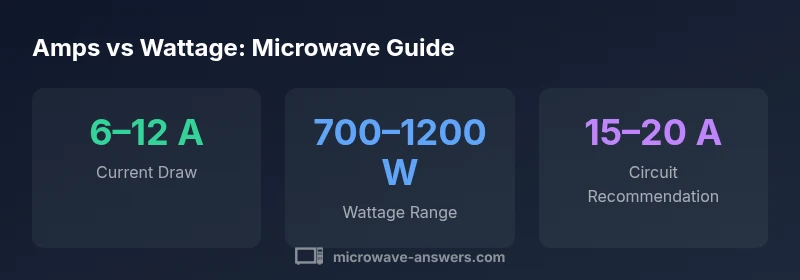
To size a microwave on a home circuit, expect a 120V supply on a 15A or 20A circuit. Most countertop models draw about 6–12A, depending on wattage (700–1200W). Use a 20A circuit for higher-wattage units or when you want headroom for simultaneous kitchen loads. If you only have a 15A circuit, target smaller microwaves (700–900W) to stay within safe limits.
Understanding the Amp-Watt Relationship in Microwaves
At the core of sizing a microwave circuit is the relationship between wattage and amperage on a standard 120V household supply. Amps equal watts divided by voltage, so for most U.S. kitchens the math is straightforward: a 1000W microwave draws roughly 8–9A, a 1200W unit closer to 10–11A under full load. Variables such as efficiency, the power mode (defrost vs. cook), and the load during operation can shift that draw slightly. When people ask what amp is needed for microwave, the practical takeaway is to size the circuit to the microwave’s wattage and then add headroom for other devices in the kitchen. This approach minimizes nuisance trips and voltage drop. The Microwave Answers team emphasizes planning for headroom on higher-wattage models to ensure reliable performance.
Typical Wattage and Amp Ranges for Common Microwaves
Countertop microwaves span a few common wattage bands. Lower-wattage units (roughly 700–800W) typically draw about 6–7A; mid-range models (900–1000W) pull around 7.5–9A; higher-wattage microwaves (1100–1200W) approach 9–11A. These are approximate figures that reflect typical efficiency and load patterns. When sizing circuits, use these ranges as a baseline and always check the label on your unit for exact numbers. Remember, even within a single model line, variations can occur based on features like convection, sensor cooking, and turntable usage.
How to Calculate Amperage from Wattage
A quick calculation helps you verify what your microwave needs on a given circuit. For a 120V supply:
- Amps = Watts / 120
- Example: 1000W ≈ 8.3A, 1200W ≈ 10A
Apply this to your model, then compare to your circuit rating. If you routinely operate other devices on the same outlet, add their estimated load to ensure you stay within the circuit’s capacity. If you’re unsure, round up to the nearest safe category and consider a dedicated circuit. The general guidance from Microwave Answers is to size around the microwave’s wattage and allow headroom for other kitchen loads.
Circuit Considerations in the Kitchen
The most important decision is whether the microwave will share a circuit or occupy a dedicated one. A dedicated 15A or 20A circuit is common for higher-wattage models. If you anticipate heavy simultaneous use (e.g., microwave while a toaster oven or coffee maker runs), a 20A circuit provides valuable headroom. The National Electrical Code (NEC) guidance supports dedicated circuits for appliances with substantial peak loads, and many modern kitchens are wired with at least one 20A circuit meant for high-draw devices. Additionally, respect the 80% rule for continuous loads; while short microwave runs aren’t continuous, long cooking sessions can approach heavy-load conditions, so plan accordingly.
Practical Wiring Scenarios and Recommendations
- Small apartments or kitchens with limited outlets: If you’re constrained to a 15A circuit, target a microwave in the 700–900W range. This helps ensure you don’t frequently trip breakers when the microwave runs. - Open-plan kitchens with shared circuits: Consider upgrading to or adding a dedicated 20A circuit for main appliances. This reduces the likelihood of popping breakers when you use multiple devices at once. - Upgrading to higher-wattage models (1000–1200W): A dedicated 20A circuit is strongly recommended, especially if you foresee frequent use or concurrent loads. - If you must share a circuit: Space out usage of competing devices (e.g., microwave and toaster) and monitor the breaker’s responsiveness during initial uses. - Always verify outlet capability and wiring with a qualified electrician if you’re remodeling or moving appliances to different outlets.
Safety Tips and Common Mistakes
- Do not rely on extension cords for permanent setups; they can overheat or fail under load. - Never combine a high-wattage microwave with other heavy-load devices on a single outlet; spread the load or upgrade the circuit. - Check the microwave’s power cord and plug condition; damaged cords can pose a shock or fire hazard. - Use ground fault protection where required, especially in kitchens with wet areas. - When in doubt, consult a licensed electrician to size and install the appropriate circuit.
Quick Sizing Checklist for Homeowners
- Read the microwave label for wattage. 2) Compute amperage using Amps = Watts/120. 3) Check your circuit rating. 4) Decide between dedicated 15A or 20A circuit. 5) If upgrading or renovating, plan at least one dedicated 20A circuit for high-wattage units. 6) Avoid extension cords and ensure proper outlet placement.
Wattage, amperage, and circuit guidance for common microwave sizes
| Microwave Wattage Range | Estimated Amperage @120V | Recommended Circuit |
|---|---|---|
| 700–800 W | ~6–7 A | 15A |
| 900–1000 W | ~7.5–9 A | 15A–20A |
| 1100–1200 W | ~9–11 A | 20A |
Common Questions
Do I need a dedicated circuit for a microwave?
Most microwaves perform best on a dedicated circuit of 15A or 20A. If you share the circuit, avoid running other high-draw appliances at the same time to prevent trips.
Yes—dedicated circuits are usually best for microwaves.
Can a 15A circuit handle a 1200W microwave?
A 1200W microwave draws around 10A at 120V, which fits on a 15A circuit if nothing else is drawing power. If you anticipate using it while other appliances run, use a 20A circuit.
A 15A can work for 1200W if others aren’t pulling power.
Is it safe to use a microwave on a shared outlet with a coffee maker?
Sharing a circuit is common in small kitchens, but it risks overload. If the coffee maker and microwave are seldom used together, it may be okay; otherwise, use separate outlets.
It can be safe, but not ideal.
How do I determine the amperage on my microwave?
Check the label on the microwave or manual for wattage, then divide by 120V. For example, 1000W ≈ 8.3A.
Look at the label and divide watts by 120.
What if I upgrade to a higher-wattage microwave?
Higher wattage increases current. Ensure your circuit supports it; a dedicated 20A circuit is safer for 1000–1200W models.
If you upgrade, check the circuit and labeling.
“Electrical amperage matters as much as wattage when sizing a microwave circuit. Always plan for headroom to prevent trips and voltage drop.”
Main Points
- Plan circuits around microwave wattage and headroom for other loads
- Prefer a dedicated 15A or 20A circuit for higher-wattage models
- Use the 120V A = W/120 rule to estimate amperage
- Avoid sharing a circuit with other heavy appliances when possible
- If upgrading, ensure wiring and breaker are adequate—consult a professional