How to Tell If a Microwave Capacitor Is Bad: Quick Troubleshooting
Urgent, practical guide to diagnose a bad microwave capacitor. Learn symptoms, safe checks, and when to call a pro. Step-by-step, with safety-first advice to minimize shock risk and equipment damage.


To tell if a microwave capacitor is bad, start with safety: unplug the unit and avoid touching internal parts. Look for bulging, leakage, or a burnt smell on the capacitor. If the microwave fails to heat, arcs, or blows fuses, the capacitor is a likely culprit, but other components can mimic the issue. See the steps below for safe testing.
What a microwave capacitor does and why it fails
A microwave oven's high-voltage capacitor is a critical energy store in the HV circuit that feeds the magnetron during cooking. It smooths the high-voltage supply and helps sustain peaks that the magnetron requires. Over time, capacitors can wear, drift in capacitance, or suffer dielectric breakdown from heat and voltage spikes. If you're asking how to tell if microwave capacitor is bad, look for heating faults, unusual noises, or electrical arcing near the HV area. Common root causes include age, overheating, power surges, or a failing high-voltage diode or magnetron. Visually inspect for bulges, crusted leakage, or a crusty residue on the capacitor housing. Smell is a clue too—burnt-electrical smells may indicate insulation damage. Remember: you must never attempt to discharge or test a charged HV capacitor unless you have specific training and the correct safety equipment. This article focuses on safe observations and non-invasive checks you can perform without opening the sealed HV chamber.
Common signs of a bad capacitor in a microwave
Think like a service manual in practical form: if the capacitor is failing, the oven may heat unevenly or fail to heat at all. You might hear humming, buzzing, or crackling from the cabinet, or see a small arc next to the HV area. Fuses or the main breaker may trip, and the oven may reset or display odd error codes. The outer surface of a failing capacitor can bulge, or the epoxy seal can crack, allowing moisture intrusion. You may notice a burnt smell around the HV area. Important: these signs can also point to other problems in the high-voltage chain (diode, magnetron, wiring). Do not rely on a single symptom; corroborate with multiple checks before concluding a capacitor issue. When in doubt, treat any suspected capacitor fault as a safety-critical problem and seek professional service.
Safety first: immediate precautions before testing
Safety is non negotiable with high-voltage microwave work. Always unplug the unit from the wall and, if possible, unplug from the circuit breaker. Do not attempt to touch or discharge any high-voltage components with your bare hands. High-voltage capacitors can retain dangerous charges even after power is removed. Keep the microwave unplugged during any inspection, and avoid metal tools that could bridge circuits. If you smell burning, hear popping, or notice smoke, power down and stop. Never reassemble or operate the oven if you are unsure about how to safely access or test the HV area. This guide emphasizes observation and non-invasive checks; for actual testing or replacement, hire a qualified technician.
Safe diagnostic approaches you can perform (non-destructive)
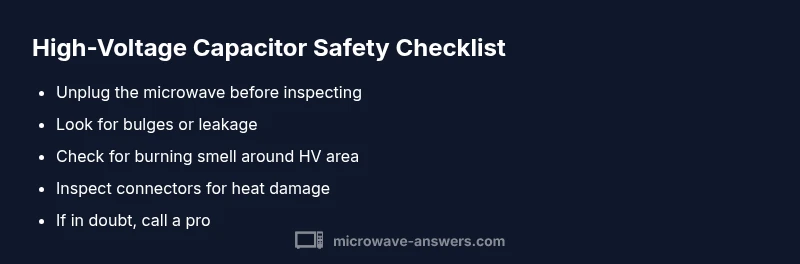
There are non-destructive, non-invasive steps you can take to assess capacitor health without opening or discharging the high-voltage section. Start with a visual inspection: look for bulging, leakage, crusting, or swollen caps on or near the HV circuit. Check connectors and wiring for signs of heat damage or looseness. Verify that the door interlock and fuses function correctly—these failures can mimic capacitor symptoms. If your model’s service manual provides a safe test procedure, follow it precisely. In most cases, a professional will use a HV capacitor tester or replace the HV module. Do not attempt to measure capacitance or resistance in a live circuit with a standard multimeter; wrong tools or methods can cause shock or further damage. The emphasis here is on recognizing signs and knowing when to escalate to service.
Replacement considerations and when to call a pro
If a capacitor is confirmed bad, replacement should use the exact part specifications from the model’s service documentation. Using an incorrect voltage rating or capacitance can damage the power supply, magnetron, or diodes and may create a new safety risk. Many repairs involve replacing the entire HV assembly, which is safest when handled by a trained technician. Budget time and cost for parts, labor, and potential recalibration of the HV circuitry. After replacement, the unit should be tested by a pro to confirm proper insulation and safe operation. If you prefer DIY, consider only non-pressurized scenarios or consumer-safe components, and stop at the point of service—high-voltage work is not a place for experimentation.
Final tips to prevent capacitor issues
Keep your microwave clean and dry; moisture can affect HV components. Use a surge protector to limit voltage spikes, and avoid running the microwave on a faulty circuit. Regularly inspect the external cabinet for swelling or damaged seals. If you have an older unit, consider professional servicing at recommended intervals to catch capacitor wear early. Remember, safety-first is the baseline for every diagnostic step. By following cautious checks and knowing when to call a pro, you reduce the risk of shock and costly damage.
Steps
Estimated time: 60-90 minutes
- 1
Power down and unplug the microwave
Always begin with safety. Unplug the unit and, if possible, switch off the circuit breaker. Wait at least several minutes to allow any stored energy to discharge before touching external surfaces. Keep hands away from the HV area and use insulated gloves if you must handle any components at all.
Tip: Never assume a unit is safe after unplugging—high-voltage parts can retain charge. - 2
Locate the HV area using the service manual
Refer to the manufacturer’s service manual to identify the HV capacitor and surrounding components. Do not open any sealed HV chamber unless you have training and the right tools. Diagram references will help you avoid miswiring.
Tip: If you’re unsure, stop and contact a professional to avoid dangerous shocks. - 3
Inspect the capacitor visually for bulges or leaks
Look at the external casing for swelling, cracks, or crusty leakage around the capacitor housing. A swollen cap is a clear sign of failure and should not be tested further. Check adjacent connectors for signs of heat damage or arcing.
Tip: Use a bright light and a mirror to inspect hard-to-see areas. - 4
Check for obvious HV chain faults (fuse/diode/magnetron)
While not disassembling the HV circuit, inspect accessible fuses and connectors for signs of damage. If a fuse blows repeatedly or you see darkened wiring, this points to a fault in the HV chain that may involve the capacitor.
Tip: Document any signs before seeking professional service. - 5
Decide on replacement or professional service
If you identify a bad capacitor, replacement should follow exact OEM specifications. In most cases, replacing the HV assembly is safer and more reliable than swapping a single capacitor. Arrange professional service to verify insulation and safe operation after replacement.
Tip: Post-replacement, schedule a functional test by a technician to confirm proper operation.
Diagnosis: Microwave won't heat, displays erratic heating, or blows fuses
Possible Causes
- highBad high-voltage capacitor (capacitance drift or dielectric breakdown)
- mediumFaulty high-voltage diode
- lowFaulty magnetron or wiring in HV circuit
Fixes
- easyUnplug the unit immediately and do not work on HV components unless trained
- mediumConsult the service manual and arrange professional testing of the HV capacitor and related parts
- hardReplace the capacitor or entire HV assembly with the correct spec part per OEM guidelines
Common Questions
Can a microwave operate without a capacitor?
No. The high-voltage capacitor is essential for delivering energy to the magnetron. Without it, the microwave won’t function properly and could blow fuses or fail dangerously.
No; a microwave can’t operate safely without its high-voltage capacitor.
Is it safe to touch the capacitor to check for bulges?
No. High-voltage components can retain dangerous charges and should only be handled by trained professionals with proper equipment.
Don’t touch it; it can shock you even when unplugged.
What are common signs of a bad high-voltage capacitor?
Common signs include no heating, irregular heating, buzzing or arcing, and blown fuses. These may also indicate issues with other HV components.
Look for buzzing, no heat, or blown fuses to suspect a cap issue.
How much does capacitor replacement typically cost?
Costs vary by model and region; a technician can provide a precise quote after inspection. In many cases, replacing the HV assembly is more reliable.
Costs vary; get a professional quote for accuracy.
Can I test the capacitor with a multimeter?
Not safely with a standard meter. HV capacitors require specialized equipment and procedures to test without risk.
Generally not safe with a regular multimeter; use professional testing tools.
When should the whole HV assembly be replaced instead of just the capacitor?
If multiple HV components show wear or OEM guidance calls for it, replacing the entire HV module is safer.
Often safer to replace the whole HV module when in doubt.
Watch Video
Main Points
- Unplug before any inspection.
- Bulging or leakage signals capacitor failure.
- HV work requires a pro; don’t DIY high-voltage repairs.
- Replace only with exact spec parts per manual.
- Seek professional testing if unsure at any step.