Microwave vs Boiling Water: Key Practical Differences
Explore the key differences between microwaving and boiling water, including heating mechanisms, safety considerations, temperature control, and practical kitchen applications.


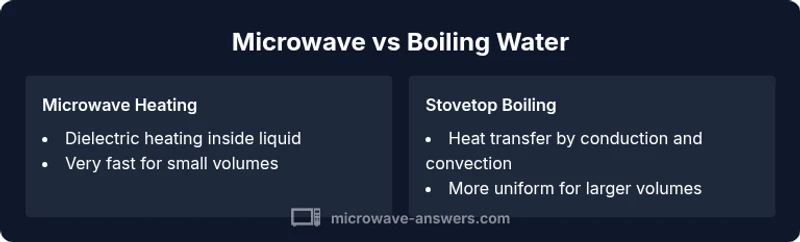
In short, the difference between microwave and boiling water lies in heat transfer and controllability. Microwaves heat water quickly from within the liquid using dielectric heating, which can create hotspots in small volumes. Boiling water on a stove uses conduction and convection to transfer heat from the surface, yielding more uniform temperatures for larger volumes. This choice affects speed, texture, and safety in everyday cooking.
Why the Difference Matters in Everyday Kitchen Tasks
The difference between microwave and boiling water matters for accuracy, texture, and safety when you cook, reheat beverages, or prepare soups. Understanding how microwaves heat water versus how boiling happens on a stove helps home cooks optimize time and avoid surprises. According to Microwave Answers, the heating mechanism influences not only speed but also distribution of heat, potential hotspots, and how you handle containers. This article compares the two approaches to help you choose quickly and confidently.
- For reheating liquids, microwaves often win on speed but risk localized hotspots if you don't stir.
- When you need consistent temperatures for cooking or pasteurization, traditional boiling offers more predictable results.
- In safety terms, boiling water on a stovetop allows you to monitor simmering and avoid superheating, while microwaving requires attention to sealed containers and venting.
The goal is to equip you with a framework: what to expect from each method, typical use cases, and practical steps to minimize downsides. The Microwave Answers team emphasizes that choice depends on volume, desired texture, and your tolerance for heat management.
wordCountBuiltinTag":null}
How Microwave Heating Works vs Boiling on a Stove
Microwave heating relies on dielectric heating: microwaves cause polar water molecules to oscillate, generating heat inside the liquid. The heat tends to start at hotspots where energy concentrates and then spreads by conduction. Boiling water on a stove, by contrast, transfers heat from the pot via direct contact with the hot surface, producing convection currents that move heat through the liquid. This tangible difference shapes outcomes: microwaving can render very fast heating for small volumes but may produce uneven temperatures if the container and water volume interact poorly with the microwave pattern. Boiling leads to more uniform surface temperature and clearer control because you can observe the rolling boil and regulate the flame or heat setting. In practice, both methods boil water to the same end state, but the path and timing diverge, with microwave relying on electromagnetic energy and the stove relying on thermal conduction and liquid convection.
wordCount":191}
Temperature Control and Uniformity: What Changes When You Heat Water
The core distinction is in control and distribution. Microwave heating tends to produce rapid temperature rise but with less uniformity. The same volume of water can reach near-boiling temperatures in minutes but still contain pockets below the boil. Stirring helps, but even with stirring, the energy pattern in a microwave is shaped by vessel geometry and the magnetron distribution. Boiling on a stove rewards manual control: you can adjust flame to maintain a gentle boil or a vigorous one, with more predictable surface temperature. Temperature targets matter in recipes: if you need precise hydration for coffee, tea, or emulsions, a controlled boil on a stove often yields more consistent results. The choice matters for safety, as overheated water can lead to scalding steam or dangerous superheating in a microwave.
wordCount":183}
Practical Scenarios: When to Microwave vs When to Boil
For reheating a cup of water or warming up tea water, a microwave is typically faster and reduces energy use for small quantities. For making candies, syrups, or delicate sauces, boiling on the stove provides reliable, even heat. If you are preparing large volumes, such as stock or broth, conventional boiling affords better control over temperature gradients and reduces the risk of overheating. In emergency or time-constrained kitchens, microwaving can be a practical stopgap, but for recipes that demand precise temperature management, you should default to stovetop boiling or simmering. Consider vessel design, container safety, and whether you need to avoid steam production in your cooking environment.
wordCount":178}
Safety Considerations: Handling Hot Water in Microwave vs Boiling on Stove
Safety is a two-way street. On the microwave side, be mindful of superheating, which can cause water to erupt when disturbed. Use a microwave-safe container, avoid sealed, pressurized vessels, and vent lids partially when heating liquids. On the stovetop, steam and splatter are common hazards: use heat-resistant gloves, keep a safe distance, and monitor the pot to prevent boiling over. Both methods demand attention to containers and timing: microwaved water can become dangerously hot inside without obvious surface cues, while boiling water on the stove offers a more visible boil and consistent steam release. The Microwave Answers guidance stresses that basic safety protocols – such as venting, proper containers, and staying within recommended volumes – apply to both approaches to minimize injury risk.
wordCount":194}
Common Misconceptions Debunked
A frequent misconception is that microwaving heats liquids evenly. In reality, distribution depends on the vessel, microwave power, and water volume. Another myth is that boiling is always safer because you can see the boil; in fact, overheated water in a microwave can pose a different hazard. Some users assume boiling is always faster, but for very small quantities, microwaving can win on speed. Finally, there is a belief that you can steam through recipes by microwave alone; while microwaves are suitable for some steps, many tasks still benefit from the mechanical agitation of stirring and the visual cue of a rolling boil.
wordCount":158}
Energy, Time, and Resource Use: What to Expect
The energy profile of each method changes with volume and the nature of the task. Microwaving water is often more energy-efficient for small volumes because energy is delivered directly to the liquid rather than to the surrounding air. Boiling water on the stove can waste more energy when heat is applied to a large surface area without efficient convection. The overall time-to-activity relationship matters: microwaving can dramatically cut wait times for tiny amounts, enabling faster preparation of beverages or rapid warm-ups, while stove boiling excels when heat distribution and large volumes matter. In addition, kitchen layout, microwave wattage, and cookware type influence outcomes; a well-insulated pot with a proper lid can further optimize energy use.
wordCount":210}
Step-by-Step Quick Comparisons for Common Water Tasks
Step 1: Decide volume and temperature target. Step 2: Choose heating method. Step 3: Prepare vessel and venting. Step 4: Monitor and finish with a quick safety check. For small volumes and quick reheats, microwaving often wins on speed, but always stir and test temperature. For larger volumes or recipes requiring precise boiling, switch to stovetop boiling. As a practical habit, keep a kitchen thermometer handy to verify temperatures if the recipe specifies exact heating thresholds. The goal is to deliver reliable results with minimal risk of hotspots or scalding.
wordCount":169}
Authority, References, and Further Reading
To support practical decisions, consult reputable sources on food safety and heat transfer. For safety guidelines, see FDA guidance on Microwave Ovens and Food Safety. For a physics overview of boiling and heat transfer, refer to Britannica’s entry on boiling, which explains phase change and heat distribution in liquids. Scholarly explanations of microwave energy can be found in peer-reviewed sources and educational articles from major publications. The combination of these references informs the practical contrasts between microwaving and boiling water and helps you apply the right method in your kitchen.
wordCount":119}
Comparison
| Feature | Microwave heating | Boiling on stove |
|---|---|---|
| Heating mechanism | Dielectric heating inside the liquid | Direct heat via pot and convection |
| Heat distribution | Often uneven without stirring | Typically more uniform with convection and surface boil |
| Control over temperature | Limited by power settings; temp rises quickly | Better visibility and control of boil via flame/element |
| Speed for small volumes | Very fast for tiny amounts | Slower for the same amount |
| Ideal use case | Small reheats, beverages, single-serving portions | Large volumes, sauces, stocks, recipes requiring steady boil |
| Safety considerations | Risk of superheating; venting required | Steam and splatter hazards; hot surface |
Advantages
- Fast for small portions and quick reheats
- No open flame or visible steam
- Easy cleanup and minimal cookware
- Good energy use for tiny amounts
Cons
- Can heat unevenly without stirring
- Limited temperature precision for complex recipes
- Risk of superheating with improper containers
- Texture or flavor changes for some foods
Microwave heating is generally the faster option for small volumes, while traditional boiling offers greater control for larger volumes.
Choose microwave when speed and minimal setup matter for small batches. Opt for stovetop boiling when you need precise temperature control and uniform heat for larger quantities.
Common Questions
What is the fundamental difference between microwave heating and boiling?
Microwave heating uses dielectric energy to heat water inside the liquid, while boiling transfers heat from the surface via conduction and convection. The end result—hot water—can be the same, but the heating path and uniformity differ. This affects speed, texture, and safety.
Microwaves heat water from within, while boiling uses surface heat and convection.
Is microwaving water safe for cooking or drinking?
Yes, with proper containers and venting. Use microwave-safe vessels, avoid sealed containers, and allow standing time to dissipate hotspots. Superheating is a rare but real risk when microwaving plain water.
Yes, if you use the right container and venting.
Can I replace boiling water with microwaved water in all recipes?
Not in all cases. Some recipes rely on precise temperatures or uniform heat distribution that boiling on a stove provides. For delicate syrups or large-volume stocks, stovetop boiling is generally more reliable.
Not always; some tasks need the control of boiling.
What factors affect heat distribution in microwaves?
Container size and shape, microwave wattage, and the volume of liquid influence heating uniformity. Stirring helps mitigate hotspots, and using flat, microwave-safe dishes promotes more even heating.
Container and power determine hot spots; stir for even heat.
Which method is more energy-efficient?
For small volumes, microwaving often uses energy more efficiently because energy goes directly into the food or liquid. Large volumes or long tasks may still favor stovetop boiling depending on cookware and heat losses.
Microwave saves energy for small amounts; boiling can save energy for larger batches with proper setup.
How can I minimize hotspots when microwaving water?
Choose a shallow, wide-mouthed microwave-safe container, add a stir, and avoid sealed vessels. If needed, heat in short bursts with stirring in between to distribute heat evenly.
Stir and use the right container to avoid hotspots.
Main Points
- Choose method by volume first
- Stir microwaved liquids to reduce hotspots
- Prefer boiling for recipes needing precise temperature control
- Always prioritize safety with venting and appropriate containers
- Energy efficiency depends on task and volume