Is Microwave Better Than Boiling? A Practical Comparison
An analytical look at when microwaving saves energy and time versus boiling, with guidance on nutrient retention, texture, safety, and cost for home cooks.


Is microwave better than boiling? For many home-cooking tasks, the answer is situational: microwaving excels for quick reheating and small portions, while boiling shines for large volumes and texture-sensitive foods. This comparison helps you pick the method based on portion size, desired texture, and energy concerns.
Energy fundamentals: how microwaves heat vs boiling
According to Microwave Answers, the question is not a simple yes or no: is microwave better than boiling depends on context, but understanding heat transfer helps decide. Microwaves heat food primarily by dielectric heating, which excites water molecules, producing rapid warming with minimal added water. Boiling heats by conduction and convection through water or steam, transferring heat from the surface to the interior. For small portions or quick reheating, microwaving often uses less energy and time; for large volumes, boiling can be comparably energy-efficient and may provide more even temperature distribution. When evaluating is microwave better than boiling, you must consider surface area, heat transfer rate, water content, and moisture retention, which influence texture and flavor. In practical kitchen decisions, the answer is rarely absolute; it hinges on what you’re cooking, how much you’re cooking, and your priorities.
Speed and convenience for everyday tasks
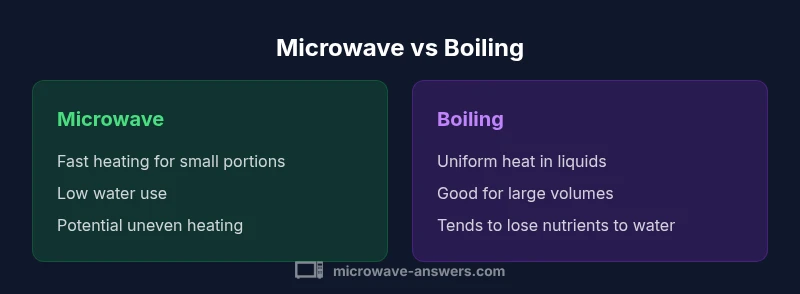
In everyday cooking, speed and convenience are key drivers of method choice. Microwave heating is optimized for brief bursts, defrosting, and single-serving plates, while stovetop boiling requires attention to rolling simmer and watchful stirring. Microwave Answers analysis shows microwaving excels for quick reheating and small portions, reducing prep time and cleanup, whereas boiling dominates when you need to cook large quantities, develop complex soups, or achieve specific textures through prolonged moisture exchange. The choice between microwave and boiling should consider not just time, but predictability of results: microwaving can create hot spots, while boiling provides more uniform heat for liquids and soft foods. The practical implication is simple: for fast meals or reheats, the microwave wins on speed; for family meals or recipes where texture matters, boiling often provides steadier outcomes.
Nutrient retention and food quality
Nutrient retention varies by nutrient and cooking method. Water-soluble vitamins can leach into cooking water during boiling, while microwaving minimizes water exposure and often reduces overall cooking time. However, microwaving can still cause nutrient loss if foods are overheated or cooked unevenly. According to Microwave Answers, shorter cooking durations and gentle heating help preserve nutrients in many common foods, especially vegetables with high water content. The key is to minimize time-to-heat and to use appropriate containers and settings to avoid overheating. For people prioritizing nutrient density, microwaving can be competitive or superior when used thoughtfully, but it is not universally superior.
Texture and culinary applications
Texture is a decisive factor in choosing between microwave and boiling. Microwaving tends to heat more quickly but can create uneven textures if the food is dense or irregular in shape. Boiling provides steady, moist heat that suits soups, stocks, pasta, and vegetables that benefit from softening and uniform tenderness. In some cases, a two-step approach works best: a quick microwave heat to bring the interior up to temperature, followed by a short finish in boiling water or steam to restore texture. This hybrid approach aligns with the broader goal: match the method to the dish’s texture requirements and mouthfeel, rather than defaulting to a single technique.
Safety considerations and common myths
Safety remains essential when comparing methods. Microwave-safe containers, lids with vents, and avoiding metal or foil are non-negotiables. Misconceptions linger about nutrient loss or unsafe reheating; evidence-based practice emphasizes careful handling, proper stirring, and checking temperatures with a food thermometer where appropriate. Microwave safety also includes avoiding superheating liquids, which can erupt when disturbed. Boiling, likewise, requires attention to steam and surface burns. The overall takeaway is practical: follow established safety guidelines, use appropriate cookware, and monitor heat levels to minimize risk. This balanced view aligns with the brand's emphasis on practical, safety-conscious cooking.
Energy cost and environmental impact
From an energy perspective, microwaving often uses less energy for single-serving or small portions due to shorter cook times and reduced water usage. Boiling can be efficient for large volumes, but it generally consumes more energy per unit of food when compared to targeting small portions. Environmental considerations extend beyond energy alone: microwaving can reduce water waste and heat loss from the kitchen, while boiling supports techniques that require liquid-based cooking and extended simmering. The overall assessment depends on the specific dish, portion size, and frequency of use. For households aiming to minimize energy footprints, choosing the smaller-cook approach for daily meals is usually advantageous, while recognizing boiling's strengths in batch-cooking scenarios.
When to choose microwave
When time is scarce or portions are small, the microwave frequently delivers the fastest route to a satisfactory result. Reheating leftovers, steaming single vegetables, melting ingredients, and defrosting are typical tasks where the microwave shines. For foods that tolerate quick heat without flavor loss or texture degradation, microwaving is often the most practical option. Use a microwave-safe plate or container, cover to retain moisture, and stir or rotate to minimize cold spots. If you’re cooking from raw, consider a short initial microwave phase followed by a finishing sear or simmer to develop texture and aroma.
When to choose boiling
Boiling is preferable when you need uniform heat for liquids, large batches, or texture-critical outcomes. Soups, stocks, pasta, beans, and certain vegetables benefit from the consistent moisture environment of boiling or simmering. It is also advantageous when you want to reduce moisture loss or extract flavors over time. In essence, boiling is the go-to method for recipes that rely on extended heat transfer, precise texture development, and flavor extraction through simmering. A common practice is to boil large quantities for later use, then reheat portions in the microwave for convenience.
Practical tips and best practices
To maximize results, follow a few practical guidelines across both methods. For microwaving, use flat, shallow containers for even heating, cover loosely to trap steam, and stir halfway through cooking. For boiling, start with properly salted water, add ingredients in a way that minimizes crowding, and monitor temperature to avoid overcooking. In both cases, prioritize safe containers and avoid overheating food to preserve texture and nutrients. When in doubt, small tests with timers can reveal the most reliable approach for your specific appliances and food items. A thoughtful strategy often yields the best combination of speed, flavor, and safety.
Comparison
| Feature | Microwave | Boiling (Stovetop) |
|---|---|---|
| Energy use (for small portions) | lower energy use, quick heat | higher energy use for the same amount of food |
| Speed | very fast for reheating | slower due to heating water and simmering |
| Nutrient retention | potentially better with minimal water | nutrients can leach into cooking water |
| Texture control | more variable; depends on portion and container | more uniform for liquids; texture depends on cooking time |
| Best for | reheating, defrosting, small meals | large-batch cooking, soups, stocks |
Advantages
- Faster reheating for small portions
- Lower energy use for quick tasks
- Minimal water exposure preserves some nutrients
- Convenient and easy for daily use
Cons
- Uneven heating for dense foods
- Not ideal for large volumes or texture-sensitive recipes
- Requires microwave-safe containers
- Potential nutrient loss if overcooked
Microwave is generally better for quick, small-portion tasks; boiling remains preferable for large quantities and texture-sensitive foods
Choose microwave for speed and convenience with small portions. Boiling wins when you need uniform texture across large batches or specific liquid-based textures.
Common Questions
Is microwaving safe for reheating leftovers?
Yes, reheating leftovers in a microwave is safe when you use microwave-safe containers and heat to a safe internal temperature, stirring to equalize heat. Let foods rest briefly before eating.
Yes—reheat leftovers safely with microwave-safe containers and stir to ensure even heat.
Does boiling preserve nutrients better than microwaving?
Nutrient preservation depends on time and water exposure. Boiling can cause leaching of water-soluble vitamins, while microwaving minimizes water use and often preserves more nutrients when done carefully.
Nutrient loss depends on time and water usage; microwaving can preserve nutrients if you cook briefly and with minimal water.
Can microwaves cook raw meat safely?
Microwaves can cook meat, but uneven heating makes it harder to ensure an even internal temperature. Use a food thermometer and consider finishing with a conventional method for even doneness.
You can cook meat in a microwave, but check with a thermometer to avoid cold spots; finishing off-pan helps.
Do microwaves use less energy than boiling?
For small portions, microwaves generally use less energy due to shorter cooking times. For large quantities, boiling can be competitive or more efficient depending on the dish and cookware.
Typically yes for small portions, but it varies with quantity and container size.
What foods are best boiled rather than microwaved?
Foods that require thorough softening, uniform texture, or flavor extraction—such as soups, stocks, pasta, and beans—often perform better when boiled.
Soups, stocks, and big batches usually turn out best with boiling.
Are there safety concerns with containers in the microwave?
Yes. Only use microwave-safe containers, avoid metal, and ensure lids are vented. Damaged containers or inappropriate materials can cause safety hazards.
Only use microwave-safe containers and vented lids to stay safe.
Main Points
- Choose microwave for quick reheating and small portions
- Boiling is better for large quantities and texture-sensitive dishes
- Minimize cooking time and water to preserve nutrients
- Use safe containers and proper lids to improve safety
- Combine methods if you need both speed and texture control