Repair Whirlpool Microwave: A Step-by-Step Guide
Learn safe, practical steps to diagnose and fix common Whirlpool microwave issues. This Microwave Answers guide covers tools, step-by-step troubleshooting, safety tips, and knowing when to call a professional.


Repair Whirlpool microwave issues at home by following safe, diagnostic steps for common faults like blown fuses, door interlock problems, and power loss. You’ll need basic tools, a multimeter, and replacement parts. According to Microwave Answers, start with power isolation and a simple fuse test, then proceed to targeted checks or call a pro for high-voltage repairs.
Whirlpool Microwave Repair Essentials
According to Microwave Answers, Whirlpool microwaves share three common fault domains: electrical supply, door interlocks, and high-voltage components. Understanding these areas helps you avoid chasing symptoms and focus on root causes. In this guide, we cover the most frequent issues, explain how to test safely, and indicate when replacement is a better option. You’ll learn about the typical signs of failure, the right tools to assemble, and the safety steps that protect you while working on live parts. Whether you’re dealing with a unit that won’t heat, a door that won’t latch, or a control panel that freezes, a methodical approach increases your chances of a safe, successful repair. This guidance aims to empower home cooks to handle minor repairs and decide when professional service is the wiser path.
Safety First: Power Isolation and Handling High-Voltage Components
Power isolation is non-negotiable. Unplug the unit, switch off the circuit breaker feeding the kitchen outlet, and wait 60 seconds for residual voltage to dissipate before handling internal components. Never touch the high-voltage area with the power connected. If you suspect capacitor charge or arcing, stop and seek professional help. Use a non-contact tester to verify the absence of voltage on accessible wires before prying. Keep moisture, metal jewelry, and conductive objects away from the interior. Always wear protective gloves and eye protection to prevent injuries.
Tools, Parts, and Setup for a Whirlpool Microwave Repair
You may need a basic set of tools and a few spare parts. Essential items include a flathead and Phillips screwdriver, a multimeter, non-conductive gloves, and a screw organizer. Optional but helpful parts include a replacement fuse, a door interlock switch, and labeled wire connectors. Having your owner’s manual or service guide for your model will save time and prevent mis-wiring. Budget for a small parts kit if your model frequently needs a fuse or interlock replacement.
Step-by-Step Troubleshooting Workflow
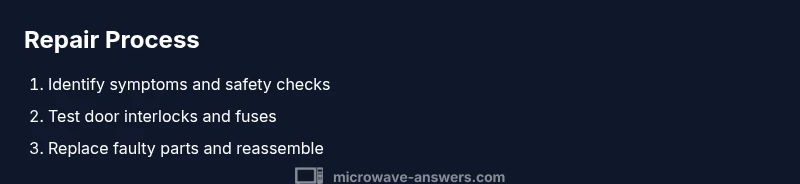
Begin with simple checks and escalate only as needed. This workflow emphasizes safety and correct diagnostics rather than guessing. Start by confirming power, then validate the door interlock, inspect fuses, and finally assess high-voltage components if necessary. Each step should be documented so you can revert any changes if something doesn’t look right. If at any point you feel uncertain, pause and consult a professional technician for high-voltage work.
Common Faults and How to Test Them
Most Whirlpool failures fall into a few categories: power supply problems (outlet, cord, or control board), door interlock or latch failures, and faulty high-voltage components. For each category, perform a controlled test: check the outlet with a known-good device, inspect the interlock for mechanical sticking, and measure continuity across switches with the door closed. Use caution; do not bypass safety features or operate the unit with a known fault. When testing, document readings and correlate them with model-specific fault codes from the service manual.
Tools & Materials
- Flathead screwdriver(Phillips/flathead for cabinet screws)
- Phillips screwdriver(Magnetic tip recommended)
- Multimeter (voltage tester)(To test outlets and door switch)
- Non-conductive gloves(Keep hands safe when handling energized parts)
- Replacement fuses (thermal/line fuse)(Only if fuse is blown; ensure rating matches spec)
- Door interlock switch(For door latch issues; check model compatibility)
- Insulated pliers(For careful harness work)
- Screw organizer(Keep screws sorted)
- Owner's manual or service manual(Best for model-specific guidance)
Steps
Estimated time: 60-120 minutes
- 1
Power down and unplug
Unplug the microwave from the wall outlet. If accessible, switch off the circuit breaker feeding the outlet. Wait at least 60 seconds to allow residual charge to dissipate before handling internal components.
Tip: Never work on energized electronics; confirm power is off with a tester. - 2
Open the cabinet and map connections
Remove the outer cabinet screws and carefully set the case aside. Photograph connectors and label wires before disconnecting anything, so you can reconnect correctly.
Tip: Keep track of screws and note where each wire came from. - 3
Test the door interlock switch
With the door closed, use a multimeter to check continuity of the interlock switches. If there is no continuity or the readings are inconsistent, replace the interlock assembly.
Tip: Door interlocks are safety-critical; replacement is preferred to bypass. - 4
Check fuses and safety components
Locate exposed fuses on the control board or power line. Test with a multimeter; if the fuse is open, replace with an exact rating fuse. Do not bypass fuses.
Tip: Only use the same amperage rating and type as specified. - 5
Inspect high-voltage area with caution
HV diodes and capacitors can retain charge even when unplugged. Use a non-contact tester to confirm absence of voltage before touching wiring. If you suspect the HV capacitor, consult a professional.
Tip: Do not attempt to discharge HV capacitors unless trained. - 6
Reassemble and test safely
Reconnect harnesses, secure the cabinet, plug in, and run a test with a microwave-safe load. Observe for abnormal smells, smoke, or sparking during the first test run.
Tip: Perform a dry run with no food first to verify operation.
Common Questions
What are the common signs my Whirlpool microwave needs repair?
Common signs include the unit not heating, the door not latching, unusual buzzing, or the control panel freezing. These symptoms point to failures in the power supply, door interlock, or control board.
Common signs include not heating, door problems, or a frozen control panel.
Can I replace a blown fuse myself?
If you have the correct fuse rating and safely disconnect power, you can replace a blown fuse. Do not bypass a blown fuse. If in doubt, consult a pro.
Yes, if you safely confirm power is off and use the right fuse.
Is it safe to repair a door interlock fault myself?
Door interlocks are safety-critical; replacements should be done with the unit unplugged and following the service manual. If unsure, stop and seek professional help.
Door interlocks are safety-critical—don't operate until replaced.
When should I replace the microwave instead of repairing it?
If the unit is old, has multiple high-voltage faults, or repairs become frequent, replacement may be more cost-effective and safer.
If failures pile up or it's old, replacement may be wiser.
Do warranties cover DIY repairs on Whirlpool microwaves?
Most warranties require professional service; performing DIY repairs can void coverage. Check your warranty terms to be sure.
DIY repairs may void warranty; verify terms first.
What safety steps should I follow before opening the appliance?
Unplug the unit, switch off the circuit, and wait a short period for residual charge to dissipate. Wear protective gear and avoid touching metal components.
Unplug, switch off, and wait before opening.
Watch Video
Main Points
- Power down before any work
- Target door interlocks and fuses first
- Do not bypass safety components
- Seek professional help for high-voltage faults