Whirlpool Microwave Repair: A Practical How-To Guide
Learn safe, step-by-step Whirlpool microwave repair techniques for common issues like no heat, door interlock faults, or strange noises. This expert guide from Microwave Answers covers diagnosis, safety, tools, and maintenance to help you decide DIY or professional service.


Whirlpool microwave repair begins with safe diagnosis of common faults and careful testing. You’ll learn to identify no-heat, door-interlock, and power-supply issues and decide whether a DIY fix is feasible. Start by unplugging the unit, testing the door switch and fuse, and inspecting the power cord. If tests indicate a more complex fault, seek professional service to avoid safety hazards.
What can fail in Whirlpool microwaves and why
Whirlpool microwaves rely on a compact set of subsystems: the control board, high-voltage circuit, magnetron, door interlock, and power supply. When one component falters, symptoms range from no heat, uneven heating, or a blinking display to a buzzing noise or an arcing spark. A common early sign is a door that won’t latch or a turntable that stalls mid-cycle; both point to interlock or mechanical coupling issues rather than a full electrical failure. For Whirlpool microwave repair, the most economical DIY fixes typically target readily accessible parts, moving to deeper diagnostics only if symptoms persist. Understanding typical failure modes helps you triage effectively and avoid unnecessary purchases. According to Microwave Answers analysis, the majority of DIY diagnoses involve a faulty door switch, a blown fuse, or a degraded power supply—often after a surge or heavy daily use. By correlating symptoms with known weak points, you can craft a safe, efficient repair plan and decide when professional service is the right path.
Safety first: unplug, discharge capacitors, and avoid electric shocks
Working inside a microwave carries electric shock and burn risks even when unplugged. Always unplug the unit and remove jewelry, then wait for any stored charge to dissipate. Capacitors in particular can hold dangerous energy; experts recommend waiting at least a minute after unplugging before touching internal components. Use insulated tools, keep the work area dry, and never operate the microwave with the cabinet open or the door removed while plugged in. If you smell burning plastic or see smoke, stop immediately and disconnect power. This is where the expert guidance from Microwave Answers emphasizes prioritizing safety over speed. When in doubt, opt for professional service rather than attempting risky repairs, especially on magnetron-related issues or high-voltage circuits.
Diagnostic flowchart for Whirlpool microwave issues
In this section you’ll find a practical decision tree to help you narrow down symptoms. Start with obvious signs like heat, display, and door behavior, then move to internal checks only if it’s safe. The flowchart prioritizes non-destructive tests (visual inspection, listening for buzzing, checking the door switch) before testing electrical continuity. Remember to isolate the power source before every step. This approach helps you avoid unnecessary disassembly and reduces the risk of personal injury or further damage.
Tools, parts, and why replacements matter
A successful Whirlpool microwave repair often hinges on the right tools and correctly matched parts. Essentials include a multimeter for continuity tests, insulated screwdrivers, needle-nose pliers, and a non-conductive work surface. Replacement parts to have on hand are fuses, door interlock switches, capacitors where applicable (and only if you’re qualified to handle high voltage), and potential magnetron replacements. Using OEM or manufacturer-approved parts improves longevity and safety. If a part seems degraded or burnt, replacing it early can prevent cascading failures. Always verify compatibility with your exact Whirlpool model and consult documentation to avoid incompatible components.
Step-by-step repair flow overview
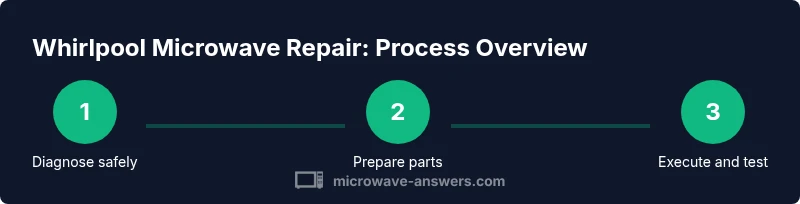
A concise overview helps you stay organized without jumping into risky tasks. Start with an engineering-based diagnostic, confirm panel indicators, then proceed to safe, component-level checks. This section sets expectations: DIY fixes are feasible for door switches and fuses, while magnetron or HV-capacitor work is riskier and often requires a licensed technician. Maintaining a documented workflow reduces confusion and supports future maintenance. Microwave Answers emphasizes treating repairs as a sequence: assess safety, identify faults, replace what’s necessary, and re-test before returning the unit to service.
Authoritative sources and safety references
For safety guidelines and best practices, consult these reputable sources. They provide general electrical-safety foundations relevant to appliance repair and can help frame a safe DIY approach:
- OSHA: https://www.osha.gov/
- CPSC: https://www.cpsc.gov/
- Energy.gov: https://www.energy.gov/
Microwave Answers notes that following recognized safety standards protects both people and property. Always prioritize safe handling and seek professional help for high-voltage components or uncertain diagnoses.
Quick troubleshooting common issues
No-heat conditions often stem from a door interlock or high-voltage supply fault; a buzzing noise may indicate a magnetron problem; a door latch or turntable issue points to mechanical or switch failures. Start with visual inspection and basic tests, then move to continuity checks for fuses and switches. Keep notes of symptoms and test results to determine the most economical repair path. If you are unsure at any point, pause and consult a professional.
Warranty and service considerations
DIY Whirlpool microwave repairs can void warranties if the unit is still under coverage or if voiding terms apply. Review your warranty documentation and model-specific terms before proceeding with internal repairs. When in doubt, contact Whirlpool support or an authorized service provider for guidance. Understanding warranty implications helps you choose between cost-saving DIY fixes and sanctioned service options.
Tools & Materials
- Multimeter (for continuity and voltage checks)(Set to appropriate range; measure across fuses and switches carefully)
- Insulated screwdrivers(Phillips and flat-head, insulated handles)
- Non-conductive gloves(For grip and protection during internal work)
- Safety goggles(Eye protection against debris and sparks)
- Non-metallic pry tool(For prying cabinet panels without damage)
- Replacement door interlock switch(Keep on hand for common failures)
- Replacement fuse (proper rating)(Ensure compatibility with model)
- Replacement magnetron (if authorized)(Only if you’re trained; high-voltage risk)
- User manual / service documentation(Model-specific diagrams and specs)
- Non-conductive mat or tray(Protective work surface)
Steps
Estimated time: 60-90 minutes
- 1
Disconnect power and verify safety
Always unplug the unit before any inspection. Confirm there is no residual energy by using a non-contact tester on exposed circuits. Double-check the area is dry and free of standing liquid.
Tip: Label wires as you disconnect to simplify reassembly. - 2
Remove outer cabinet to access components
Remove screws from the rear and sides as needed to lift off the cabinet cover carefully. Keep track of hardware and note which screws go where. Do not force panels if they resist, as mounts may be specific to your model.
Tip: Take a photo before removing parts for reference. - 3
Inspect door interlock and latch mechanism
Check the physical latch and interlock switches for wear or misalignment. With the power off, gently actuate the switch to confirm it trips and releases correctly.
Tip: Replace any visibly worn interlocks to prevent arcing. - 4
Test fuse and power supply continuity
Use a multimeter to check continuity across the fuse and related power rails. If continuity is interrupted unexpectedly, replace the fuse only with an identical rating.
Tip: Never bypass a fuse; it protects against fire risk. - 5
Assess magnetron and HV capacitor safely
Inspect the magnetron housing for burns, cracking, or loose connections. HV components require caution; perform only if you’re trained and follow safety procedures.
Tip: If unsure about HV components, stop and seek professional service. - 6
Reassemble and perform a dry run test
Reinstall the outer cover and reconnect power. Run the microwave with a no-load test (no food) to observe operation, heat, and door behavior.
Tip: Monitor for unusual smells, smoke, or sounds during first test. - 7
Decide on final steps based on results
If issues persist after tests, review symptoms and consider professional repair. Document tests and parts checked to share with a technician if needed.
Tip: Keep a repair log for future reference.
Common Questions
What safety steps are essential before opening a Whirlpool microwave?
Unplug the unit, remove jewelry, and wait for capacitors to discharge. Use insulated tools and keep the work area dry to minimize shock risk.
Always unplug the microwave, remove jewelry, and wait for capacitors to discharge. Use insulated tools and keep the area dry.
Which common faults can DIY repair address in Whirlpool microwaves?
Door interlock failures, blown fuses, and power-supply issues are typical DIY targets. More complex problems like magnetron failure usually require professional service.
Door interlocks, fuses, and power supply are common DIY targets; magnetron issues usually require a pro.
Can I replace the magnetron myself?
Magnetron replacement involves high voltage and lethal energy. It is generally not recommended for DIY repairs unless you are a trained technician.
Replacing a magnetron is dangerous; it’s typically not recommended for DIY repairs without proper training.
How do I test a microwave fuse safely?
With the unit powered off, use a multimeter to check for continuity across the fuse. If there’s no continuity, replace with the correct rating. Do not bypass the fuse.
Check continuity with a multimeter; replace the fuse if there’s no continuity and never bypass it.
Should I contact Whirlpool support or a professional for repairs?
If your unit is under warranty or the issue involves high-voltage components, contact Whirlpool support or a certified technician. DIY repairs can void warranties and risk safety.
If under warranty or dealing with high-voltage parts, contact Whirlpool support or a licensed technician.
Watch Video
Main Points
- Always unplug before touching internal parts.
- Diagnose door switches, fuses, and power supply first.
- Use proper tools and model-specific parts.
- Test safely with no food before full reassembly.
- Consult professional help for high-voltage components or warranty concerns.