Microwave Whirlpool Repair: A Practical How-To Guide
Learn safe, practical steps to diagnose and repair common Whirlpool microwave issues, with tools, parts, and maintenance tips from Microwave Answers.


This guide helps you safely diagnose and repair common Whirlpool microwave issues, from power checks to door interlock and high-voltage component testing. Follow a structured, step‑by‑step approach for safety, correct disassembly, and reliable testing. You’ll learn what can be repaired at home, what to replace, and when to seek professional help if the fault involves high‑voltage parts.
Safety First: Assessing Risk and Shutting Down Power
According to Microwave Answers, safety is non-negotiable when dealing with high-voltage kitchen appliances. Before you touch any wires, unplug the unit and remove any external power source. Do not rely on the unit being off just because it stopped heating; capacitors can hold a charge. Use a non-contact voltage tester to confirm no live current at the power cord, then place the microwave on a dry, non-conductive surface. Keep children and pets away from the work area. If the microwave is built into a cabinet or wall, switch off the circuit breaker to ensure the line is dead. Finally, consult the Whirlpool user manual for model-specific safety warnings and labeling.
Safety-first mindset reduces the risk of shock, burns, or fire during inspection and repair. Always consider whether a failure involves safety interlocks or high-voltage components, which may require professional service.
Common Whirlpool Microwave Issues and Quick Diagnostics
Whirlpool microwaves are reliable when properly maintained, but common failures include non-heating behavior, arcing, odd buzzing sounds, and a non-turning platter. Start diagnostics by confirming power supply at the outlet and the integrity of the door interlock system. If the unit hums and does not heat, check the magnetron circuit and high-voltage diode. If there is arcing, inspect the interior for damaged waveguides or small metallic fragments. The turntable motor and spur gear should spin freely; friction or worn rollers can cause rotation failure. For a doorway hinge or latch that sticks, test the door interlock with a multimeter while the door is closed to ensure it interrupts current as designed.
Latency in heating or erratic behavior often points to worn switches or failed diodes, while persistent arcing points to grounding or shielding issues.
Tools, Parts, and Safety Supplies You'll Likely Need
Preparing the right toolkit makes the repair smoother and safer. Essential tools include a screwdriver set (Phillips and flat), needle-nose pliers, a multimeter or continuity tester, a non-contact voltage tester, insulated gloves, and safety glasses. Common replacement parts tend to be door interlock switches, fuses, high-voltage diodes, capacitors, and occasionally the magnetron. Keep a small container or tray for screws and connectors, and label wires as you disconnect them to ease reassembly. Always use genuine Whirlpool parts or reputable equivalents to maintain electrical safety and warranty considerations.
Step-by-Step Troubleshooting Workflow (Overview)
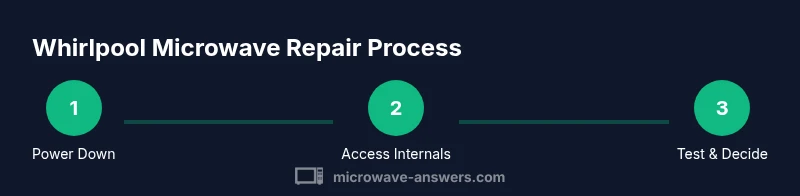
This section provides the high-level sequence you’ll follow in the dedicated Step-by-Step block. It covers disconnecting power, removing outer panels safely, testing door interlocks and switches, checking fuses/diodes, and verifying the magnetron assembly when applicable. The workflow emphasizes careful observation, testing with suitable equipment, and documenting findings. If, after testing, you identify a high-voltage component fault, consider professional service due to the risk of shock or capacitor discharge.
Remember: A practical approach prioritizes safety and model-specific instructions from Whirlpool.
Maintenance and Preventive Care for Whirlpool Microwaves
Regular cleaning and careful usage extend the life of Whirlpool microwaves. Wipe interior after use to prevent splatter buildup on waveguides; avoid using harsh cleaners that can leave residues. Ensure the door seals and hinges move freely without obstruction. Do not slam the door or force misaligned latches, which can hasten interlock wear. Periodically inspect the power cord for cracks or insulation damage. If you notice any heat smell, discoloration, or unusual sounds, pause usage and inspect or seek professional service. A little proactive care reduces the risk of sudden failures and keeps the microwave operating safely.
Tools & Materials
- Screwdriver set (Phillips and flat-head)(Phillips #2 and slotted for typical Whirlpool screws)
- Needle-nose pliers(For wires and connectors, avoid kinking)
- Multimeter or continuity tester(Check switch continuity and diode functionality)
- Non-contact voltage tester(Confirm no live current before touching components)
- Replacement parts (door interlock switch, fuse, diode, magnetron, capacitor) as diagnosed(Purchase based on issue; keep a small spare kit)
- Insulated gloves and safety glasses(Protect from sharp edges and accidental sparks)
- Electrical tape(Temporary insulation and wire securing)
- Screw organizer or magnetic tray(Keeps screws and connectors organized)
- Microwave-safe testing container or cup(For functional test without hot liquids)
Steps
Estimated time: 60-120 minutes
- 1
Power Down and Verify Safety
Unplug the microwave and switch off the circuit breaker if it’s hard-wired. Wait at least 60 seconds to disperse any stored charge, then use a non-contact tester to confirm no live current before touching internal parts.
Tip: If the outlet shows power on a tester after unplugging, double-check the circuit or contact an electrician. - 2
Remove Outer Cover to Access Internals
Remove screws from the back or sides to lift the outer casing and expose the control board, door interlock module, and waveguide area. Keep track of screws and note where each component connects.
Tip: Take photos of connectors before unplugging anything to simplify reassembly. - 3
Test the Door Interlock and Door Switch
With the door closed, test the interlock switch and door switch with a multimeter for continuity. If either shows open or inconsistent readings, replace the faulty switch.
Tip: If you’re unsure about readings, compare to the model’s service manual or Whirlpool guidance. - 4
Inspect the High-Voltage Diode and Capacitor
Discharge the capacitor safely before touching any HV parts. Test the diode in both directions and inspect the capacitor for bulging or leakage. Replace if defective or swollen.
Tip: Never test or power a live unit with exposed HV components; risk of shock is high. - 5
Check the Magnetron Assembly (If Heating Is Affected)
If there’s no heating but all other checks pass, the magnetron could be the culprit. Verification usually requires specialized equipment and is best handled by a trained technician.
Tip: Magnetron replacement is generally costlier; evaluate repair vs. replacement options. - 6
Reconnect and Securely Reassemble
Reassemble components in reverse order, ensuring all connectors are snug and wires aren’t pinched. Replace the outer cover and tighten screws securely.
Tip: Double-check that no tools or screws remain inside the cavity before powering on. - 7
Power On and Conduct a Safe Test
Plug the microwave back in and run a brief test with a microwave-safe container of water. Listen for abnormal sounds and watch for smoke, sparks, or unusual smells; don’t leave unattended.
Tip: Stand back during the first test run to observe any issues from a safe distance. - 8
Evaluate Results and Decide on Next Steps
If the unit heats normally and no arcing occurs, you’ve likely solved the issue. If problems persist, consider professional service or assess replacement costs.
Tip: Keep receipts and notes for warranty or future service references.
Common Questions
What safety precautions are required before repairing a microwave?
Always unplug the unit and disconnect power at the circuit breaker if necessary. Discharge capacitors safely and avoid touching high-voltage components. If in doubt, stop and seek professional help.
Always unplug the microwave and switch off the circuit if needed. Discharge any capacitors safely and call a pro if you’re unsure.
Can I fix a non-heating Whirlpool microwave myself?
Some non-heating issues, like a faulty door interlock or a blown fuse, can be repaired at home. Complex failures in the magnetron or transformer typically require professional service.
Some simple non-heating issues can be fixed at home, but magnetron or transformer problems usually need a pro.
What parts are commonly replaced in Whirlpool microwaves?
Common parts include door interlock switches, fuses, diodes, capacitors, and sometimes the magnetron, depending on the symptom. Always source parts compatible with your model.
Door interlocks, fuses, diodes, capacitors, and sometimes the magnetron are common replacements; verify model compatibility.
Is it dangerous to discharge the microwave capacitor myself?
Discharging a high-voltage capacitor can be dangerous if done improperly. If you’re not trained, seek professional help rather than attempting a course of action yourself.
Discharging HV capacitors can be risky; get a pro if you’re unsure.
How do I know when replacement is cheaper than repair?
If the repair costs approach or exceed the price of a new unit, replacement may be more economical. Also consider the age of the microwave and potential energy efficiency gains.
If repair costs are close to or higher than a new unit, replacement could be the smarter choice.
What if arcing occurs after a repair?
Arcing indicates a shielding or grounding issue or a damaged waveguide. Stop using the unit and recheck internal components or consult a professional.
If arcing happens, stop using it and have a pro inspect the unit.
Are Whirlpool warranties affected by DIY repairs?
DIY repairs can affect factory or extended warranties. Check the warranty terms and document any parts or service performed.
DIY work can void warranties; read your terms and document everything.
Watch Video
Main Points
- Prioritize safety before any repair.
- Identify whether the issue is interlock, diode, or magnetron related.
- Label and organize parts to ease reassembly.
- Know when professional service is the safer option.