Microwave Not Heating Up: Urgent Troubleshooting Guide
If your microwave won't heat, follow our urgent, safe troubleshooting steps—from power checks to internal faults. Learn quick checks, step-by-step fixes, and when to call a professional.


If your microwave won't heat, the most likely cause is a power issue or a fault in the magnetron circuit. Start with safe checks: confirm the outlet works, the door seals shut, and the microwave is set to a heating function. If the issue persists, avoid opening the magnetron housing; call a professional.
What a microwave not heating up usually means
When a microwave fails to heat, it typically points to an electrical or internal component issue rather than the oven simply being out of time. According to Microwave Answers, the most common culprits are a power supply problem or a door interlock that prevents the high-voltage circuit from engaging. This section explains the usual fault tree and helps you decide whether you can safely test the unit at home or should stop and call a pro. We’ll outline quick checks, what you can safely test, and when the problem likely requires professional service. Expect clear, actionable steps you can take without opening the device’s sealed internals. Before you begin, unplug the microwave and keep it away from water. Never attempt to test or replace high-voltage parts unless you are trained. Heating issues can be caused by the door latch failing to sense closure, a blown fuse in the control circuit, or a faulty magnetron. Understanding the typical sequence helps you diagnose safely and avoid unnecessary repairs. According to Microwave Answers, a practical starting point is to verify power, door, and mode settings before considering disassembly. This approach minimizes risk while giving you a clear path forward.
Quick checks you can perform safely (no disassembly required)
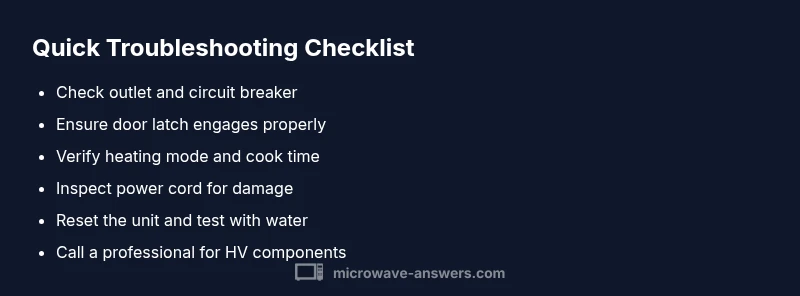
Start with the obvious and low-risk checks. Check for power: is the outlet working? Try another appliance on the same outlet or reset the circuit breaker. Confirm the door closes securely and the latch engages—many microwaves will not heat if the door safety switch isn’t triggered. Verify you’ve selected a heating mode (not just timer) and set a reasonable cook time. Inspect the power cord for damage; a frayed cord can fail to supply voltage. If the unit has a 'child lock' or 'eco mode,' disable it to ensure the oven runs normally. These checks are quick, inexpensive, and often resolve non-heating issues. If the microwave powers on but still won’t heat after these steps, the fault is more likely inside the unit and may require professional inspection.
Common culprits by severity and how to recognize them
The simplest to test are power and door-related: outlet, breaker, door interlock. If you hear a hum but no heat, or the light behaves oddly, that can hint at magnets or control circuitry. A blown fuse in the control panel can stop heating entirely but keep the light on; only a qualified technician should replace HV components. A malfunctioning magnetron is a more serious fault that typically requires replacement and professional service. This section maps symptoms to likely causes so you can decide on next steps and safety considerations.
Diagnostic flow: symptom → diagnosis → solutions (overview)
Symptom: No heat. Diagnosis: power supply, door interlock, fuse, control board. Solutions: reset breaker, test door latch, inspect fuse with professional guidance, and if necessary, replace HV components. This overview helps you prioritize steps without risking injury or further damage.
Step-by-step: fix the most common cause (power/door interlock)
- Safety first: Unplug the microwave and wait 60 seconds. 2) Test the outlet with another small appliance to confirm power. 3) Inspect the door: ensure it latches firmly and the seal is clean. 4) Reset the microwave by unplugging for 60 seconds, then plug back in and run a short test with a cup of water. 5) If heating still fails, contact a professional technician. Pro tip: never bypass safety interlocks; they exist to prevent dangerous HV conditions.
Safety notes, warnings, and professional help
No heating can indicate serious electrical issues inside the unit. Do not open internal compartments beyond the user-accessible panels. Avoid attempting to replace high-voltage components yourself. If you suspect a faulty magnetron, high-voltage transformer, or control board, arrange professional service promptly to prevent electric shock or fire hazards.
Prevention tips to extend microwave life
Regularly inspect the door seal and hinges for wear, keep the interior clean and dry, and avoid running empty or with metal objects inside. Use microwave-safe containers with correct venting and avoid covering with thick metals or aluminum foil. Schedule professional maintenance if you notice unusual noises, sparks, or consistent heating failure at specific power levels.
Steps
Estimated time: 30-45 minutes
- 1
Ensure safety and power supply
Unplug the unit, wait 60 seconds, and test the outlet with another device. If the outlet is dead, fix power supply before proceeding.
Tip: Always unplug before inspecting any internal components. - 2
Check the door and latch
Make sure the door closes securely and the seal is intact. A faulty door switch will prevent heating even if the unit powers on.
Tip: Clean the door gasket to maintain a proper seal. - 3
Test basic heating settings
Set a standard microwave mode and heat a cup of water for 1-2 minutes to observe if heat is generated.
Tip: Avoid running for longer than necessary if no heat is detected. - 4
Perform a controlled reset
Unplug again, wait 2 minutes, plug back in, and run a short test. If no heat, the issue is likely internal.
Tip: Document any unusual sounds or smells for the technician. - 5
Call a professional
If the unit still doesn’t heat, schedule service. Do not attempt HV component replacements yourself.
Tip: Request a diagnostic report and a written estimate.
Diagnosis: Microwave won't heat
Possible Causes
- highNo power from outlet or circuit breaker tripped
- highDoor interlock switch or latch not engaging
- mediumBlown fuse or damaged component in high-voltage circuit
- lowFaulty magnetron or control board
Fixes
- easyReset the breaker or try a different outlet
- easyCheck door latch, clean seals, and ensure door closes firmly
- mediumProfessional inspection to replace fuse or HV components
- hardReplace magnetron or repair control board via a licensed technician
Common Questions
Why won't my microwave heat even though the light and clock work?
Power is available, but the heating circuit is incomplete. This points to the door interlock, fuse, or magnetron. A professional inspection is advised if the magnetron or HV components may be faulty.
If the light and clock work but there’s no heat, the problem is usually in the heating circuit such as the door switch, fuse, or magnetron. A technician should diagnose HV components.
Is it safe to use a microwave that won’t heat?
No. A non-heating microwave can indicate electrical faults that may cause arcing or shock. Stop using it and seek professional repair.
No, don’t use it. Electrical faults can be dangerous and may lead to shocks or fires; have it inspected by a professional.
What is the first thing I should check when it won't heat?
Check the power source, ensure the door closes properly, and verify you’ve chosen a heating mode with a valid cook time. If these pass, the fault is more likely internal.
First, make sure it’s plugged in, the door shuts, and you selected a heating mode with a cook time.
Can a non-heating microwave be repaired cheaply?
Depending on the fault, some issues are inexpensive to fix (door latch replacement or fuse) while others (magnetron or HV components) can be costly and may warrant replacement.
Costs vary. Some fixes are cheap, but magnetron or HV repairs can be expensive and may lead you to replace the unit.
How long should a typical microwave last before repair or replacement?
Most microwaves last several years with proper use. Repeated heating failures or escalating repair costs often indicate replacement is worth considering.
Most microwaves last many years, but repeated issues can mean it’s time to replace.
Should I attempt to replace the magnetron myself?
No. Replacing a magnetron involves high-voltage components and may violate safety standards. Hire a licensed technician.
No—magnetron work is dangerous and should be done by a professional.
Watch Video
Main Points
- Check power and door interlock first
- Avoid opening HV components yourself
- Call a professional for magnetron or HV issues
- Prevent future failures with regular maintenance