Difference Between Microwave and Speed Oven: A Practical Guide
Explore the difference between microwave and speed oven to decide which appliance fits your kitchen. Learn heating methods, cooking results, speed, energy use, and buying tips for home cooks and homeowners.


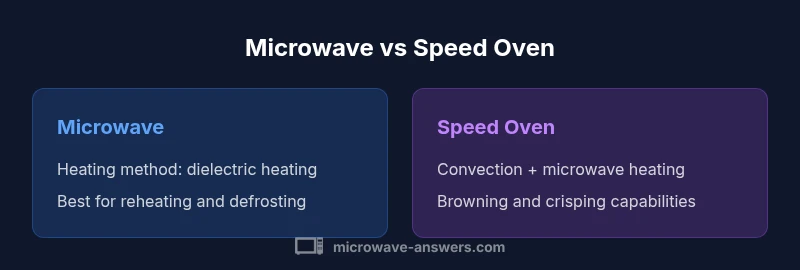
Understanding the difference between microwave and speed oven helps you choose the right appliance for your kitchen tasks. A microwave heats mainly with dielectric energy, excelling at reheating and defrosting quickly. A speed oven blends microwave energy with convection or other heat methods to brown, crisp, and cook more evenly. The choice affects texture, speed, and versatility, and it often dictates space and budget considerations.
What is the difference between microwave and speed oven?
In the context of kitchen appliances, understanding the difference between microwave and speed oven is essential for practical decision making. At its core, the phrase captures how these devices heat food, how fast they operate, and what kind of cooking results you can expect. Microwave answers emphasize speed and convenience for reheating and defrosting, while speed ovens add convection, browning, and more culinary flexibility. For home cooks assessing upgrades, this distinction guides buying, placement, and everyday use, helping you optimize both time and texture in your meals.
According to Microwave Answers, most households benefit from recognizing that speed ovens are not simply faster microwaves—they are hybrid machines that bring multiple heating modes into a single cavity. This nuance matters when you want results closer to conventional baking without a full-size oven. In short, the difference between microwave and speed oven comes down to how heat is generated, how food is finished, and what tasks each appliance can reliably handle.
How microwave heating works and where it shines
A microwave heats food using dielectric heating, where microwave energy causes water molecules in the food to vibrate. This rapid molecular agitation generates heat from the inside out, which is why microwaves are excellent for quick reheating, softening butter, and defrosting frozen items. The core advantage is speed: you can go from fridge to plate in minutes. Microwaves are also generally compact, affordable, and energy-efficient for small tasks. However, they struggle with browning, crisping, and even cooking for thicker items because the heat is not concentrated on the surface in the same way as traditional ovens.
How speed ovens add convection and browning
Speed ovens are hybrids that combine microwave energy with convection heating, radiant broiling, or both. This enables not only rapid heating but also browning and crisping—traits typical of a traditional oven. The result is more versatile cooking, from roasted vegetables with a caramelized edge to baked desserts with gentle crusts. Because they can use convection, speed ovens often cook more evenly than a standalone microwave, especially for dense items. They are particularly valuable when you want the convenience of quick microwaving plus oven-like results without running a full-size oven.
Performance: speed, capacity, and cooking scope
In performance terms, a microwave prioritizes speed for small tasks: reheating coffee, defrosting meat, or cooking small portions in minutes. A speed oven expands the scope to include baking, roasting, and broiling, while still offering microwave shortcuts. Expect shorter cooking cycles than a conventional oven for many items, with the caveat that larger dishes may require multiple cycles or more careful positioning. The practical takeaway is that if your meals demand browning, browning, caramelization, or a crust, a speed oven will outperform a typical microwave in those tasks.
Texture and browning: what to expect
Texture is where the speed oven earns a clear edge. Microwave-only cooking tends to leave foods moist and uniform but lacks surface browning. Speed ovens achieve crispiness and color through convection and dry heat, producing roasted vegetables with a bite, golden pastries, and browned proteins. If your weekly menu includes casseroles that benefit from a crust or a seared exterior, the speed oven delivers. For delicate reheats or soups, the microwave mode still works well, but texture improvements are limited without the convection element.
Practical cooking scenarios: when to use which appliance
Reheating leftovers: the microwave is hard to beat for speed and minimal moisture loss. Defrosting: microwave defrost is convenient but can unevenly start cooking edges; a heat-assisted approach in a speed oven can mitigate this. Baking and roasting: speed ovens excel when you want even cooking plus browning, especially for small to medium batches. Snacks and quick meals: a microwave remains unmatched for ultra-rapid results, while the speed oven can handle small baking tasks without heating a full-size oven.
Space, size, and installation considerations
Microwaves are typically compact and budget-friendly, ideal for apartments or secondary kitchens. Speed ovens tend to be larger, costlier, and may require a dedicated power supply or built-in installation. The decision often hinges on how much counter space you’re willing to devote and whether you want an all-in-one solution or a dedicated microwave for fast reheating. In smaller kitchens, a compact microwave plus a separate speed oven (or a compact built-in model) can balance space and functionality.
Safety, maintenance, and lifecycle considerations
Both appliances require basic safety practices: avoid metal objects in microwave modes, use microwave-safe containers, and follow manufacturer temperatures for speed oven cycles. Maintenance for a speed oven may involve more complex cleaning due to multiple heating modes, seals, and fans. Longevity typically follows usage and build quality; investing in reputable brands and proper service plans helps reduce risk of breakdowns. Regular cleaning of vents and turntables improves performance for both appliance types.
Buying tips: how to compare specs and features
When comparing models, look for features that matter to your cooking style: wattage (microwave power) versus overall heating power in speed ovens, available presets, convection capabilities, and the ability to use only microwave mode or convection mode as needed. Read user reviews about texture outcomes and reliability. Compare interior dimensions to ensure your preferred dishes fit, and check whether the unit can be installed in your kitchen layout if you’re pursuing an integrated solution.
Common myths and misconceptions about microwave vs speed oven
A frequent misconception is that a speed oven is merely a fast microwave. In reality, many speed ovens use convection and radiant heat to imitate traditional oven results. Another myth is that microwaves are inherently unsafe; when used with proper containers and settings, microwaves are a safe and efficient way to heat food. Finally, some think speed ovens always deliver better quality; in practice, the best choice depends on your meals, space, and budget.
Quick-start decision framework: which should you choose for your kitchen?
If your cooking tasks are dominated by reheating and simple prep, a microwave is usually the right fit. If you want versatility—baking, roasting, browning—without a separate oven, a speed oven can offer a balanced solution. For compact kitchens, consider models that blend compact footprint with multiple modes. In households that bake or roast frequently, the speed oven can be a time-saver and texture-improver.
Comparison
| Feature | Microwave | Speed Oven |
|---|---|---|
| Heating method | Dielectric heating (microwave energy) | Hybrid heating: microwave + convection/radiant heat |
| Best for | Reheating, defrosting, quick tasks | Baking, roasting, browning, versatile cooking |
| Texture outcomes | Moist, less browning | Crisp, browned surfaces, more even cooking |
| Size and footprint | Typically compact | Larger, often built-in or countertop with higher capacity |
| Cooking speed | Very fast for small portions | Fast or mid-range with added convection cycles |
| Energy efficiency | Very efficient for quick tasks | Efficient with versatility but higher overall energy use when running multiple modes |
| Price tier | Low to mid-range | Mid to high range depending on features and build |
| Maintenance | Low maintenance, simple cleaning | More complex due to multiple modes and components |
Advantages
- Low upfront cost and compact footprint (microwave)
- Versatile all-in-one capability with browning and baking (speed oven)
- Faster reheating and defrosting in the microwave mode
- Crisp, browned results achievable with speed oven convection
Cons
- Microwave lacks browning and surface texture control
- Speed oven is generally more expensive and larger
- Speed oven may require professional installation or dedicated space
- Some recipes won’t adapt well to hybrid modes
Speed ovens win for versatility and texture; microwaves excel at simple, ultra-fast reheats.
If you value browning, roasting, and baking in a compact space, a speed oven is the stronger all-in-one choice. If your priority is quick reheating, defrosting, and low upfront cost, a traditional microwave remains best.
Common Questions
What is the main difference between microwave and speed oven?
The main difference is heating method and capabilities. A microwave uses dielectric heating for rapid reheating, while a speed oven combines microwave energy with convection or other heat modes to brown, roast, and cook more like a traditional oven. This makes the speed oven more versatile, but often more expensive and larger.
Microwaves heat food quickly with dielectric energy, while speed ovens add convection and browning for more oven-like results.
Can I replace a speed oven with a regular microwave?
A microwave cannot fully replace the baking, roasting, and browning capabilities of a speed oven. If you mostly reheat and defrost, a microwave suffices; if you want crispy textures and oven-like cooking, you’ll miss those features.
If you want browning and full cooking versatility, a regular microwave won’t replace a speed oven.
Are speed ovens more energy efficient than microwaves?
Energy efficiency depends on usage. Microwaves are highly efficient for small, quick tasks, while speed ovens can be efficient overall when used for a mix of microwave and convection tasks, but may draw more power during longer convection cycles.
Overall, microwaves save energy on quick tasks; speed ovens save time and add functionality but can use more power during browning cycles.
What cooking tasks are better suited to a speed oven than a microwave?
Baking, roasting, browning, and recipes requiring crispy textures are better suited to a speed oven. It also handles small-batch cooking with results similar to a traditional oven, which a microwave cannot achieve without extra steps.
If you want crispiness and even browning, go with a speed oven.
Do speed ovens require special wiring or venting?
Some speed ovens are built-in and may require dedicated electrical capacity or ventilation in higher-end models. Portable countertop versions typically need standard outlets and minimal ventilation, but always check installation specs for your home.
Check the model’s installation guide for power needs and any venting requirements.
What should I look for when buying a microwave or speed oven?
Consider your cooking style, space, and budget. Look for power ratings, microwave-only and convection modes, preset programs, interior size, ease of cleaning, warranty, and whether it fits your kitchen layout (built-in vs countertop).
Focus on what you’ll cook most and how much space you have.
Main Points
- Identify your top tasks (reheating vs baking)
- Expect browning advances with speed ovens, not with plain microwaves
- Assess space and installation needs before choosing
- Consider upfront cost versus long-term utility when deciding