Convection Microwave vs Traditional: A Practical Comparison of Microwave Like Ovens
Compare convection-enabled microwave ovens with traditional microwaves to decide if a microwave like oven fits your kitchen, budget, and cooking style. Practical tips, pros/cons, and buying guidance for home cooks.


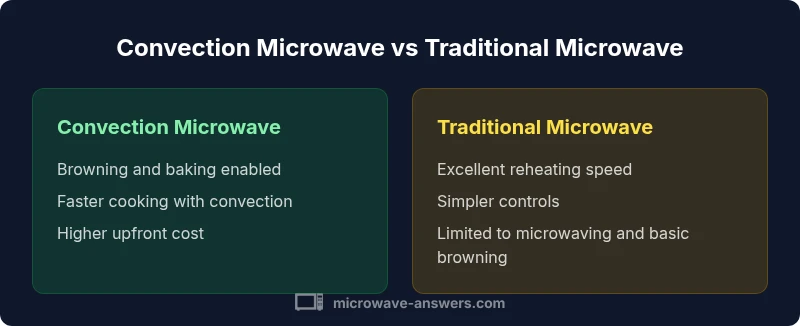
Compared to a traditional microwave, a microwave like oven—often a convection microwave—adds browning, roasting, and true baking capabilities, all in a compact unit. For most households, this all-in-one appliance offers the best overall value and flexibility. If you mostly reheat or defrost, a plain microwave suffices, but you’ll sacrifice oven-like versatility and even browning. The choice hinges on how often you bake or roast.
Understanding the microwave like oven landscape
The term microwave like oven describes devices that combine microwave heating with built-in convection, browning, and baking capabilities. In practice, most households encounter two broad categories: convection microwaves (the common "microwave like oven" variant) and plain traditional microwaves that lack baking functions. The distinction matters because it affects speed, texture, and the range of meals you can prepare. According to Microwave Answers, shoppers increasingly evaluate these units not just on speed but on whether they can replace a second oven for everyday cooking. The upshot is clear: a microwave like oven can dramatically broaden what you cook, from crispy reheated leftovers to pastries and roasted vegetables, while still delivering the convenience of microwave heating. As you compare models, consider your typical meals, space, and budget; many homes find that the extra flexibility pays off in a few months of use.
Core performance dimensions: speed, texture, and bake quality
When evaluating any microwave like oven, a handful of performance dimensions matter most: speed, texture, and bake quality. The microwave functions deliver rapid heating, but the convection element determines whether foods develop browning and a crisper exterior. In practice, convection-enabled units can re-create oven-like results for roasted vegetables, casseroles, and pastries, while plain microwaves excel at reheating with minimal texture changes. Real-world testing shows that the best models optimize microwave power with pre-heating and a fan-assisted bake cycle to avoid soggy bottoms. For most households, the trade-off comes down to how often you bake or roast versus how often you reheat. The Microwave Answers team notes that subscribers increasingly weigh marginal gains in texture against upfront costs, emphasizing that “microwave like oven” performance is not just about speed but about the type of meals you plan to cook frequently.
How convection changes the results
Convection in a microwave like oven uses a fan and an additional heating element to circulate hot air. This combination accelerates browning, improves crust formation, and yields more uniform cooking compared with a microwave that relies solely on microwaves. In practical terms, you’ll get roasted vegetables with crisp edges, meats with more even sear, and baked goods that rise and set similarly to traditional ovens. The trade-off is that convection modes often require more precise settings and preheating times, and you might need to adapt recipes that assume a standard oven. As you’re evaluating models, look for adjustable fan speeds, multiple convection modes, and an interior that is easy to clean. A few minutes exploring the control panel can save hours of trial and error in the kitchen.
Size, fit, and installation considerations
Most microwave like ovens come in countertop, over-the-range, or built-in form factors. Countertop models are portable but take counter space; over-the-range units save cabinet space and typically vent outdoors or recirculate. Built-in versions can blend with cabinetry for a seamless look but require professional installation or precise measurements. Before shopping, measure height, width, and depth allowances plus ventilation clearance. Also consider whether you want built-in trim kits or a free-standing unit. If you have a small kitchen, a compact convection model can still deliver baking results, but you’ll want to evaluate the total footprint including door swing and any external venting. Installing or upgrading is a good time to plan for electrical outlets that support higher wattage.
Energy use and cost of operation
Convection mode uses more energy than a plain microwave because it runs a fan and a heating element. However, because you can cook larger items more quickly, the overall energy impact for many meals can be comparable or even lower than using a separate oven for small batches. If you often bake or roast, the incremental energy cost may be offset by eliminating a second appliance. For households mindful of operating costs, look for models with high-efficiency insulation, smart preheat routines, and energy-saving modes when not in active cooking. Remember that energy efficiency depends on usage patterns; a microwave like oven is not always the most frugal option for every dish, but it can cut total cooking time significantly for weeknight meals.
Feature checklist for buyers
Create a short list of must-haves to avoid feature bloat. At minimum, you should evaluate: convection capability with adjustable fan speeds; sensor-assisted cooking; even heating distribution; interior capacity; ease of cleaning (smooth enamel or stainless steel); and intuitive controls. Additional features to consider include: automatic defrost, crisp or bake modes, multiple power levels, turntable vs flat-surface cooking, and a reliable door seal. If you frequently bake, confirm a sufficient cavity size to accommodate standard pans and casserole dishes. Some models offer air fry settings or dedicated pastry modes; these can expand versatility but cost. Test cycles and demo videos can help you compare performance without buying.
Pricing landscape and value judgments
Prices for convection-enabled microwave ovens vary widely by size, brand, and features. Expect a range that reflects the balance of convection power, sensor accuracy, and build quality. In general, you’ll pay more for a true convection microwave than for a basic microwave, but the gap narrows when you consider the value of replacing a separate oven for small households or apartments. When evaluating value, look beyond sticker price to long-term savings, reliability, warranty, and availability of replacement parts. If a model has a strong track record of durability, the higher initial cost can translate into lower total cost over several years. The Microwave Answers approach emphasizes total cost of ownership rather than upfront price alone.
Use-case scenarios by household type
For a busy family that bakes weekly, a microwave like oven makes sense due to its versatility. A single person who cooks infrequently may prefer a compact, budget-friendly microwave with essential features. A household with limited space could benefit from a countertop model that does double duty as a small oven. If you host dinner parties, a larger-capacity convection microwave can handle poultry roasts and casserole trays. Finally, if your cooking includes delicate sauces and microwaved liquids, ensure your unit has precise temperature control and robust simmer functions. Tailor your choice to how you cook, not just what you think you should buy.
Common myths and misunderstandings
There are several myths about microwave like ovens that deserve debunking. Some shoppers assume convection always produces perfect browning; in reality, results depend on pan type and preheating. Others believe these units are energy hogs; modern convection microwaves can be energy-conscious with smart modes. A common misconception is that you must replace your oven to bake; in many kitchens, a convection microwave can handle frequent baking tasks but not all heavy baking loads. Finally, many users fear that microwaves cannot handle baking; with the right cookware and settings, a microwave like oven can deliver surprisingly good results. Always test with your favorite recipes to calibrate times.
Maintenance and care tips
Keeping a microwave like oven clean is essential to performance. Wipe the interior after spills with a damp cloth and avoid abrasive cleaners that could damage the enamel. Clean the door seals and the vent grille regularly to maintain proper airflow. For convection, ensure the fan housing remains unobstructed and check the turntable motor periodically. Periodic calibration checks can help sustain accurate temperature readings. If you notice uneven cooking or unusual noises, consult the user manual or the manufacturer’s support resources. Regular maintenance can extend the life of your appliance and keep heating consistent.
Practical buying workflow: checklists and steps
Follow a simple workflow to compare models efficiently. Step 1: define your primary use cases (reheating vs baking). Step 2: list must-have features (convection, sensors, capacity). Step 3: measure your space and confirm electrical requirements. Step 4: compare warranties and service options. Step 5: read independent reviews and consumer tests. Step 6: watch demo videos to see real-world performance. Step 7: test at a showroom if possible. Step 8: calculate total cost of ownership. This structured approach reduces decision fatigue and helps you pick a model that meets both your kitchen needs and budget.
What to expect in real-world cooking
Real-world cooking with a microwave like oven blends speed with oven-like results. Reheating leftovers becomes crisp on the edges, when using convection modes. Baking and roasting paths can deliver moist interiors and golden exteriors when you choose appropriate cookware. However, the best results come from following manufacturer guidance on pan types, preheating times, and recommended cookware materials. Expect a learning curve as you adapt favorite recipes to the appliance; once you adjust timing and temperatures, you’ll enjoy a reliable, versatile kitchen companion.
How to compare specific models: a 5-step method
Create a short list of models that fit your needs. Step 1: verify convection capability and fan control. Step 2: compare interior cavity size and turntable vs flat-surface options. Step 3: evaluate sensor accuracy and auto-defrost features. Step 4: check energy-saving modes and preheat efficiency. Step 5: review warranty terms and service support. Step 6: read independent tests on reliability. Step 7: consider brand reputation and spare parts availability. Following these steps helps ensure you choose a microwave like oven that aligns with your cooking habits and budget.
Final buying guide snapshot
At-a-glance guidance: if you bake or roast frequently, choose a convection microwave; if your priority is the simplest reheating and the lowest cost, a traditional microwave may be sufficient. Always weigh upfront price against the convenience of a single appliance that replaces several cooking steps. The Microwave Answers team emphasizes testing with your own recipes and reading current reviews from trusted sources before purchasing.
Comparison
| Feature | Convection microwave | Traditional microwave |
|---|---|---|
| Browning capability | Yes | No |
| Baking capability | Yes (convection/baking) | Limited/Not available |
| Cooking speed | Fast reheating and cooking | Very fast reheating only |
| Counter space | Similar footprint | Typically smaller footprint |
| Energy efficiency | Moderate to high (dual function) | High efficiency for microwave-only tasks |
| Price range | $120-350 | $60-150 |
| Best for | Home bakers and busy households | Reheat-focused tasks |
Advantages
- All-in-one appliance saves counter space
- Versatile: reheating, browning, baking
- Faster overall cooking for many meals
- Improved even heating with built-in convection
- Can replace a separate oven for small kitchens
Cons
- Higher upfront cost than a plain microwave
- More complex controls can require learning
- Some models are bulky for small spaces
- Convection mode may overcook if misused
Convection microwave wins for most households; traditional microwave remains viable for tight budgets.
Choose a microwave like oven if you want oven-like results without a separate oven. If you only need quick reheating, a traditional microwave is a cost-efficient option.
Common Questions
What exactly is a microwave like oven?
A microwave like oven combines microwave heating with convection (hot air) and sometimes browning elements. It can reheat, bake, and roast using a single appliance. The main difference from a plain microwave is its ability to produce oven-like textures.
A microwave like oven is a microwave plus convection. It bakes and browns, not just reheats.
Can a microwave like oven fully replace a traditional oven?
For many weeknight meals, yes; but heavy baking or large batches may still be best with a full-size oven. A convection microwave can cover many tasks.
It can replace many tasks, but not all large-batch baking.
Are convection microwaves energy efficient?
They can be energy efficient for small meals since you skip preheating a full oven, but the extra convection fan increases energy use. Overall, usage patterns matter.
They can be efficient for small meals, but watch preheating.
What features matter most when buying a microwave like oven?
Look for true convection capability with adjustable fan, sensor cooking, even heating, interior size, and ease of cleaning. Optional features like air fry and bake modes add versatility but cost.
Focus on convection, sensors, capacity, and a good door seal.
How should I clean and maintain a microwave like oven?
Regularly wipe the interior, clean the door seals, and remove the turntable for cleaning. Check vents for blockages and follow the manufacturer’s maintenance schedule. This keeps performance consistent.
Wipe after use, check seals, follow manual.
Main Points
- Know your cooking needs before buying
- Convection adds browning and baking
- Balance budget, space, and features
- Look for sensors and even heating