Convection Microwave vs Regular Microwave: A Practical Guide
Is a convection microwave better than a regular microwave? This analytical guide compares browning, speed, energy use, and practical buying guidance for home cooks.


According to Microwave Answers, convection microwaves add a built-in fan and heating element to microwave heating, enabling browning and oven-like results. For many home cooks, this makes a convection model a versatile upgrade over a regular microwave, especially for baking and crisping tasks. If you value oven-like versatility in a small footprint, a convection microwave is often the better choice.
How convection microwaves work
According to Microwave Answers, convection microwaves blend microwave energy with a built-in convection fan and a heating element. This combination creates a circulation of hot air that browns, crisps, and bakes foods in a way a standard microwave cannot. In practice, you switch on convection mode to simulate an oven while preserving the speed of microwave heating. The technology relies on circulating airflow to transfer heat evenly, reducing cold spots and delivering oven-like results on a compact countertop. For many cooks, the question often reduces to a simple inquiry: is a convection microwave better than a regular microwave? When used correctly, it can replace many oven tasks without adding a second appliance.
Key performance differences you should care about
When choosing between convection and regular microwaves, focus on three practical dimensions: texture, speed, and versatility. Convection models combine a fan and a heating element with microwave energy, producing browning, crisping, and more even cooking. Regular microwaves heat mainly by microwaves, so reheating is rapid but can be uneven and lacks browning. Importantly, the user experience changes: with convection you often see oven-like finishes, while without it you gain simplicity and speed. For households that bake or roast occasionally or want dessert-like crusts on snacks, convection is a meaningful upgrade; for quick reheating and defrosting, a traditional model remains appealing.
Browning and baking: can a microwave mimic an oven?
Convection microwaves excel at browning and baking because air flow transfers heat from all sides. In practice, you can crisp toppings, roast vegetables, bake cookies, and even reheat pizza with a crust that resembles oven-finished textures. However, outcome depends on pan quality, placement, and recipe adjustments. Start with familiar dishes and compare results to your conventional oven. With the right bakeware, you unlock a surprising range of textures that standard microwaves cannot provide.
Speed, efficiency, and energy use: what to expect
Most users notice that simple reheating is still fast in convection models, but true baking or roasting can take longer than a pure microwave mode. Convection mode may consume more power during the active phase, yet the heating is more even, which can reduce the need for multiple cycles. Energy efficiency hinges on your typical tasks: if your meals regularly benefit from browning, the overall time saved on finishing can offset higher power draw. Microwave Answers analysis shows that, for mixed-use scenarios, total energy use can be comparable between convection models and some traditional microwaves when you leverage convection for small bakes.
Size, capacity, and placement considerations
Convection microwaves are usually larger than standard models and can require more space for proper ventilation. When evaluating fit, measure clearance above and around the unit, especially if you have upper cabinets or tight kitchen layouts. The interior cavity tends to be larger to accommodate racks and baking pans, which is helpful for roasting vegetables, baking sheet meals, and even small poultry. Price ranges vary by wattage and feature set, so budgeting for the extra footprint is part of the planning process. If you cook for a family, the added capacity can pay off quickly, whereas single-person households may prefer a compact unit.
Cooking tasks best suited for convection microwaves
Use convection mode for tasks that benefit from browning and even heat: roasting vegetables, baking cookies or pastries, reheating pizza with a crisp crust, and cooking small roasts. It also shines for simple sheet-pan meals and casseroles where you want a golden top. For ultra-quick reheating, a traditional microwave remains hard to beat. Think of convection as a gateway to oven-like versatility in a single appliance, while the regular microwave keeps things lean and fast for everyday reheating.
Cookware and accessories for convection mode
Choose microwave-safe glass, ceramic, or silicone that can withstand higher heat. Some convection recipes allow metal elements or racks, but you should always consult the user manual before using metal containers. Use shallow pans to maximize airflow and rotate pans for even browning. Avoid dark, nonstick coatings that may overheat at high convection temperatures and always start with the appliance's recommended racks and placements. Proper cookware ensures better results and safer operation.
Practical buying guidance for different budgets
If you’re budgeting, look for models that offer a true convection option, a reasonable wattage, and reliable sensor features. Mid-range models typically provide the best balance of performance and cost, while premium units offer smart features and larger capacities. For budget shoppers, prioritize convection and a robust interior cavity over cosmetic extras, since the core benefits come from airflow and browning. As a general rule, plan for a unit that can replace several oven tasks without sacrificing essential microwave speed.
Safety, maintenance, and longevity considerations
Regular cleaning of the interior and vents helps preserve airflow and performance. Avoid placing foil in the convection cavity, and follow the recommended cleaning cycle in your manual. Periodic checks on door seals and racks prevent heat loss and ensure even cooking. If you notice uneven browning or unusual noises, consult the manufacturer’s guidance or a service professional. A well-maintained convection microwave can deliver oven-like results for years, which makes it a compelling long-term investment for busy households.
Real-world workflows: 3 example meal plans
- Quick-crisp dinner: roast vegetables on a convection rack, then finish with a brief baking cycle for a crispy edge. 2) Weeknight bake: bake salmon fillets on a sheet pan with asparagus, using convection to achieve a light crust. 3) Dessert in a pinch: bake cookies or a small cake in a shallow pan, using the convection setting for even texture and browning. These workflows illustrate how convection microwaves blend speed with oven-like texture, enabling new weeknight possibilities.
Comparison
| Feature | Convection Microwave | Regular Microwave |
|---|---|---|
| Cooking method | Combines microwave energy with a built-in convection fan and heating element | Microwave energy only; no convection |
| Browning/baking | Yes — browning and baking are possible with convection | Limited to reheating/defrosting; no browning |
| Preheating needs | Usually not required for everyday baking tasks | Not applicable; no baking mode |
| Cooking speed for reheating | Very fast for reheating with added texture when needed | Typically fastest for reheating; no oven-like texture |
| Evenness of heating | More even due to airflow; fewer hot spots | More prone to uneven heating without convection |
| Best for | Versatile cooking: baking, roasting, crisping, and reheating | Simple reheating and defrosting; compact convenience |
| Price range | Moderate to high (depends on features and wattage) | Low to moderate; often budget-friendly |
Advantages
- Faster browning and crisping when using convection mode
- Ability to bake and roast without a separate oven
- Saves space by combining functions in one appliance
- Better even heating for a wider range of dishes
Cons
- Higher upfront cost than many standard microwaves
- Larger footprint and potential installation considerations
- Convection mode can take longer for simple reheating than a pure microwave
- Some cookware compatibility limitations depending on model
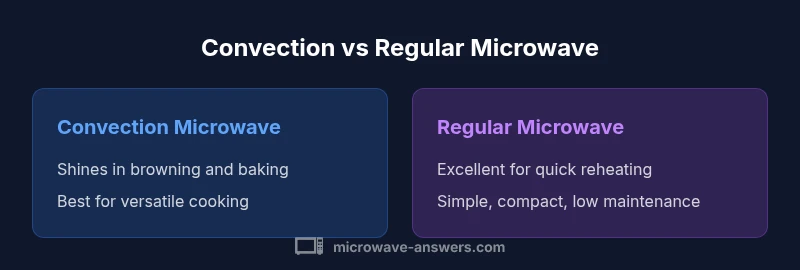
Convection microwaves generally offer greater versatility, especially for browning and baking, while regular microwaves remain best for speed and simple reheating.
Choose convection if you value oven-like capabilities in a compact unit. Choose regular if you primarily reheat and defrost quickly and want a lower upfront cost.
Common Questions
What is a convection microwave and how does it differ from a regular microwave?
A convection microwave adds a built-in fan and heating element to microwave technology, allowing circulating hot air to brown and bake. A regular microwave relies on microwave energy alone for reheating and defrosting, offering speed but limited texture options. The key difference is oven-like versatility without a separate oven.
A convection microwave uses a fan and heating element for browning and baking, while a regular microwave focuses on quick reheating.
Can I bake in a convection microwave?
Yes. Convection microwaves enable baking and roasting with an oven-like finish. Start with familiar bake recipes and use appropriate bakeware for best results. The convection mode distributes heat evenly, which helps with browning and texture.
Yes, you can bake in convection mode; use the right bakeware and follow the recipe as you would in a small oven.
Are convection microwaves faster for reheating?
For simple reheating, both can be quick, but convection mode adds steps for proper browning or crisping. Reheating in standard microwave is typically faster, while convection reheats and finishes with texture similar to oven-prepared foods.
Reheating is fast in a standard microwave, but convection can deliver a crisper finish when needed.
Do I need special cookware for convection mode?
You should use microwave-safe cookware, and some convection recipes benefit from shallow pans that promote airflow. Some convection models allow metal racks or pans—always consult the manual before using metal. Start with glass, ceramic, or silicone pieces labeled microwave-safe.
Use microwave-safe cookware and check the manual about metal racks before using convection mode.
Is a convection microwave worth it for a small kitchen?
If you want oven-like capabilities without a full-size oven, a convection microwave can be worth it for a small kitchen. It saves space by combining functions, but you pay more upfront and may need extra countertop space.
For small kitchens, convection can replace an oven in many tasks, but consider space and cost.
Do convection microwaves use more energy?
Energy use depends on the task; convection can consume more power during active cycles, but it may reduce total time for certain baking tasks. Over typical mixed-use cooking, total energy use is often comparable to a regular microwave when used efficiently.
Energy use varies; convection can use more power during bake cycles but may save time overall.
Main Points
- Assess your need for browning vs. speed
- Convection adds oven-like versatility in a countertop unit
- Check cookware compatibility before buying
- Consider space, budget, and typical meals when deciding
- A well-chosen convection microwave can replace many oven tasks