Is Microwave Stronger Than Oven? Power, Speed, and Safety
Explore whether a microwave is stronger than an oven, focusing on heat delivery, speed, browning, safety, and practical use cases to choose the right appliance.


Is microwave stronger than oven? In short, no—the microwave doesn’t heat by sustained high temperature like an oven. It excites water molecules for rapid interior heating, while ovens rely on radiant heat and convection for even browning. For quick reheating and moisture preservation, the microwave shines; for browning, texture, and large dishes, the oven is stronger.
Is microwave stronger than oven? Understanding the basics
Food heating science often prompts the question: is microwave stronger than oven? The short answer depends on what you mean by stronger. A microwave can deliver rapid interior heating by exciting water molecules, while an electric or gas oven relies on radiant heat and convection to warm the food from the outside in. This distinction matters for texture, moisture, and browning. According to Microwave Answers, most home cooks experience a sensation of speed with microwaves, but not necessarily greater peak temperatures. For many common tasks—reheating leftovers, soft pastries, or steaming vegetables—a microwave delivers impressive throughput with less energy wasted on preheating. Yet if your goal is crispness, browning, or roasting a large roast, the oven's heat distributes more evenly across the surface and can reach higher surface temperatures. So, is microwave stronger than oven? It’s stronger in interior heating speed; it’s weaker in surface browning and long, high-heat cooking.
Heat delivery mechanisms: microwave vs oven
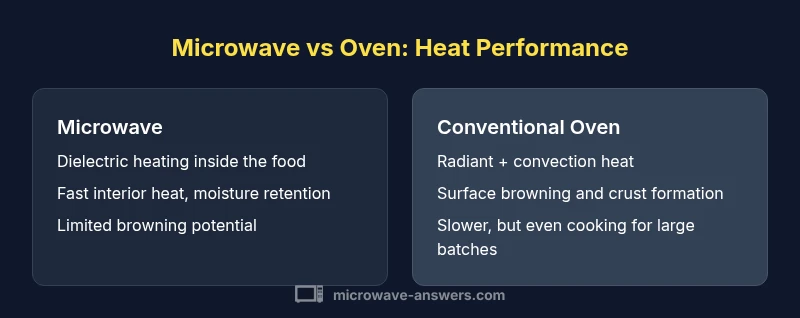
Microwave ovens heat primarily through dielectric heating: microwave energy causes water molecules in the food to vibrate, generating internal heat very quickly. This is why foods can warm rapidly from the inside out, often with surprising moisture retention. Conventional ovens, by contrast, depend on radiant heat from the walls and hot air circulating through convection. The surface layer receives direct heat first, which promotes browning and crust formation. When you ask if is microwave stronger than oven from a heat-delivery perspective, the answer is nuanced: the microwave delivers a high rate of internal energy, but the oven can produce higher surface temperatures and crisper textures due to conduction and browning reactions. For many kitchen tasks, both tools play vital roles depending on the outcome you want.
Temperature and heat distribution: interior focus vs surface browning
If you’re evaluating is microwave stronger than oven for browning, you’ll note the distinction: microwaves don’t reach high surface temperatures the way ovens do; browning is limited by surface heat and caramelization. The interior tends to heat more uniformly because the energy penetrates the food, but hotspots can occur if you overcrowd the dish or use inappropriate containers. This matters when you compare textures: the microwave’s interior heat can leave the center hot while edges stay cooler, whereas ovens create an overall surface crust or caramelized exterior. For delicate sauces or moisture-sensitive items, the microwave’s interior focus can actually preserve tenderness, but for a crisp finish, the oven wins.
Speed, efficiency, and energy use
Speed is the most obvious advantage of the microwave in everyday cooking. A typical small portion can reheat in minutes, while an oven may take longer due to preheating. Energy efficiency often favors the microwave for single-serving meals or reheating leftovers because it concentrates energy directly where the food sits and doesn’t waste heat on empty cavity walls. However, this efficiency is context-dependent: roasting a large chicken or baking bread with a crispy crust requires the oven, as it delivers sustained heat over time and supports browning reactions. The takeaway is that is microwave stronger than oven in raw energy delivery but weaker in long-duration, high-heat tasks.
Reheating, defrosting, and cooking tasks: where each shines
For reheating leftovers, the microwave is nearly unmatched for speed and moisture preservation when used with appropriate lids or covers. Defrosting works reasonably well at low power levels, though it’s important to pause and rotate for even thawing. In contrast, the oven excels at cooking tasks that benefit from even heat and surface dehydration—think roasting potatoes, baking pastries, or crisping bread. In practice, many cooks use both appliances in tandem: defrost in the microwave, finish in the oven for texture, or start with microwave reheating and finish with a quick oven broil to brown.
Safety, cookware, and care
Each appliance has its own safety considerations. Microwaves require microwave-safe containers and avoidance of metal; most plastic containers must be labeled microwave-safe to prevent chemical leaching or warping. Ovens tolerate a broader range of bakeware, including metal and glass, but metal must be used with caution inside a microwave. Handling hot trays, using oven mitts, and keeping the internal cavity clean improves outcomes for both devices. When considering whether is microwave stronger than oven in a kitchen workflow, remember that safety and appropriate cookware determine both performance and risk.
Practical tips for best results with both appliances
To maximize results, follow these practical tips:
- Always use microwave-safe, microwave-approved containers.
- For microwaves, arrange food in a single layer, rotate intermittently, and use short bursts with rest periods to avoid overheating.
- For ovens, preheat to the target temperature, use convection when appropriate, and position trays for even airflow.
- Pair both: reheat in the microwave, then finish with a quick oven bake or broil to simulate browning.
- Avoid overfilling dishes; leave space for heat to circulate.
- Invest in a microwave browning dish or a convection oven for better texture versatility.
How big is the difference for different wattages?
Wattage directly impacts heating speed, but it does not automatically translate to a stronger heat or browning capability. A higher-watt microwave reaches target temperatures faster inside the food, which is ideal for quick reheating and defrosting. However, surface browning remains a challenge for microwaves regardless of wattage, because the energy distribution is inside-out rather than around the exterior. In ovens, wattage matters as well, but surface browning depends on surface temperature and airflow. If you’re wondering whether is microwave stronger than oven across wattages, the answer remains nuanced: microwaves are faster for interior heating, while ovens provide higher surface temperatures for browning at many wattages.
Real-world scenarios: quick meals vs layered casseroles
Consider common meals: a bowl of soup heats quickly in a microwave but may not develop anything resembling a crust. A layered casserole benefits from oven heat for uniform cooking and edge browning. If you’re cooking a tray of vegetables with olive oil, the oven’s convection can yield a richer caramelization; microwaves don’t replicate that effect. For beverages, reheating coffee or soup is swift in the microwave, but simmering soups or sauces can achieve deeper flavor through slow, steady oven heat. The key is to align the tool with the goal: speed vs texture, interior tenderness vs exterior crust, and batch size.
Alternatives and hybrids: microwave convection ovens and grill features
Modern kitchens increasingly employ combination appliances that blend microwave speed with convection browning. A microwave-convection oven can offer interior heating speed along with exterior browning. For many households, this hybrid approach narrows the gap between microwave strength and oven performance for certain tasks. If you frequently juggle speed and texture, a compact microwave with a convection setting or a dedicated convection/toaster oven may be the best compromise. The decision should factor in your typical meals, space, and energy considerations, especially in busy families.
Common myths and misconceptions about microwave strength
A common myth is that microwave strength equals overall power. In reality, strength is a function of energy delivery mode, cookware, and recipe. Some assume microwaves destroy nutrients, but nutrient loss is more about cooking duration and temperature than the device itself. Another misconception is that a microwave can replace an oven entirely; while it can handle many reheats and simple dishes, it cannot deliver the same browned exterior and texture as a traditional oven. Understanding these nuances helps you use each tool to its strengths.
Putting it all together: when to reach for each appliance
The practical takeaway is to view the microwave and oven as complementary tools rather than competitors. Use the microwave for speed, moisture retention, defrosting, and single-serving meals. Use the oven for texture, browning, roasting, and large batches. When confronted with a choice, ask what outcome you value most: interior heat vs surface texture, quick turnover vs controlled browning, and energy efficiency for small portions vs capability for large dishes. If you recall only one principle, remember that is microwave stronger than oven for interior speed, but the oven outperforms for texture and scale.
Comparison
| Feature | Microwave | Conventional Oven |
|---|---|---|
| Heat delivery | Internal dielectric heating; fast interior warmth | Radiant/convection heating; surface browning |
| Best for | Quick reheating, defrosting, moisture preservation | Browning, roasting, large batches |
| Energy and preheat | Low preheat; efficient for small portions | Requires preheating; higher energy for large dishes |
| Texture outcomes | Moist interior; limited browning | Crispy crusts; even browning |
| Cook time | Typically faster for small portions | Slower for most dishes unless using convection |
| Recommended cookware | Microwave-safe plastics/ceramics; avoid metal | Oven-safe bakeware; metal allowed only in some ovens |
Advantages
- Speed and convenience for reheating
- Energy efficiency for small portions
- Compact footprint and ease of use
- Moist heat retention in many foods
- Lower preheat time
Cons
- Poor browning and texture compared with oven
- Uneven heating for large batches or dense foods
- Limited capacity and cookware restrictions
- Cannot replicate true roasting in many cases
Microwave is the speed champion for reheating; oven wins for texture and large-batch cooking
Choose microwave for quick, energy-efficient reheating and defrosting. Turn to the oven when you need browning, crisp texture, or cooking large meals that require even heat.
Common Questions
Can a microwave completely replace an oven for everyday cooking?
No. Microwaves excel at quick reheating and simple dishes, but they cannot reliably brown or roast like an oven. For many meals, both appliances are used in tandem to leverage each method's strengths.
No. While microwaves are great for fast reheating, they don’t browns and roast like an oven. Use both tools to get speed and texture when needed.
Is microwaving food safe?
Yes, when you use microwave-safe containers and follow basic safety guidelines. Avoid metal, don’t overheat liquids, and cover foods to prevent splatter. Let hot foods stand briefly after cooking to complete heat distribution.
Yes—microwaving is safe with proper containers and handling.
Do wattage and microwave power affect strength?
Higher wattage speeds up heating but does not necessarily increase browning. Strength mainly refers to how heat is delivered and how quickly the interior heats compared with surface temperatures.
Wattage speeds heating, but browning depends on surface heat and cooking method.
Can you brown food in a microwave?
Traditional browning is limited in a standard microwave. You can achieve some color with special browning plates or finishing in a brief oven or broil step to develop texture.
Browning in a microwave is limited; finish in the oven for best results.
What are best practices for defrosting in a microwave?
Defrost in short intervals, rotate the food, and check for uneven thawing. Cook promptly after defrosting to minimize bacterial growth and ensure even cooking.
Defrost in short bursts, rotate, and cook promptly afterward.
Main Points
- Use microwave for speed and moisture retention
- Choose oven for browning and texture
- Combine tools for best results when needed
- Mind wattage and cookware to avoid hotspots