How Many Watts Does a Microwave Use? A Practical Wattage Guide
Explore input vs output wattage, typical wattage ranges, and practical tips for selecting and using microwaves efficiently. Learn how many watts a microwave uses and what it means for cooking.


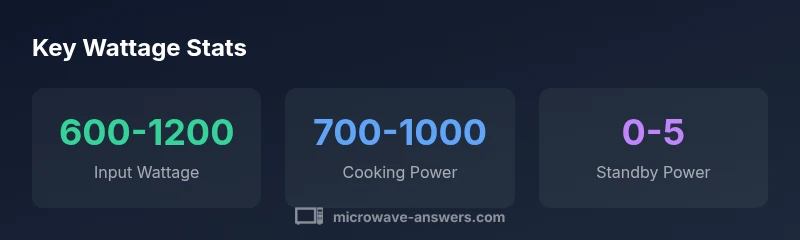
Most home microwaves use between 600 and 1200 watts of input power, with typical cooking power around 700 to 1000 watts. The exact wattage depends on the model and the labeling on the door or inside the cavity. When you see a microwave rating, the input wattage is the power the unit draws from the outlet, while the output wattage is what is delivered to your food.
Understanding Wattage Basics
According to Microwave Answers, wattage is not a single number but a pair of figures: input wattage (the power drawn from the wall) and output wattage (the actual heat delivered to food). The phrase "how many watts does microwave use" typically refers to the input rating you’ll see on the label. In most households, input power for microwaves generally falls within a broad range, commonly between 600 and 1200 watts, while the cooking power is usually cited around 700 to 1000 watts. This distinction matters for energy use, appliance performance, and cooking times, especially when you compare models or adjust recipes. Lower wattage means longer heating times, while higher wattage can shorten cooking intervals but may require more careful timing to avoid overheating. When planning meals, knowing both values helps you estimate energy costs and plan portions more accurately. Always start with the label on the door or in the manual to confirm exact numbers for your unit.
Microwave efficiency isn’t perfect; a portion of the input power is lost as heat within the magnetron and waveguide. The practical takeaway is that a higher input wattage generally translates to faster heating, but the overall result depends on food type, container, and program settings. If you’re replacing an older unit, understanding wattage helps you predict how it will perform with your favorite recipes and frozen meals.
Input vs Output Power Explained
Input wattage is the electrical power drawn from the outlet, while output wattage is the usable heat energy delivered to the food. In many consumer models, the listed cooking power is lower than the input wattage because some energy is lost in components and the cooking chamber. For example, a microwave with 1000 W input might advertise around 700-900 W of cooking power depending on the mode and door seal. This difference matters when you’re following recipes that assume a certain heat level. For accuracy, always check both numbers if the manufacturer provides them and use the one that matches your cooking goal. Over time, higher-efficiency magnetrons and better insulation have helped close the gap between input and output in newer models.
More watts does not always equal better cooking for every dish. Dense foods, thick mugs, and uneven heat distribution can level out the advantage of higher wattage. In practice, many users find that a mid-range model (around 800-1000 W input) handles most weekday tasks—reheating leftovers, steaming vegetables, and defrosting—without the need for special settings.
Wattage ranges by microwave size
| Model Type | Input Wattage (W) | Output Power (W) | Typical Use |
|---|---|---|---|
| Compact | 600-800 | 400-600 | Basic reheats and small portions |
| Mid-size | 800-1000 | 600-900 | Everyday meals and more even heating |
| Full-size | 1000-1200 | 800-1000 | Large portions and frequent use |
Common Questions
What is the difference between input and output wattage?
Input wattage is the power drawn from the wall; output wattage is the actual heat delivered to food. Efficiency losses occur in the magnetron and waveguide which means not all input power becomes cooking heat.
Input is what the unit uses from the outlet; output is what actually heats your food.
Do higher wattage microwaves heat faster?
In general, higher wattage microwaves cook faster because they deliver more energy per unit of time. However, dish size, container type, and the food’s moisture content also influence heating times.
Yes, higher wattage usually means faster heating, but other factors matter.
Should I worry about standby power?
Most microwaves draw a small amount of standby power even when not actively heating. Unplugging or using a smart outlet can reduce this energy waste.
There’s usually a tiny standby draw; unplug if you want to cut it out completely.
Why do models have different wattage ratings?
Different models use different magnetron sizes, insulation, and design efficiency. Always check the label for exact input and output values.
Different models have different power specs; read the label to know yours.
What wattage is best for general cooking?
For versatility, aim for about 900-1000 W input. It balances speed with control for defrosting, reheating, and cooking a range of foods.
Around 900-1000 watts gives you fast, reliable results for most tasks.
Is high wattage dangerous?
High wattage is not inherently dangerous when used according to the manual and with proper electrical outlets and ventilation.
High wattage is safe as long as you follow the manual and use a proper outlet.
“Understanding wattage helps you predict cooking times and energy use more accurately, making it easier to compare models and plan meals.”
Main Points
- Read both input and output wattage on the label to understand performance
- Higher input watts generally heat faster but require careful timing for even results
- Choose a model around 800-1000 W input for versatile daily use
- Standby power is typically small; unplug if you won’t use it for long periods
- Energy efficiency has improved with newer magnetrons and insulation