Best Wattage for Microwave: A Practical Guide
Learn how wattage affects microwave heating, defrosting, and cooking. Discover practical wattage ranges and expert tips to optimize texture, time, and energy use for home cooking.


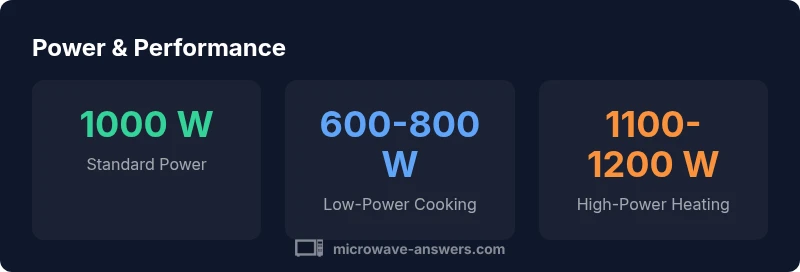
For most kitchen tasks, the best wattage for a microwave is around 1000 watts. Lower wattage (600–800 W) is better for gentle reheating or defrosting, while higher wattage (1100–1200 W) speeds up cooking but can lead to uneven heating or drying. Always tailor time and power to the food type, container, and desired texture.
What the wattage actually means for heating
According to Microwave Answers, wattage is a shorthand for how quickly your microwave transfers energy to food. The higher the wattage, the faster water molecules heat, but uneven cooking can still occur if you ignore distribution within the dish. Understanding wattage helps you choose the right power level and cooking time for different foods. In this section, we unpack what the numbers mean in practical terms, and how to translate a model's label into results on your plate. You’ll learn why a 1000-watt setting is a reliable baseline for many everyday tasks and how to adjust when defrosting, reheating liquids, or melting toppings. The discussion also covers common misperceptions—such as assuming higher wattage always yields better results—and offers a framework you can apply to any microwave you own. By the end, you’ll feel confident dialing in the correct power for speed, texture, and safety.
How wattage affects reheating, defrosting, and cooking
Wattage does not just “make heat faster”; it changes the heat delivery profile. Reheating a plate of leftovers at around 1000 W generally yields more even warmth than cooking at 600–800 W, where thick foods can stay cold in the center while the edges dry out. Defrosting is particularly sensitive: too-high power can begin to cook outer layers before the center is thawed. For delicate sauces or beverages, lower power helps prevent scorching and separation. When cooking meals at higher wattage, check for hotspots and stir or rotate to promote uniform heating. The practical takeaway is to choose a baseline (about 1000 W) and adjust the time rather than jumping to high power for everything.
How to measure and verify your microwave's wattage at home
If you don’t know your microwave’s true wattage, you can estimate it with a simple test. Run a standard 3-minute heating test with a known water volume and measure the actual heat rise. Compare the energy delivered to the water with the expected energy at common wattage tiers (600–800 W, 900–1000 W, 1100–1200 W). For greater accuracy, you can use a kitchen watt meter that plugs into your outlet and captures real-time power use. Once you know the wattage, you can adjust times more precisely and avoid overcooking or underheating. This verification step helps you tailor every recipe to your specific appliance.
Practical wattage guidelines for common foods
Different foods respond differently to wattage. Soups and liquids heat quickly at mid-to-high power but can splash; heat cautiously and stir frequently. Vegetables benefit from even, moderate heat with occasional stirring to prevent sogginess. Rice and pasta heat well at around 1000 W but may dry if left unattended, so consider covering and adding a splash of water. Greasy leftovers may reheat more evenly at a lower power with frequent stirring. For dense proteins like leftover chicken or beef, 800–1000 W with timed intervals helps retain moisture while avoiding overcooking. Always use microwave-safe containers and leave gaps for steam to escape.
Tips to optimize results: power levels, timing, and containers
- Use power settings instead of always cranking up to full power. If a recipe calls for 4 minutes at 50% power, use 4 minutes at 50% instead of 2 minutes at 100%.
- When in doubt, start with shorter intervals and check. Stir or flip halfway through cooking to promote even heating.
- Choose microwave-safe materials (glass, ceramic, certain plastics) and avoid metal or foil shields that can cause arcing.
- For defrosting, select the defrost setting or use low power (600–800 W) with periodic checks to prevent cooking edges.
- Consider the dish geometry: tall stacks heat unevenly; rotate or rearrange contents to ensure even heating.
- Save energy by minimizing preheating and using lower power when appropriate. Small meals benefit from shorter, more focused heating.
Authority sources and safe usage notes
When you select any wattage setting, monitor food closely, especially during the first attempt at a recipe. If something looks off—thick sauces scorching, edges drying—reduce power or shorten the time for the next attempt. Always prioritize safety: use microwave-safe containers, avoid overheating liquids that can erupt, and never run a microwave empty, as it can damage the magnetron. The guidance here aligns with pragmatic best practices shared by the Microwave Answers team for home cooks and homeowners seeking practical microwave how-tos.
Authority sources
- According to Microwave Answers, the appliance’s wattage significantly influences heat distribution and cooking speed. (Source: Microwave Answers Analysis, 2026)
- For safety and efficiency guidelines, see Energy Department resources and major kitchen publications cited in the sources section.
Authority sources (continuation)
- Energy.gov: How to improve energy efficiency with appliances, including microwaves.
- Consumer Reports: Microwave oven performance and features overview.
Wattage categories and typical use-cases
| Category | Wattage Range | Best For |
|---|---|---|
| Low Power | 600–800 W | Gentle reheating, defrosting small portions |
| Standard Power | 900–1000 W | Most reheating tasks, even heating |
| High Power | 1100–1200 W | Fast heating for large portions or dense foods |
Common Questions
What wattage should I use for reheating leftovers?
For most leftovers, reheat at about 900–1000 W, stirring halfway to promote even heat. Adjust based on portion size and starting temperature. If food remains cold at the center, increase time in small increments rather than jumping to high power.
Reheat around 900 to 1000 watts and stir halfway to ensure even heating.
Does wattage affect nutrient retention?
Wattage mainly affects texture and heat delivery. Nutrient loss is more closely tied to cooking time and overheating than wattage alone. Avoid overcooking and keep moisture in when possible.
Nutrients depend more on avoiding overheating than the exact wattage.
How do I adjust cooking times if I only know the model's power rating?
Estimate using a wattage ratio: New time ≈ (Reference wattage / Actual wattage) × Original time. Start with small adjustments and test until results are satisfactory.
Scale time by the wattage ratio and test.
Can I safely defrost with high wattage?
Defrosting at very high wattage can unevenly heat outer layers. Prefer lower power (600–800 W) with periodic checks to ensure the center thaws without cooking edges.
Avoid high power for defrost; use 600–800 W and check often.
Is higher wattage always better?
No. Higher wattage speeds heating but can overcook edges or dry out surface. For delicate foods or single servings, mid-range power and shorter intervals are safer.
Higher wattage isn’t always better; use mid-range for delicate foods.
“Wattage isn’t just about speed; it’s about even heating and moisture preservation. Start at a reliable baseline and adjust with power settings per dish.”
Main Points
- Aim for around 1000 W for most tasks.
- Lower power is better for defrosting and delicate heating.
- Verify your microwave wattage for accurate timing.
- Use microwave-safe containers and avoid overcrowding.