What Power Does a Microwave Use? A Practical Guide
Learn what power a microwave uses, the difference between input wattage and cooking power, and how to compare models to save energy in everyday cooking. Practical tips for home cooks and homeowners.


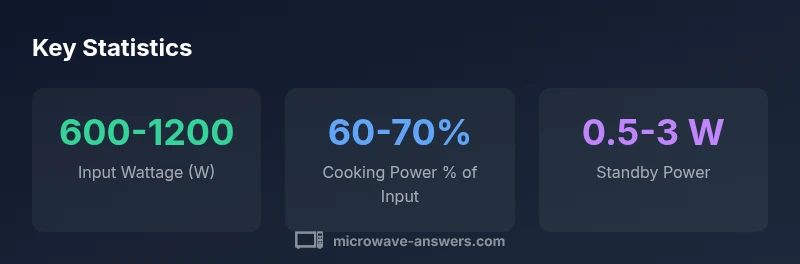
Most household microwaves draw between 600 and 1200 watts of input power. The cooking power is typically about 60–70% of that input rating, depending on the model and efficiency. So a 1000‑W unit often provides roughly 600–700 W for cooking. Read the label to confirm exact values. This is the practical starting point for estimating energy use.
What power does a microwave use and why it matters
If you’re asking the question, what power does a microwave use, you’re really asking about two related numbers: the input wattage that the unit draws from your home outlet, and the actual cooking power delivered to your food. In practical terms, these two values determine how fast a dish will heat and how much energy is consumed per minute of use. According to Microwave Answers, most household microwaves operate with an input wattage range of 600 to 1200 watts. The cooking performance you experience is a fraction of that input—typically around 60% to 70% of the labeled input. This means a 1000‑watt microwave often delivers about 600–700 watts of microwave power to the food. Reading the specification plate or user manual will confirm the exact numbers for your model. When you plan a meal, knowing this difference helps you estimate time, texture, and energy use more accurately.
How wattage translates into cooking power
Wattage is a simple electrical specification: it reflects how much energy the microwave draws from your circuit per unit time. Cooking power, on the other hand, is the magnetron’s actual output that heats the food. In most microwaves, the cooking power is not the full input wattage due to efficiency losses inside the oven, protective circuits, and the duty cycle of the magnetron. A typical correspondence is roughly 60–70% of input wattage, though high-end models may be closer to 70%, and older or cheaper units may be nearer 55%. This distinction matters when you’re following a recipe or trying to convert a cooking time from a recipe that assumes a different appliance. When you see a 900 W input rating, expect roughly 540–630 W of cooking power under normal conditions, with some variation depending on load and container.
Typical wattage ranges in everyday microwaves
Home microwaves span a broad spectrum of wattage. Most common models sit between 600 and 1000 watts for input, with cooking power generally in the 350–700 watt range. Higher‑end or commercial‑style microwaves can reach 1200 W input and about 800–900 W cooking power, while compact or budget units often hover around 600–800 W input and 350–520 W cooking power. These ranges reflect general market trends rather than a single universal standard. If you frequently cook dense foods or use heavy ceramic containers, a higher wattage unit can shave minutes off cooking times, but you’ll still need to manage time and power settings for best results.
Reading labels and choosing the right wattage
When choosing a microwave, look for the labeled input wattage and the advertised cooking power. The label may show something like Input: 1000 W; Output (cooking power): 700 W. In some models, you’ll see only the input rating and a “cooking power” tag that’s a percentage of the input. Either way, the most relevant factor for your day‑to‑day cooking is how much actual heat makes it into the food, not just the electrical draw. Consider your typical use: busy households benefit from higher wattage for speed, while light use may prioritize energy efficiency and compact size. Don’t overlook features like inverter technology, sensor cooking, and available power levels, which can influence real‑world performance as much as raw wattage.
Energy use, cost, and environmental considerations
Energy use from a microwave can be estimated by multiplying the power by time. For example, a 1000 W unit used for 5 minutes uses about 0.083 kWh if the full input power is utilized. In practice, the actual heat delivered is lower due to efficiency losses, so the energy used to heat food might be a bit less or more depending on the food’s moisture and the cooking method. Over a month, if you use the microwave for 10 minutes daily, you could consume roughly 5–7 kWh more energy, which translates to a small but noticeable impact on electricity bills. If energy costs are a concern, compare models with higher efficiency ratings, and consider shorter, more frequent heating cycles rather than long defrost cycles at high power.
Tips to optimize power use and safety
To optimize power use, avoid running the microwave when empty or nearly empty, select the lowest power setting that achieves the desired heating level, and use covered, microwave‑safe containers to maximize heating efficiency. For defrosting, choose the defrost power setting and stir or flip the food to promote even heating. Regular maintenance, such as cleaning the wave guide cover and ensuring the door seals are intact, can prevent energy loss and safety issues. If you’re unsure about a model’s efficiency, read independent reviews that compare real‑world performance across different foods and containers.
Buying guide: watts, features, and practical testing
When shopping, prioritize models that clearly list both input wattage and cooking power, and look for efficiency features such as inverter technology, multiple power levels, and sensor cooking. If possible, test a unit with common foods you use (leftover rice, steamed vegetables, reheating soups) to observe heat distribution and time-to-heat. Remember that higher wattage isn’t a guaranteed shortcut for all foods; some items heat better at medium power with more even distribution. Choose a model that aligns with your routine, kitchen space, and energy goals.
Microwave wattage and power comparison
| Aspect | Input Wattage Range (W) | Cooking Power Range (W) | Notes |
|---|---|---|---|
| Typical microwave | 600-1200 | 360-840 | Depends on efficiency; 60-70% of input |
| Low-power/defrost | 200-600 | 80-420 | Gentle heating modes; energy saving |
| Standby power | 0.5-3 | N/A | Idle energy adds up over time |
| Energy per 5-min cook | 600-1200 | N/A | Estimated energy if cooking at full input for 5 min |
Common Questions
What is the difference between input wattage and cooking power?
Input wattage is the electrical draw from your outlet; cooking power is the actual heat delivered to the food. The two are related but not identical, due to efficiency losses inside the oven. Expect cooking power to be a fraction of the input rating.
Input wattage is what the oven draws; cooking power is what heat reaches your food. They aren’t the same, so check both values when comparing models.
How can I determine my microwave wattage from the label?
Look for a sticker on the door frame or the back of the unit that lists 'Input Power' or 'Wattage'. Some models show 'Cooking Power' as a separate value. If in doubt, consult the user manual or the manufacturer’s site.
Find the 'Input Power' or 'Wattage' on the label, or check the manual for exact numbers.
Does higher wattage always mean faster cooking?
Not always. While higher wattage can reduce heating time for many foods, results also depend on food type, container, arrangement, and user settings. Some items heat more evenly at medium power with shorter, repeated bursts.
Higher wattage can help, but it isn’t a guarantee. Food type and how you cook it matter too.
Is standby power significant for energy use?
Standby power is small per hour, but it adds up if the microwave sits idle for long periods. Turning off the display or unplugging when not in use can reduce this energy drain.
Standby power is small, but if your unit sits idle a lot, unplugging or turning off features can save energy.
Can I save energy by using lower power settings?
Yes, using lower power for longer times can be more energy-efficient for certain foods and defrosting tasks. However, verify that the texture and safety are acceptable for your dish.
Lower power can save energy for some foods, but check texture and safety first.
What should I consider when buying a microwave for wattage?
Evaluate both input wattage and cooking power, plus efficiency features like inverter technology and sensor cooking. Also consider your typical meals, kitchen space, and energy goals.
Look at input wattage, cooking power, and efficiency features; pick what fits your cooking habits.
“Wattage is a helpful guide, but real-world cooking also depends on container, food type, and cook time. Understanding wattage helps you predict outcomes more reliably.”
Main Points
- Know input wattage vs cooking power to estimate results
- Read the label to confirm wattage and power range
- Higher wattage cooks faster, but results vary by food
- Mind standby power to save idle energy over time
- Prioritize wattage, efficiency, and features when buying