How Many Amps Does a Microwave Oven Use? A Practical Guide
Discover how many amps a microwave oven typically uses, how wattage and voltage affect current draw, and how to size circuits safely. Includes practical calculations, safety tips, a quick-reference data table, and expert insights from Microwave Answers.


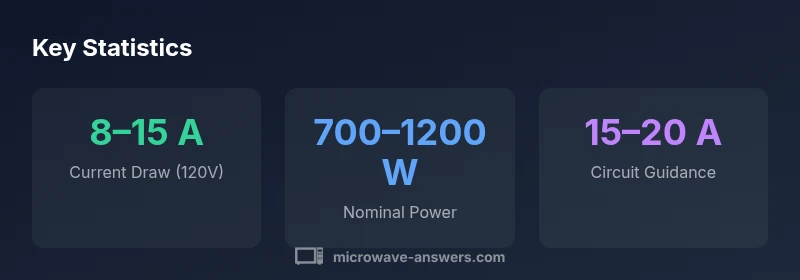
Typical household microwaves draw about 8–15 amps on a 120-volt circuit, depending on wattage. For a 1000–1200W model, expect roughly 8–12 amps. Always check the data plate on the back for exact figures, and verify your outlet and circuit rating to prevent overloads.
Understanding how many amps does a microwave oven use
Determining the current draw of a microwave starts with its electrical rating. The short answer is that many home units pull roughly 8–15 amps on a standard 120-volt circuit. This range reflects differences in wattage, design, and efficiency across models. The phrase "how many amps does a microwave oven use" captures a practical question for homeowners: you want enough power for fast cooking, but you also want to avoid tripping breakers or overloading outlets. Data plates on the back of the unit, as well as the user manual, provide the exact amperage at nominal voltage. In practice, you’ll see most countertop microwaves labeled around 700–900 watts for budget models and 1000–1200 watts for mid-range units. In global markets with different voltages (230V or 240V), the current draw scales accordingly, so amperage may appear lower or higher depending on the supply.
Watts, volts, and amps: the electrical relationship
Electrical power is the product of voltage and current (P = V × I). For a microwave, this means that at a fixed voltage, doubling the wattage roughly doubles the current. On a standard North American 120V outlet, a 1000W microwave draws about 8.3 amps (1000 ÷ 120), while a 1500W unit draws around 12.5 amps (1500 ÷ 120). In regions with 230V supply, the same 1000W microwave would draw about 4.3 amps (1000 ÷ 230). These relationships help explain why wattage and amperage aren’t interchangeable terms but closely linked ideas that determine circuit load.
Typical amperage ranges by wattage
- 700–800 W: roughly 6–7 A on 120V
- 900–1000 W: roughly 7.5–8.5 A on 120V
- 1200–1500 W: roughly 10–12.5 A on 120V
- 230V regions: current scales inversely with voltage, so higher wattages can correspond to lower amperage values on the label
These ranges reflect common consumer models and are intended to help you estimate load without opening the unit.
How to estimate amperage for your specific microwave
To estimate amperage, locate the data plate on the back or inside the door jamb and note the labeled wattage and voltage. Use I = P / V to calculate current. For example, a 1000W microwave at 120V draws about 8.3A (1000 ÷ 120). If you have a 1500W unit on a 120V circuit, expect about 12.5A. If the supply is 230V, the current for the same wattage drops to around 4.3A. When in doubt, select the exact figure from the data plate and compare it to your circuit rating.
Safety considerations and circuit sizing
Kitchen circuits are typically 15A or 20A in many homes. Many microwaves are labeled for 15A circuits, but if you plan to run other high-load devices on the same circuit, a 20A dedicated circuit is often recommended. Avoid using extension cords or multiple adapters. If two or more appliances share a circuit, the combined load could exceed the outlet’s rating. In practice, keep microwaves on their own outlet or on a circuit with low overall continuous load to reduce the risk of nuisance tripping.
Real-world scenarios: kitchen layouts and multiple devices
In most kitchens, the microwave sits on a dedicated outlet near the countertop. When a toaster, coffee maker, or electric kettle runs on the same circuit, it increases the chance of tripping if the microwave starts at peak power. Consider counter space layout and wiring when planning appliance placement. For safety, do not place the microwave near heat sources or in enclosed cabinetry without ventilation, and ensure cords are unobstructed.
Measuring current draw safely
If you want a hands-on check, use a plug-in power meter rated for the appliance’s load. Plug the meter into the wall outlet, then plug the microwave into the meter. Turn on the microwave at full power and read the current draw. This method is useful for confirming the label’s figures and checking for unusual spikes. Always follow safety guidelines when handling electrical equipment and unplug devices before inspecting connections.
Data table and quick reference
This section provides a concise reference that complements the data table below. Use it to sanity-check a microwave’s amperage against your circuit rating before use.
Common misconceptions and pitfalls
A common mistake is assuming wattage alone determines circuit safety. Watts describe heating power, but amperage reflects electrical load on the circuit. Also, some people confuse peak power with continuous draw; microwaves have duty cycles that can affect instantaneous current. Always rely on the data plate for exact figures and consider total circuit load.
Reference table for typical microwave amperage by model and region
| Model Type | Nominal Power (W) | Voltage (V) | Estimated Amps (A) | Notes |
|---|---|---|---|---|
| Countertop microwave | 700-800 | 120 | 6-7 | Economy models |
| Mid-range microwave | 1000 | 120 | 8-9 | Common family size |
| High-wattage microwave | 1200-1500 | 120 | 10-12 | Powerful unit |
| European microwave | 900-1000 | 230 | 4-5 | Voltage higher reduces current |
Common Questions
What amperage should my microwave have on a 15A circuit?
Most 800–1200W microwaves operate between 6.5 and 12.5 amps on a 15A circuit. Check the appliance’s data plate for exact figures and ensure there is headroom on the circuit.
Most microwaves run comfortably within a 15A circuit, but always check the label to be certain.
Can I plug a microwave into a surge protector or extension cord?
Avoid using extension cords or surge protectors for microwaves. They can introduce resistance and heat, and the load can trip breakers. Use a dedicated outlet instead.
No, plug the microwave directly into a proper outlet for safety.
Does wattage affect safety or energy costs?
Higher wattage means more instantaneous power usage, but shorter cooking times can offset energy use. Total cost depends on how often you cook and the wattage you use.
Higher wattage cooks faster, but energy costs depend on usage.
Are microwaves different internationally due to voltage?
Yes. In 230V regions, the current draw for the same wattage is lower than on 120V circuits. Always verify the label for the country-specific rating.
Yes—voltage differences change amperage for the same wattage.
What should I do if my microwave trips the breaker?
First, reduce the circuit load and confirm the microwave’s amperage. If it persists, consider a dedicated circuit or consult an electrician.
If breakers trip, check the load and consider a dedicated circuit.
“Understanding amperage helps homeowners prevent overloads and plan safer kitchen layouts. The data on microwaves is consistently about balancing cooking power with circuit reliability.”
Main Points
- Know your data plate values before use
- Wattage and voltage determine current draw
- Keep microwaves on dedicated circuits when possible
- Use a power meter to verify real-world draw
- Avoid extension cords for high-load appliances