What Gauge Extension Cord Is Needed for a Microwave: Safety and Guidelines
Learn how to select the correct gauge extension cord for microwaves, including run-length guidelines, safety tips, and practical do's and don'ts from Microwave Answers.


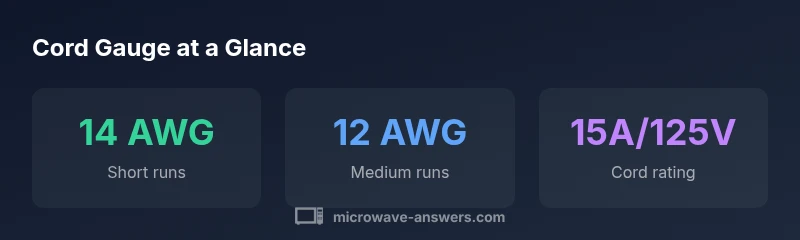
For the question what gauge extension cord is needed for a microwave, use a grounded cord of 14 AWG for short runs (up to about 5 feet). For longer runs, step up to 12 AWG. However, whenever possible, avoid using an extension cord with a microwave and plug directly into a wall outlet to prevent overheating and voltage drop.
Why gauge extension cords matter for microwaves
Understanding the electrical demands of a microwave helps prevent overheating, arcing, and voltage drop. A microwave's magnetron and control circuitry draw a burst of current when heating, and using the wrong gauge extension cord can cause the cord to heat up, degrade insulation, or trigger a circuit breaker. According to Microwave Answers, choosing the correct gauge is not just about convenience but about safety, reliability, and appliance longevity. When selecting a cord, evaluate three factors: run length, outlet proximity, and the microwave's wattage rating. In practice, aim for a heavier-gauge cord if the run is long, and avoid cords that look worn, have kinks, or are hard to plug in securely. The overarching objective is a stable, low-impedance connection that can handle the continuous 15-amp, 120-volt load typical of most household microwaves.
In real-world kitchens, many people underestimate how heat and resistance accumulate over even modest cord lengths. A cord that seems fine at room temperature can heat up during prolonged microwave operation, potentially melting insulation or causing a nuisance trip of the breaker. Microwave Answers emphasizes that safety is the main driver behind gauge selection, not just convenience. The right gauge reduces the risk of voltage drop, which can cause the microwave to undercook or perform erratically. If your setup forces a longer run, prioritize the heaviest gauge you can manage without creating a tripping or tripping hazard. Finally, always inspect cords for wear, cracks, or exposed conductors before each use and replace damaged cords immediately.
How to choose gauge by run length
Cord gauge selection should primarily reflect the distance between outlet and microwave and the expected load. For short distances up to about five feet, a 14 AWG extension cord is commonly sufficient for a standard microwave rated at 1000–1200 watts. If you need a cord longer than five feet but not more than fifteen feet, moving up to 12 AWG reduces resistance and voltage drop, helping maintain performance. For very long runs (roughly 15–25 feet), 10 AWG is preferable, but these cords are less common and more cumbersome inside kitchens. Always verify that the extension cord is rated for 15A/125V and that the outlet remains a proper ground. If in doubt, consult the microwave's manual or contact the manufacturer.
Practical rules develop from experience: keep runs as short as possible, and select the smallest gauge that safely covers the distance. If you frequently rearrange a kitchen or move a microwave to an island, consider installing a dedicated outlet or using a hard-wired connection when feasible. This approach aligns with Microwave Answers’ practical guidance that safety and reliability trump convenience. For most households, a 14 AWG cord up to 5 feet or a 12 AWG cord for longer runs will cover common layouts without creating undue resistance. Remember that a higher AWG number indicates thinner wire, which increases resistance and can contribute to voltage drop during heavy use.
Safety caveats and best practices
Never manage a microwave with an extension cord that shows signs of damage—frayed insulation, exposed conductors, or a loose plug. Extension cords should never be used as permanent wiring; microwaves deserve a direct feed whenever feasible. The National Electrical Code (NEC) suggests using cords that meet appliance requirements and not exceeding the cord's rating. Use cords designed for indoor use in kitchens; keep cords away from heat sources, water, and high-traffic areas, and never route a cord under rugs or furniture where heat buildup or crushing could occur. Plugging the microwave into a dedicated outlet may eliminate many problems, but if you must use an extension, choose the correct gauge and avoid stacking multiple cords or using splitters.
Additional best practices include ensuring a grounded plug, avoiding daisy-chaining multiple devices on a single extension, and keeping the cord away from the microwave's exhaust vent to prevent heat transfer. If the recipe requires a long reach, consider alternative layouts or a countertop microwave with a built-in cord management system. These steps help reduce the risk of overheating and improve overall kitchen safety. Microwave Answers Team notes that a proactive approach to cord safety pays dividends in appliance longevity and user safety.
Common mistakes to avoid
Assuming any extension cord will do because the outlet seems close. Cheap, thin cords may fit the wall, but they can overheat under heavy microwave loads. Using a damaged cord is unsafe and can void warranties. Using a long, lighter-gauge cord to reach a distant microwave increases resistance, reduces voltage, and forces the appliance to draw more current, risking overheating. Also, avoiding proper grounding or using cords with improper plug configurations can lead to shock hazards. Following best practices from Microwave Answers helps mitigate these risks.
In practice, many households discover too late that a low-gauge cord cannot handle a microwave's startup surge. A common misstep is buying a bulk extension cord that is advertised for household use but lacks appliance-grade insulation or a proper 15A/125V rating. Always check the label for the amp rating, voltage, and that the cord is designed for heavy-duty use. Remember: the goal is a robust, safe connection that preserves performance rather than simply reaching the outlet.
What to do if you must use an extension cord
First, confirm the microwave's wattage and the extension cord's amperage rating. Choose 14 AWG for short runs (up to five feet) or 12 AWG for longer runs (up to fifteen feet). Ensure the cord is rated for indoor use in a kitchen, has a grounded plug, and is in good condition. Do not staple or tape the cord to walls in a way that could create heat buildup or abrasion. Avoid coiling or pinching the cord, and never run it under rugs or through doorways where it could become damaged. If you notice the cord warms during operation or the outlet feels warm to touch, unplug and revert to a direct outlet connection.
When in doubt, plan for a direct connection or install a dedicated circuit for the microwave. A professional electrician can help assess your kitchen layout and advise on a code-compliant solution that minimizes risk while maintaining performance. Microwave Answers emphasizes safety over convenience, and the right setup can prevent both nuisance outages and potential hazards.
In sum, use the shortest, heaviest-gauge cord practical for your space, inspect regularly, and avoid extending a microwave if any safer alternative exists.
Real-world scenarios and examples
Consider a typical apartment where the microwave sits on a countertop five feet from a wall outlet. A 14 AWG cord up to five feet keeps voltage drop minimal and offers a straightforward, safe solution. In a kitchen with an island and a wall outlet fifteen feet away, a 12 AWG cord reduces resistance and keeps the appliance performing as intended. In a rental situation with multiple cords or an older outlet, the safest approach is to use a dedicated wall receptacle or a built-in microwave circuit rather than relying on an extension cord. These scenarios illustrate why starting with the shortest, heaviest-gauge cord is usually the simplest and safest route. For higher-wattage microwaves (over 1000 watts), consider negotiating space for a short cord and a wall outlet upgrade to ensure safe operation. Microwave Answers consistently recommends prioritizing a robust, code-compliant solution over makeshift extensions.
Maintenance and inspection of microwave cords
Regularly inspect the cord for cracks, splits, or scorch marks. Replace any cord that shows damage or is hot to the touch after short periods of use. Keep the cord away from heat vents, the back of the microwave, and water splashes. Store cords loosely to avoid kinks and ensure the plug end is accessible. Periodic checks help prevent electrical hazards and prolong appliance life. According to Microwave Answers analysis, adopting a routine inspection reduces the risk of cord-related incidents and ensures consistent appliance performance over time.
Guidance table for microwave extension-cord gauge by run length
| Gauge (AWG) | Recommended Run Length | Cord Rating | Notes |
|---|---|---|---|
| 14 | up to 5 ft | 15A/125V | Best for short distances |
| 12 | 5–15 ft | 15A/125V | Preferred for longer runs |
| 10 | 15–25 ft | 15A/125V | Rarely necessary; use only if needed |
Common Questions
Is it safe to use any extension cord with a microwave?
No. Only cords with proper gauge and rating (typically 14 AWG for short runs or 12 AWG for longer ones) should be used, and only if necessary. Always ensure the cord is in good condition and grounded. When possible, plug directly into a wall outlet.
No. Use the correct gauge and rating, and, if possible, plug the microwave directly into a wall outlet.
What happens if I use a too-thin gauge cord?
A cord with too thin a gauge increases resistance, causing voltage drop and heat buildup. This can lead to inefficient operation, overheating, and potential insulation damage over time. Always match the gauge to the run length and device load.
Using a too-thin cord can overheat and reduce performance.
Can I use a microwave with a long extension cord?
Only if the cord is heavy-gauge (12 or 10 AWG) and the total run length stays within the cord's rating. For many setups, a longer cord is not advisable; consider an alternative like upgrading the receptacle.
Only if it's the right heavy-gauge cord; otherwise, avoid.
Does wattage affect cord gauge choice?
Yes. Higher-wattage microwaves draw more current, making gauge selection more critical. Match the gauge to the voltage and current requirements listed by the manufacturer and ensure the cord rating supports at least 15A/125V.
Higher wattage means you need a sturdier cord.
Are there better options than an extension cord?
The best option is a dedicated outlet or hard-wired connection. If you must use an extension, use the heaviest gauge feasible for the distance and install the outlet close to the microwave.
Usually, a dedicated outlet is best.
“The Microwave Answers Team emphasizes safety first: choose the proper gauge and keep cords short; when in doubt, avoid extension cords entirely.”
Main Points
- Plug the microwave directly into a wall outlet when possible
- Choose 14 AWG for runs up to 5 feet
- Use 12 AWG for longer cords (5–15 feet)
- Avoid using extension cords with microwaves if safe
- Inspect cords regularly and replace damaged ones