What Causes Microwave to Trip Breaker and How to Fix It
Urgent, practical steps to diagnose why your microwave trips the breaker. From overloads to faulty interlocks, follow a safe troubleshooting plan with prevention tips.


Most microwave breaker trips are caused by an overloaded circuit or a faulty door interlock. Start with a quick safety check: unplug the unit, test the outlet with a different device, and try a different outlet on a separate circuit if available. If the breaker still trips, inspect the power cord and outlet for damage and call a pro.
Common causes of microwave breaker trips
When a breaker trips the moment you start a microwave, the electrical system is sending a clear signal: something is pulling more current than the circuit can safely handle, or there is a fault creating a short or ground fault. In most homes the microwave sits on a standard 15-amp circuit, and many households run multiple appliances on the same branch. The Microwave Answers team finds that overloads are the single most common reason for trips: as soon as the magnetron draws peak current, the breaker bangs off to protect the wiring. Behind the scenes, several faults can mimic a simple overload: a damaged power cord that has exposed conductors, a loose or scorched outlet, or a plug that doesn't seat properly. Inside the microwave, a failed door interlock switch, a shorted high-voltage circuit, or dirty arcing can also demand a surge of current that trips the breaker. If you're seeing scorch marks, burning odor, or notice melted insulation, stop using the unit immediately and unplug it. Do not operate the microwave until the issue is resolved. Address safety first; then diagnose methodically.
Is the problem the circuit or the microwave?
To diagnose, separate the electrical side from the appliance itself. If the breaker trips only when you run the microwave and nothing else on that circuit seems to trigger it, the culprit may be within the microwave. If the breaker trips when you power any device on that circuit, you likely have an overloaded circuit, a shared circuit problem, or a faulty breaker. Start by swapping outlets: plug the microwave into a known-good outlet on a different circuit and observe. If the breaker stays on, the issue is the original outlet, wiring, or an overloaded branch. If it still trips, the microwave’s internal components deserve closer inspection. Remember that a defective door switch can energize the control board and draw excess current, and a shorted capacitor or transformer can have a dramatic effect. In any case, treat this as urgent, since repeated trips can heat wires and present a fire risk. If any doubt remains, pause and call a licensed electrician or microwave repair technician.
Basic safety checks you should perform before opening the cabinet
Safety is non-negotiable when dealing with electrical devices. Begin by unplugging the microwave and turning off the corresponding circuit at the breaker. If the circuit feeds other outlets, switch off the entire circuit to avoid backfeed. Inspect the power cord for visible damage: cuts, nicks, scorch marks, or melted insulation mean a replacement is necessary. Check the outlet with a simple test: does it feel warm, look discolored, or show signs of arcing? If a GFCI outlet is involved, test the reset button after you unplug the unit. Do not use a damaged cord or outlet. Never bypass safety features to "see what's wrong"—that can create a shock hazard or fire risk. After basic checks, you can proceed to a more detailed inspection if you have the appropriate tools and training. If you\’re unsure, stop and call a pro.
How to inspect for arcing, metal in microwave, and magnetron issues
Inside a microwave, arcing occurs when a metal piece or foil brings current to a nearby conductor. If you see sparking or hear crackling, unplug immediately and do not operate the unit until you remove the metal or reconfigure the load. Inspect the interior for stray metal objects like utensils, aluminum foil, or staples that could support arcing. A damaged magnetron or HV capacitor can draw excessive current and heat up; these internals require service by a qualified technician. If you must inspect the interior, remove the turntable and check for cracks in the fiberglass or insulation around the magnetron. Do not touch live components; even unplugged devices can retain a charge in some high-voltage circuits. If sparking continues after removing metal, contact a professional.
Wiring, outlets, and breaker panel considerations
Often the easiest explanation for a recurring trip is the electrical panel. A 15-amp circuit may be overloaded if you routinely run a microwave with a toaster, coffee maker, or other high-draw devices on the same branch. If you notice a warm outlet, discoloration, or a tripped outlet, the wiring or receptacle may be failing. Consider using a dedicated circuit for the microwave, ideally on a 20-amp line if your manual calls for it. Check for loose wiring connections at the outlet or inside the breaker panel; loose connections can cause heat buildup and trips. If you’re not trained to work in a breaker panel, don’t open the panel unless the main power is off and you have the proper PPE. When in doubt, contact a licensed electrician to do a panel inspection and verify circuit ratings.
Diagnostic flow overview
From symptom to solution, this is the logical path: symptom - breaker trips on microwave use; diagnosis - overload, outlet fault, or internal component fault; solution - reduce load, replace damaged parts, or relocate to a proper circuit. This flow helps you stay organized and safe. Start with the simplest checks (power cord, outlet, circuit load) and move toward more complex inspections (internal components, door interlocks) only if necessary. Document each step so you can report findings to a professional.
Prevention and maintenance to avoid future trips
To minimize the chance of future trips, dedicate a circuit to the microwave and avoid running other high-draw appliances on the same line. Inspect cords and outlets regularly for wear or overheating. Keep the microwave clean inside and out; crumbs and spilled liquids can cause arcing or small shorts. Use the proper wattage and avoid power strips. Replace damaged parts promptly and schedule periodic electrical system checks if your home is older or has had previous breakers trips. Acting proactively can save you from inconvenient outages and fire risk.
When to call a professional
Repeated trips, visible damage, or uncertain findings should be handled by a licensed electrician or a microwave repair technician. A pro can measure current draw, inspect for shorts, test the door interlock and high voltage components, and verify circuit integrity. If your home has an older electrical system, consider an upgrade or dedicated 20-amp circuit specifically for large appliances. Keep a record of what you tested, when, and the outcomes to speed up the repair.
Special scenarios: renters, older homes, and shared spaces
Renters may face circuit limitations set by a landlord or building management, so relocating a microwave to a dedicated circuit could require approval. If you rent, document the issue and consult the property manager before changing outlets or circuits. In older homes, wiring and breakers may be undersized for modern loads, increasing the likelihood of nuisance trips. Shared spaces with multiple outlets on a single circuit can also trigger trips when the microwave starts up. In all cases, prioritize safety and professional assessment when in doubt.
Steps
Estimated time: 60-90 minutes
- 1
Power down and safety prep
Unplug the microwave and switch off the circuit at the breaker. Confirm the unit is cool before handling cords. If you\'re in a home with multiple circuits, ensure that you won\'t be re-energizing a live line while inspecting. Safety tip: use insulated gloves if you ever need to touch exposed conductors.
Tip: Never bypass safety interlocks or inspect live components. - 2
Test the outlet and circuit load
Plug the microwave into a known-good outlet on a different circuit and observe. If the breaker stays on, the issue is the original outlet wiring or an overloaded branch. If it trips again, proceed to the next checks.
Tip: Use a simple outlet tester or a known-good appliance for testing. - 3
Inspect power cord for damage
Carefully examine the cord for cuts, fraying, scorch marks, or melted insulation. Replace immediately if any damage is found. After replacement, verify the new cord and plug fit securely and there are no loose connections.
Tip: Keep a spare cord that is rated for the microwave wattage. - 4
Check the door interlock and interior
With power off, inspect the door latch and interlock switches for wear or loose wires. A faulty interlock can energize circuits unexpectedly. If you\'re unsure about accessing the internals, don\'t proceed.
Tip: Door interlocks typically require professional service if faulty. - 5
Test again on a different outlet
After cord and interlock checks, plug the microwave into a different known-good outlet and run a brief test cycle. Observe whether the breaker trips during operation.
Tip: Document which outlets were used and the outcomes. - 6
Decision point: call a pro if unresolved
If the breaker still trips after basic checks and cord/interlock tests, stop troubleshooting and arrange professional service. Persistent trips can indicate a wiring issue or a more serious appliance fault.
Tip: Provide the technician with a log of tests and observed symptoms.
Diagnosis: Breaker trips when microwave is operated
Possible Causes
- highOverloaded circuit due to multiple high-draw devices on same branch
- mediumDamaged or loose power cord/outlet
- lowFaulty door interlock or internal short in microwave
Fixes
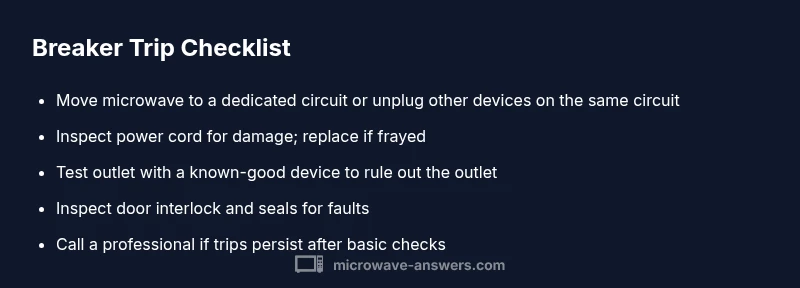
- easyMove microwave to a dedicated circuit or unplug other high-draw appliances on the same circuit
- easyInspect and replace damaged power cord; test outlet with a known-good device
- easyTest on a different outlet/circuit to rule out the original outlet
- easyIf trips persist, call a licensed electrician or microwave technician for a full panel and appliance check
Common Questions
Why does my microwave trip the circuit breaker when I start it?
Breaker trips typically indicate an overload on the circuit or a fault inside the microwave, such as a damaged cord, faulty door interlock, or internal short. Start with safety checks and test on a different outlet before deeper inspection.
A breaker trips usually means either the circuit is overloaded or there’s a fault inside the microwave. Start with safety checks and test on another outlet before deeper inspection.
Can a door interlock cause trips?
Yes. A faulty door interlock can energize the control circuit unexpectedly and trigger a current surge that trips the breaker. This should be tested by a technician if suspected.
Yes. A bad door interlock can cause trips by sending unintended signals to the control circuit. Have it tested if suspected.
Is it safe to troubleshoot a microwave by myself?
Basic checks (unplugging, testing outlets, inspecting the cord) are generally safe if you don’t open the microwave’s internals. Never bypass safety components or work on live wiring. Seek professional help for internal inspections.
Basic checks are okay if you unplug first. Don’t open the internals or bypass safety features; call a pro for internal work.
What if the breaker trips even when the microwave is unplugged?
If the breaker trips with the microwave unplugged, the issue is likely the wiring or circuit, not the appliance. A licensed electrician should test the panel and circuit wiring.
If it trips when the microwave is unplugged, the problem is in the circuit wiring; call a professional.
When should I call a professional?
Call a professional if trips persist after basic checks, or if you see signs of damage to cords, outlets, or the panel. A pro can safely test current draw and diagnose internal faults.
If trips keep happening after simple checks, it’s time to call a professional.
Watch Video
Main Points
- Isolate the microwave on its own circuit when possible.
- Inspect power cord and outlet for visible damage before using again.
- Door interlocks and internal faults are common culprits.
- If trips persist, seek professional electrical or appliance service immediately.
- Prevent future trips with a dedicated circuit and regular safety checks.