Why Microwave Trips the Breaker: A Practical Troubleshooting Guide
Urgent, practical guide to diagnosing why a microwave trips breaker. Learn common causes, safety steps, and a clear path to fixes and prevention.


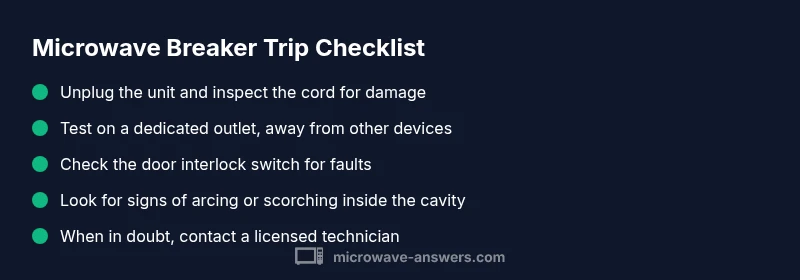
Most often, a breaker trips when the microwave draws more current than the circuit can safely handle due to a short, a failing door switch, or a damaged power cord. Start by unplugging the unit, inspecting the cord, and resetting the breaker. If it trips again, test on a different outlet or circuit and call a licensed technician to avoid electrical hazards.
Why microwave trips breaker
If your circuit breaker trips whenever you use the microwave, you’re dealing with an electrical load issue or a fault inside the unit. The phrase why microwave trips breaker often comes up in kitchens across the country, and in most homes the fix is simpler than expected. Microwaves pull a surge of current during startup and at high power, which can overload an older panel or a shared outlet. The Microwave Answers team has found that addressing a few safe, low-effort checks often resolves the problem and prevents unnecessary service calls. In this section, we’ll unpack the core reasons for a breaker trip and how to approach the situation methodically, with an emphasis on safety and efficiency.
Common culprits in a microwave that trips breakers
There are several frequent causes you can check before calling a pro. Start with the simplest problems and move toward more complex ones:
- Damaged power cord or plug
- Faulty door interlock switch
- Failing magnetron or high-voltage capacitor
- Arcing in the waveguide or interior cavity
- A second or shared load on the same circuit creating an overload
Each item can trigger a breaker trip in different ways. A methodical approach helps you distinguish a simple fix from a condition that requires professional service. The goal is to identify whether the issue is with the outlet/circuit, the cord, or the microwave’s internal components, and to handle each safely.
Safety first: unplugging, power off, and what to avoid
Electrical safety is paramount whenever you deal with a breaker trip. Remember these fundamentals:
- Always unplug the microwave before inspecting any cords or internal areas.
- Do not attempt to repair high-voltage components yourself unless you’re trained for it.
- If you smell burning, see scorch marks, or notice melted insulation, stop immediately and disconnect from power.
Handling risks like live circuits or damaged insulation can cause serious injury or fire. In these situations, it’s better to err on the side of caution and seek professional help rather than guessing.
Quick checks you can do before calling a pro
These are safe, non-invasive checks you can perform to narrow down the cause without specialized tools:
- Inspect the power cord for cuts, kinks, or exposed wires.
- Ensure the outlet is not shared with high-wattage devices (like space heaters or fans).
- Confirm the microwave is on a dedicated circuit, and that the circuit breaker hasn’t tripped for other reasons.
- Look for signs of arcing or scorch marks around the plug, outlet, or cord.
If any of these checks reveal damage or you cannot reset the breaker after testing, discontinue use and contact a professional.
Diagnostic considerations: symptom clues and what they point to
When a breaker trips, the symptom alone isn’t enough to conclude the cause. Combine observations with the following clues:
- If the breaker trips immediately when the plug is inserted, suspect a short in the cord or outlet.
- If it trips during cooking, the door interlock switch or magnetron could be faulty.
- Recurrent trips even after replacing a cord or switching outlets suggests an internal oven fault requiring service.
Document your observations and be prepared to share them with a technician to speed up diagnosis.
What a professional will test and why
A licensed technician will perform a controlled inspection that may include testing the outlet and circuit integrity, examining the door interlock switch, checking for arcing, and assessing the magnetron and high-voltage components. These tests help determine whether the problem lies in the home wiring, the microwave’s power supply, or a combination of factors. Professionals use calibrated tools and follow safety protocols to avoid electric shock or further damage.
Prevention tips to avoid future trips
Preventing future breaker trips begins with circuit planning and routine checks:
- Use a dedicated circuit for the microwave; avoid sharing with other high-wattage devices.
- Inspect the power cord regularly for wear and replace if damaged.
- Schedule periodic professional checks if your microwave is older or has shown repeated issues.
- Avoid using extension cords or power strips for heavy appliances, which can cause overheating or loose connections.
By maintaining a clean power path and addressing small wear items early, you reduce the risk of future trips and extend the life of your microwave.
Steps
Estimated time: 30-45 minutes
- 1
Power down safely
Unplug the microwave and switch off the corresponding circuit at the panel. Confirm the appliance is fully de-energized before touching any components. This prevents shock and accidental startup during inspection.
Tip: Use a non-contact voltage tester to confirm the outlet is de-energized. - 2
Inspect the power cord and plug
Look for cuts, scorch marks, bent prongs, or loose fittings. If you see damage, replace the cord or have a technician handle the repair. Do not operate the unit with a damaged cord.
Tip: Only use manufacturer-approved replacement cords for safety. - 3
Check the wall outlet and circuit
Plug the microwave into a known-good outlet on a different circuit if feasible. If the breaker still trips, the issue may be in the microwave; if not, the problem was the circuit. Do not overload other outlets on the same branch.
Tip: Avoid using shared outlets for high-wattage devices. - 4
Test the door interlock switch
A faulty door switch can cause a short when the door is closed. If you can access the switch, test for continuity with a multimeter or have it replaced by a pro if you’re not trained.
Tip: Never bypass the interlock; it’s a critical safety feature. - 5
Look for signs of arcing or internal damage
Inspect the interior for burnt areas or melted insulating material. Arcing is a serious hazard and typically requires professional repair or replacement of the offending component.
Tip: If you smell ozone or burning, stop immediately and unplug. - 6
Decide on next steps
If the breaker trips after these checks, schedule professional service. For older microwaves, it may be more cost-effective to replace the unit rather than repair high-voltage components.
Tip: Document observations to share with the technician.
Diagnosis: Breaker trips when microwave is in use or plugged in
Possible Causes
- highPower issue / circuit overload
- highDamaged power cord or plug
- highDoor interlock switch fault
- mediumMagnetron or high-voltage component failure
Fixes
- easyCheck outlet and circuit for overload; try a different circuit if available
- easyInspect power cord for damage and replace if frayed or bent
- easyTest and replace door interlock switch if faulty
- hardProfessional service to diagnose magnetron/capacitor or internal faults
Common Questions
Why does my microwave keep tripping the circuit breaker?
Breaker trips usually indicate an overload or a fault inside the microwave, such as a damaged cord, faulty door switch, or a failing high-voltage component. Start with safe checks, and involve a professional for internal faults.
If your breaker keeps tripping, it’s often due to an overload or a fault inside the microwave. Begin with safe checks and call a pro for internal issues.
Is it safe to use the microwave after a breaker trips?
Only after the circuit is reset and the appliance has been visually inspected for obvious damage. If the breaker trips again, stop and seek professional help to avoid shock or fire risk.
If the breaker trips again after resetting, stop and call a professional. Don’t use the microwave until it’s inspected.
What should I check first when a breaker trips?
First unplug the microwave, inspect the cord for damage, and check the outlet. If safe, reset the breaker and try another dedicated outlet. If it trips again, the issue is likely within the microwave.
First unplug, inspect the cord, and try a dedicated outlet. If it trips again, the problem is likely inside the microwave.
Can a door switch cause breaker trips?
Yes. A faulty door interlock switch can mimic a short by failing to safely detect door status, causing an overload. Have it tested and replaced if needed by a professional.
Absolutely—door switch faults can cause trips. A technician should test and replace it if needed.
When should I call a professional?
Call a professional if the breaker trips after basic checks, if you smell burning, or if you notice internal damage. High-voltage components should only be handled by trained technicians.
Call a professional if basic checks don’t fix it, you smell burning, or you see damage. High-voltage parts require a pro.
Could arcing inside the microwave trip the breaker?
Arcing can cause sudden surges that trip breakers. It’s a danger sign that the appliance needs professional evaluation or replacement.
Arcing is a serious warning sign—let a pro inspect or replace the unit.
Watch Video
Main Points
- Unplug and inspect before testing
- Common culprits include cords, door switches, and arcing
- Professional service is essential for magnetron/capacitor issues
- Use a dedicated circuit to prevent future trips