Microwave Fuses Replacement: A Safe DIY Guide
Learn how to safely perform microwave fuses replacement, identify warning signs, and decide when to call a professional. A guide from Microwave Answers.


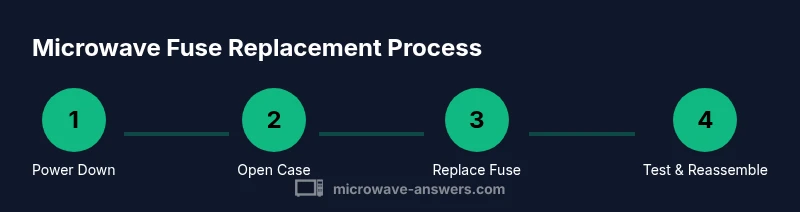
Microwave fuses replacement starts with unplugging the unit, locating the fuse or thermal cutoff, and verifying the exact rating from the label. If you’re comfortable, replace with an identical part and test with care. If you’re unsure, consult Microwave Answers or a qualified technician. Safety first—never bypass protective components.
What is a microwave fuse and why replacement matters
A microwave fuse is a protective component that interrupts current if a fault occurs inside the oven, preventing more dangerous problems such as arcing or capacitor damage. Most ovens use a small device known as a fuse or a thermal cutoff (TCO) placed in the power circuit. When the fuse blows, the microwave will stop heating or refuse to start. Replacement is sometimes straightforward, but it must use a part with the exact rating and type specified by the manufacturer. The Microwave Answers approach emphasizes using the correct part and following model-specific guidance rather than improvising. If the fuse keeps blowing, the issue may lie in the high-voltage circuit or a failing capacitor, which often requires professional service. Always verify the model’s fuse type in the user manual or a label inside the cabinet before attempting any work. If you are not confident, seek a professional opinion to avoid dangerous situations.
Safety considerations before attempting microwave fuses replacement
Safety is non-negotiable when dealing with microwave electronics. Before you begin, unplug the unit and allow any stored energy to dissipate. Do not rely on the door switch or a default on-off behavior as a safety guarantee. Keep the workspace dry and clean, wear insulated gloves if available, and use insulated tools. Many microwaves house high-voltage components that can retain a dangerous charge even after unplugging. If you feel uncertain at any point, stop and consult Microwave Answers or a qualified technician. Never bypass protective components or reassemble without verifying the integrity of safety devices.
Types of fuses used in microwaves and how to identify them
Most microwaves use either a thermal fuse/thermal cutoff (a one-time fuse) or a replaceable fuse linked to the control board. A thermal fuse is designed to blow when the oven overheats and is commonly non-resettable. A standard replaceable fuse may look like a small glass or ceramic component on the circuit board. Do not confuse these parts with a diode or resistor. The exact type and rating should be confirmed from the model’s manual or rating label. If you cannot locate the fuse type quickly, do not guess—using the wrong fuse can create a dangerous situation. Identifying the correct part is essential for a safe repair and long-term reliability, and Microwave Answers emphasizes matching the part to your specific model.
Preparing for replacement: tools, parts, and verifying model compatibility
Preparation reduces risk and improves success rates. Gather tools and confirm part compatibility before touching any wiring. Start by locating the exact model number and consulting the manual to determine whether your unit uses a thermal fuse or a traditional fuse link. Buy a replacement that matches the fuse type and the model’s rating from an authorized supplier. Keep a detailed notes trail of wiring connections and screw placement. Before you remove anything, photograph the interior layout to help reassembly. Use a labeled container for small screws and components. By planning ahead, you minimize the chance of accidental shorts or miswiring.
Replacement risks, testing after replacement, and when to call a professional
Replacing a fuse is not risk-free. If the fuse blows again after replacement, a deeper fault likely exists in the high-voltage circuit, capacitor, diode, or magnetron. Stop further DIY attempts and seek professional service to avoid shock or fire hazards. After installing the new fuse, reassemble the unit carefully and perform a cautious power-on test with no food or liquid inside. If you smell burning, see smoke, or hear buzzing, unplug immediately and consult a professional. Documentation of the model and part number will speed up future maintenance and ensure safety compliance.
Tools & Materials
- Screwdriver set (Phillips and flat-head)(Varies by model; have small and medium bits on hand)
- Non-contact voltage tester(Verify power is fully disconnected before touching components)
- Multimeter(Use only on low-voltage circuits and after discharge; do not measure HV portions)
- Replacement fuse (thermal fuse or thermal cutoff) matching the model rating(Check the label or manual to match type and rating exactly)
- Needle-nose pliers(For gently lifting and disconnecting small connectors)
- Owner's manual / model number(Essential to confirm fuse type and replacement procedure)
- Safety gloves(Optional: provides grip and protection while handling parts)
- Soldering iron and solder(Only if the fuse or leads require soldering or rework)
Steps
Estimated time: 90-150 minutes
- 1
Power down and unplug
Unplug the microwave from the wall outlet and wait several minutes for any stored energy to dissipate. Confirm no lamp or display remains powered before touching internal components. This is the essential first safety step.
Tip: If you have any doubt about remaining capacitors, stop and consult a professional. - 2
Open the cabinet safely
Remove the outer cover with the appropriate screwdriver. Keep track of all screws and note where each piece goes for reassembly. Work on a non-conductive surface to avoid accidental shorts.
Tip: Take photos during disassembly to guide reassembly. - 3
Locate the fuse or thermal cutoff
Inspect the interior area near the input power line, transformer, or control board to find the fuse or thermal cutoff. Identify whether it is a thermal fuse or a traditional fuse link and verify its location with the manual.
Tip: Do not force connectors; use gentle wiggling to free wires. - 4
Confirm the correct part
Read the rating label on the old fuse or consult the manual to confirm the exact type and rating. Do not substitute a different rating or part without verification, as this could cause damage or injury.
Tip: If the rating is illegible, do not proceed; source the model’s official spec sheet. - 5
Remove the old fuse
Carefully disconnect the fuse leads or unclip the fuse holder. If the fuse is soldered, use the correct technique to avoid lifting pads or traces. Inspect for any signs of scorching or melted components.
Tip: Avoid prying on PCB traces; damage is costly and dangerous. - 6
Install the new fuse
Install the replacement fuse with identical orientation and secure connections. Ensure any clips or holders are firmly seated and that insulation remains intact.
Tip: Double-check that no bare metal is touching adjacent conductors. - 7
Reassemble and test safely
Reattach the cabinet, plug in the unit, and perform a cautious power-on test with an empty load (a cup of water) to verify heating without producing abnormal noises or smells.
Tip: If anything seems off, power down immediately. - 8
Evaluate and decide on next steps
If the microwave functions after replacement, monitor for a period to ensure continued reliability. If the fuse blows again or you notice any fault symptoms, seek professional repair rather than persisting with DIY fixes.
Tip: Keep a record of the model and part number for future maintenance.
Common Questions
Is it safe to replace a microwave fuse myself?
Replacing a microwave fuse can be safe if you follow strict safety steps and use the correct part. Ensure the unit is unplugged, the high-voltage area is discharged, and you have model-specific instructions. If you feel unsure, seek guidance from Microwave Answers or a qualified technician.
You can replace a fuse if you follow safety steps and use the right part; otherwise, consult a professional.
Will replacing the fuse fix a microwave that won't heat?
A blown fuse might restore power, but it does not guarantee heating will work. Other high-voltage components such as the magnetron or capacitor could be the cause. After replacement, observe performance and consider professional inspection if issues persist.
A new fuse might restore power, but other faults could still prevent heating.
Why would a fuse keep blowing after replacement?
If a fuse blows again, there is likely an underlying fault in the high-voltage circuit, diode, or capacitor, or an overheat condition. Do not continue replacing fuses without diagnosing the root cause. Seek professional assessment to prevent safety hazards.
A recurring fuse blow usually means a deeper electrical fault.
Can I replace a microwave fuse with a generic part?
No. Use only a fuse that matches the model’s specified type and rating. Using an incorrect part can lead to overheating, damage, or fire. Always refer to the user manual or manufacturer guidance for compatibility.
Avoid generic parts; use the exact rated fuse for your model.
Should I discharge the capacitor before opening the microwave?
Yes. Discharging high-voltage capacitors is essential for safety before handling internal components. If you’re not trained to do this, stop and call a professional. Mishandling can result in severe shock.
Discharging HV components is critical; if unsure, hire a pro.
What is the difference between a fuse and a thermal cutoff in a microwave?
A fuse is a protective component that may be replaceable or resettable depending on type. A thermal cutoff is typically non-resettable and designed to permanently cut power if overheating occurs. They serve safety roles but are not interchangeable without checking manufacturer specifications.
Fuses and thermal cutoffs serve safety roles, but aren’t interchangeable without model-specific guidance.
Watch Video
Main Points
- Identify fuse type and rating before replacement
- Unplug and discharge safely, never work live
- Replace with exact part or professional service if unsure
- Persistent fuse failure signals a deeper electrical fault
- Document parts and steps for future DIY or service