Why Won't My Microwave Heat Up? Practical Troubleshooting
Diagnose why your microwave won't heat up with a practical, safety-first troubleshooting guide from Microwave Answers. Learn quick checks, a diagnostic flow, step-by-step fixes, and prevention tips to keep your kitchen humming.


If you're wondering why won't my microwave heat up, start with the basics: confirm it’s plugged in and the door interlock engages when closed, then test with a simple container. If power and door checks pass but no heat remains, inspect for a blown fuse or a failing magnetron. If you’re unsure, seek professional help. This quick-start path helps you decide safely whether you can fix it at home.
How microwaves heat up and where the failure happens
A modern microwave creates heat by exciting water molecules in the food with energy from a magnetron. This energy is directed into the cooking chamber, and a rotating turntable or waveguide helps distribute it evenly. When the unit won’t heat, you’re usually looking at power delivery, door interlock signaling, or high-voltage components. If you're wondering why won't my microwave heat up, start by confirming the basics: is the unit plugged in, is the outlet working, and does the door interlock engage when you close the door? From there, you can move into a safe, systematic diagnostic path. A few simple checks often reveal a problem that you can fix without professional help, or at least point clearly to a replacement or service need.
Keep in mind this topic carries safety risks when you pry into electrical parts, so proceed with caution and prioritize safety over speed.
Immediate checks you can perform safely
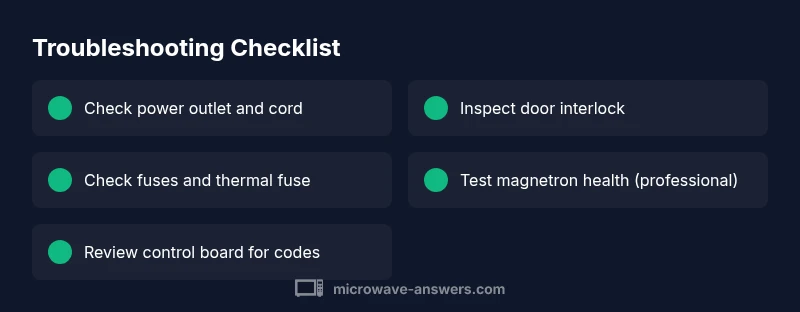
Before you panic about a fried magnetron, perform a few grounded checks. Unplug the unit, then verify the outlet by plugging in a different device. Check the power cord for nicks or damage, and inspect the plug prongs for looseness. Open and close the door a few times to ensure the latch and interlock engage properly. If the door interlock doesn’t engage or you hear no click when shut, the microwave may not heat due to a safety circuit fault. If you're wondering why won't my microwave heat up and you notice the light flicker or the display resets, those are red flags pointing toward power or control issues. Always test with a simple, non-metal container and listen for the characteristic hum as you power the unit—silence or unusual sounds can indicate a fault in the high-voltage system.
Steps
Estimated time: 45-60 minutes
- 1
Power check and safety prep
Unplug the microwave and inspect the power cord for visible damage. If the outlet or circuit shows signs of overload, unplug and reset, then test in a known-good outlet. This first step confirms whether the issue is electrical rather than related to heating components.
Tip: Always unplug before inspecting electrical parts to avoid shock. - 2
Inspect the door interlock and latch
Close the door firmly and listen for the interlock click. If the latch feels loose, doesn’t engage, or you hear no click, the interlock could be faulty. A faulty interlock can allow the unit to run without heating.
Tip: Do not bypass or bypass the interlock—it’s a critical safety feature. - 3
Check fuses and thermal fuse
If accessible, locate the fuse assemblies and inspect for burns or breaks in the conductor. A blown fuse will interrupt the high-voltage circuit, preventing heating. Replace only with the exact part specified for your model.
Tip: Use the model number to find the correct fuse type and rating. - 4
Assess magnetron health (safely)
The magnetron is the heart of heating. Visual signs like damage or unusual smells indicate failure; testing requires proper equipment and expertise. If you suspect magnetron issues, consider professional service rather than DIY testing.
Tip: High-voltage components are dangerous; avoid probing inside the magnetron area. - 5
Evaluate the control board and electronics
Look for unresponsive keypad inputs or error codes. A software reset or power-cycle can sometimes clear glitches. If codes persist, a professional diagnosis may be needed.
Tip: Document any error codes to speed up service. - 6
Make the repair vs. replace decision
If repair costs approach the price of a new unit or the microwave is old, replacement may be more economical. Gather a quote, compare with a new model, and consider energy efficiency and warranty.
Tip: Ask about warranty options or service plans.
Diagnosis: Microwave runs but foods do not heat or heat very slowly
Possible Causes
- highPower issue (outlet, cord, or breaker)
- highDoor interlock failure or misalignment
- highBlown fuse or thermal fuse
- mediumMagnetron failure or degraded components
- lowControl board fault or sensor issue
Fixes
- easyTest a known-good outlet and ensure the microwave is properly plugged in; reset the breaker if needed.
- easyInspect the door interlock for wear or damage and reseat or replace if necessary.
- mediumCheck and replace high-voltage fuses or thermal fuses per safety guidelines (or have a technician do it).
- hardAssess magnetron continuity with appropriate tools; replacement is typically hard and best left to pros.
- mediumIf the control board shows faults, seek professional diagnosis and possible module replacement.
Common Questions
Why won't my microwave heat up even when the display lights are on?
Display activity doesn’t guarantee heating. The issue is often a door interlock, fuse, or magnetron problem. Run through the power, interlock, and fuse checks first.
If the lights are on but there's no heat, the problem is typically in the interlock or high-voltage components.
Can a faulty door interlock cause heating to stop?
Yes. The interlock signals the microwave to begin heating. A worn or misaligned interlock can prevent heating even when the door appears closed.
Absolutely—a bad door interlock can stop heating even if the door looks shut.
Is it safe to open the microwave to check electronics?
No. High-voltage components can stay charged even when unplugged. Always unplug and avoid touching internal parts beyond the outer cover.
No—openings expose dangerous parts; unplug first and call a pro if needed.
What should I do first if the microwave won't heat?
Unplug, check the outlet, verify the door interlock, and inspect any visible fuses. If the issue persists, contact a technician.
First unplug and check power and the door interlock.
Can magnetron repair be done at home?
Magnetron repair or replacement involves high voltage and specialized tools. It's best handled by a trained technician.
Magnetron work is risky; hire a professional.
How long should I expect a microwave to last before replacement is wiser?
If repair costs are close to or exceed a new unit’s price, replacement is often more economical. Consider age and usage.
If repair costs stack up, think about replacing.
Watch Video
Main Points
- Start with power and door checks.
- Most non-heating issues stem from the interlock or fuses.
- Do not attempt high-voltage repairs yourself.
- Follow the diagnostic flow to decide repair vs. replacement.
- Call a professional if you’re unsure or unsafe.