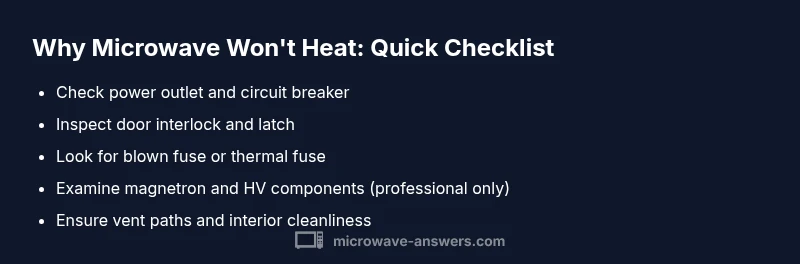
Why Your Microwave Won't Heat: A Practical Troubleshooting Guide
Facing a microwave that won't heat? This urgent, step-by-step troubleshooting guide helps home cooks diagnose power, safety, and internal component issues, with practical fixes and clear safety guidance. Learn what to check first, how to test components, and when to call a pro in 2026.


If your microwave won't heat, the most likely causes are a blown fuse, a faulty door interlock, or a failing magnetron. Start by checking the power supply, door latch, and fuses, then test with a separate outlet. If the issue persists, avoid using the unit and seek professional repair to prevent safety risks.
Common Symptom: No Heat Output
When your microwave refuses to heat, observe the symptom closely. If you hear ticking, see only the clock, or notice the light but no heat, you may be facing a power issue or a safety interlock fault. The phrase why microwave wont heat often points to a failure in the high-voltage circuit, door interlock, or magnetron. Start with the simplest checks: verify the outlet, test with another device, and ensure the door is closing correctly. If a burning smell or visible damage appears, stop immediately and unplug the unit. In many cases, basic checks reveal the culprit without professional service, especially in 2026 when newer models emphasize built-in safety interlocks and clearer fault indicators.
Quick Safety Checks You Can Do
Before you dive into components, prioritize safety. Unplug the microwave before opening any panels. Remove metal utensils, foil, and metal-trimmed containers that can cause arcing. Inspect the door seal for damage and ensure the latch closes cleanly. If you notice loud buzzing, unusual smells, or smoke, do not run the appliance; power it down and call a technician. Use a dedicated circuit for the device if possible, and avoid overloading outlets. These quick checks solve many cases of why microwave wont heat by ruling out simple causes and reducing risk to you and your home.
Electrical and Internal Components That Fail
When simple checks fail, the obstruction may lie within the microwaves electrical system. The magnetron converts electrical energy into microwave radiation; a fault here means no heat even if the timer advances. The high-voltage transformer, control board, and diodes also play critical roles. Even when a unit produces light or sound, heat generation can be disrupted by an aging transformer or a failing diode. Because these components carry dangerous voltages, diagnosing them requires careful insulation and proper test equipment. If the unit is older or diagnostics point toward the HV circuit, expect professional service.
How to Test the Magnetron and High-Voltage Circuit
Testing high-voltage components involves specialized tools and knowledge. If you are trained, disconnect power and use a multimeter to check continuity across the transformer, diode, and magnetron as per service manuals. Look for signs of arcing, cracked insulation, or burnt smells. Any abnormal readings, cracks, or overheating indicate failure. Do not attempt to power the unit with damaged cables or exposed HV parts. When in doubt, call a trained technician to perform comprehensive testing and replacement of HV parts. Safety should remain your top priority.
Door Interlock and Latch Issues
A faulty door interlock is a common reason for a microwave that wont heat. If the door latch doesnt engage correctly, the microwave may think the door is open and refuse to energize the magnetron. Check the door switch, hinge alignment, and wiring for corrosion or loose connections. Clean the latch area, reseat connectors, and ensure no debris prevents full closure. If the interlock feels loose or clicks weakly, replacement is often necessary to restore proper operation.
Thermal Fuse and Overheat Protection
Modern microwaves include thermal fuses and overheat protection to prevent fires. If the unit overheats, these safety devices can permanently interrupt heat output. Signs include a sudden halt in heating with no error message or a smell of burnt plastic. Replacing a blown thermal fuse requires disassembly and precise parts; it is not a DIY fix for most homeowners. A professional can verify cooling fans, vent paths, and interior insulation and replace the fuse if needed.
When to Replace vs Repair: Cost and Safety Considerations
If the microwave is older, or if multiple components fail (magnetron, control board, HV circuit), replacement may be more economical and safer than repair. Compare the estimated repair cost against a new unit that meets current energy and safety standards. Remember that a failed magnetron or HV components presents ongoing risk if not serviced by a professional. In 2026, many homes benefit from updated models with better energy efficiency and enhanced safety features.
Final Precautions and Prevention Tips
To prevent future heating issues, keep vents clear, clean the interior regularly, and avoid running empty microwaves. Use appropriate cookware, avoid metal, and never reuse damaged containers. If you notice inconsistent heating, uneven browning, or unusual noises, schedule a professional inspection promptly. Regular maintenance and mindful usage extend microwave life and safety.
Steps
Estimated time: 25-45 minutes
- 1
Check power source and outlet
Unplug the microwave and plug a lamp or other device into the same outlet to verify it has power. Check the circuit breaker and ensure the outlet is dedicated to a single kitchen appliance. If the outlet is controlled by a wall switch, verify it is on.
Tip: Use a dedicated circuit if possible to avoid voltage drops that mimic a bad component. - 2
Inspect door latch and interlock
Open and close the door firmly, listening for the latch catch. Check for visible damage on the door seal and ensure the interlock wiring is secure and clean. A misaligned latch can falsely indicate a closed door to the control board.
Tip: Dirt or food debris can prevent proper door closure; clean around the latch with a dry cloth. - 3
Remove external panels safely
If you have model-specific instructions, remove the outer panel to access the HV components and fuses. Disconnect power before touching any internal parts. Do not touch high-voltage parts with bare hands.
Tip: Never bypass safety features to test components; this can cause shock or fire. - 4
Check for visible damage or burn marks
Look for melted insulation, scorch marks, or a burnt smell near the magnetron, transformer, or control board. Such signs indicate component failure and safety risk.
Tip: Do not operate the unit if you observe damage; contact a professional immediately. - 5
Assess fuse and thermal protections
If you locate a fuse, check for continuity with a multimeter. A blown fuse or a tripped thermal fuse will stop heat output. Any replacement must use the exact rating specified by the manufacturer.
Tip: Only replace with the same part number and rating to maintain safety. - 6
Decide on repair vs replacement
Calculate whether repair costs approach or exceed the price of a new unit, considering safety and efficiency standards. If the device is old or multiple failures occur, replacement is often the safer choice.
Tip: Prioritize safety over minor cost savings; a newer model may save energy and reduce risk.
Diagnosis: Microwave won't heat
Possible Causes
- highPower supply or outlet issue
- highFaulty door interlock switch
- lowFailed magnetron
- lowBlown thermal fuse or overheat protection
- lowControl board failure
Fixes
- easyTest outlet with a lamp or another small appliance; reset or replace a tripped circuit breaker or GFCI outlet if needed.
- easyInspect door latch and interlock connections; reseat or replace faulty wiring and clean contacts.
- hardIf electrical tests indicate magnetron or HV circuit issues, schedule professional diagnosis and replacement as needed.
- mediumReplace a blown thermal fuse only with proper precautions; contact a pro for safe disassembly and component replacement.
Common Questions
Why wont my microwave heat even though the light and sound work?
That behavior usually points to a magnetron or high-voltage circuit fault. The unit may have power but not generate microwaves. A faulty door interlock or control board can also prevent heating while other indicators function.
Most likely a magnetron or HV circuit issue; consider a professional diagnostic if basic checks don’t help.
Can a simple power outlet cause this problem?
Yes. A weak outlet, a tripped breaker, or a shared circuit with heavy appliances can prevent the microwave from heating. Test with a different outlet on a dedicated circuit.
Yes—try a different outlet on a separate circuit to rule out power supply issues.
Is it safe to keep using a microwave that wont heat?
No. Stop using it and unplug immediately if there is any burning smell, smoke, or damage. Have it inspected by a professional before reuse to avoid fire or shock hazards.
No, unplug it now and seek a professional check before using again.
How do I test the door interlock safely?
Door interlock testing should be done by a professional because it involves high voltage and safety interlocks. Basic checks include ensuring the door closes fully and latches securely.
Testing door interlocks should be left to a pro due to safety risks.
Should I attempt DIY repairs on a microwave?
Only if you are trained in appliance repair. High-voltage components can cause serious injury or death if mishandled; professional service is recommended for magnetron or HV circuit work.
DIY is not recommended for high-voltage parts; call a pro for those repairs.
Why does food heat unevenly or sometimes not at all?
That usually comes from non-uniform magnetron emission, turntable issues, or load placement. Use microwave-safe containers and rotate food for more even heating.
Uneven heating is common and often fixed by turning or rearranging food.
Watch Video
Main Points
- Verify power and door safety first
- Avoid DIY on HV components; call a pro
- Safety features are there to protect you
- Replacement can be safer and more cost-effective than repair
- Regular maintenance extends microwave life