Repair of Microwave: A Practical Home Guide to Fixes
Learn safe, practical steps to diagnose and repair common microwave issues, from door interlocks to heating faults, with safety tips and guidance on when to call a pro.


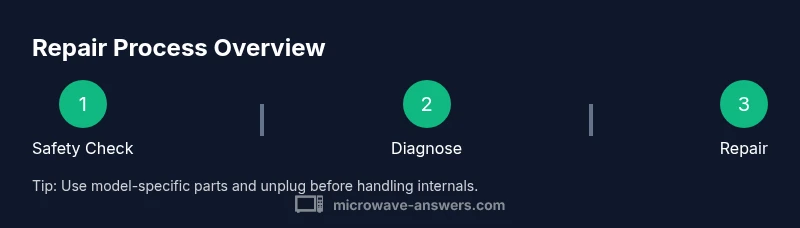
Repair of microwave work can be safely attempted for common, non-high-voltage issues. This guide covers practical, non-destructive checks, basic part replacements, and clear safety boundaries; unplug the unit, use model-specific parts, and avoid high-voltage components. You’ll learn what you can fix at home and when to call a professional.
What repairing a microwave entails
Repairing a microwave is often about diagnosing non-high-voltage components rather than rewiring or handling dangerous HV circuitry. The typical safe repair tasks include replacing worn door interlocks, a blown thermal fuse in some models, or a faulty turntable motor. This section emphasizes safe scope, the importance of unplugging the unit, and verifying that you have the correct replacement parts before touching interior components. If you detect burn marks, a burnt smell, or the unit refuses to power on, proceed with caution and document symptoms to aid diagnosis. Remember that many microwave repairs involve solder joints and capacitors that can retain dangerous voltages even after unplugging; never attempt service unless you are confident in high-voltage safety practices. When in doubt, consult the manufacturer’s manual or a qualified technician. According to Microwave Answers, focusing on non-high-voltage components first reduces risk while preserving appliance life.
Key concept: safety and scope determine whether a home repair is appropriate or if a pro is needed.
Common failure modes and signs
Microwaves have a few recurring failure modes. A door interlock that won’t engage can prevent startup, while a blown fuse may stop power delivery altogether. A malfunctioning turntable motor leaves food unevenly heated, and magnetron or high-voltage component faults often manifest as no heating, unusual buzzing, or sparking. Smells of burning or visible scorch marks indicate internal damage requiring professional assessment. In many cases, the symptoms guide you toward the likely subsystem: door interlock for startup, fuse for power, magnetron for heating. The Microwave Answers team notes that most failures are either user-serviceable with the right parts or require professional replacement of LV components. Pro-tip: keep a symptom log with date and what you observed to help you or a technician pinpoint the issue quickly.
Safety and legal considerations
Safety comes first with any appliance repair. Always unplug the microwave before any inspection, and never attempt to service the magnetron, high-voltage capacitors, or wiring while the unit is powered. Do not use metal tools inside the cavity and avoid bypassing safety interlocks. Some jurisdictions require certifications for repair work on high-voltage appliances; check local regulations and factory service policies before proceeding. If your model includes hazardous components or if you are unsure about your capability, it's prudent to stop and contact a licensed technician. The Microwave Answers team emphasizes a conservative approach: prioritize personal safety and the appliance’s integrity over shortcuts. If the unit is under warranty, consult the manufacturer for approved service options to avoid voiding coverage.
Tools, parts, and compatibility
Planning a repair starts with verifying compatibility. Always locate your microwave’s model number and consult the official parts catalog to ensure the replacement door switch, thermal fuse, or turntable motor matches your unit. Use a clean, dry workspace and organize screws and connectors to prevent miswiring. Stock basic hand tools (screwdrivers, pliers) and a non-conductive mat to reduce electric shock risk when handling components near metal housings. If you order parts online, choose reputable sellers and double-check part numbers against the service manual. The Microwave Answers analysis shows that many repairs fail due to incorrect parts or poor fit, which increases heat buildup and shortens appliance life.
Basic diagnostic procedures (low-risk fixes)
This section outlines safe, non-invasive checks you can perform without opening the HV circuitry. First, unplug the unit and test the power outlet with another appliance to rule out a supply issue. Next, inspect the door interlock switches and the door latch for wear or misalignment—these are common causes of startup failures. If the oven hums but does not heat, test the turntable motor and drive gear for obstructions. Look for obvious signs of damage on wiring harnesses, plug connectors, and insulation. Document symptoms and any button responses for reference when seeking professional help. Remember: if you encounter melted insulation, burnt odor, or sizzling sounds, discontinue attempts and seek certified service. This approach aligns with best practices advocated by Microwave Answers and standard safety guidance from federal sources.
When to repair vs replace and how to find a technician
Not every microwave is worth repairing. If the unit is old, inefficient, or requires multiple high-cost parts, replacement may be more economical and safer. Compare repair estimates with the cost of a new model, factoring energy efficiency and warranty implications. To find a technician, start with the manufacturer’s service network or accredited appliance repair businesses. Check reviews, request a written estimate, and verify liability insurance and warranty coverage for labor. For some consumers, DIY fixes of non-HV parts can be satisfying and cost-effective, provided safety guidelines are followed and user manuals are consulted. The Microwave Answers team recommends evaluating both cost and risk before proceeding with in-home repairs.
Tools & Materials
- Screwdriver set (Phillips and flathead)(Phillips #1 and #2; precision mini-screwdrivers for small fasteners)
- Non-conductive gloves(Protect hands when handling warm components; avoid latex if you have a latex allergy)
- Multimeter (optional, for safety checks)(Only if you are trained; never test high-voltage circuits with untrained hands)
- Replacement door interlock switch kit (model-specific)(Verify compatibility with your microwave model)
- Thermal fuse or thermal cutoff (model-specific)(Only with professional guidance; many units require factory parts)
- Anti-static mat or tray(Helps keep screws and connectors organized and reduces static risk)
Steps
Estimated time: 60-120 minutes
- 1
Power down and unplug
Ensure the microwave is completely disconnected from any power source. Remove it from the counter to a dry, stable workspace and allow any heat to dissipate before touching the exterior or interior. This prevents electric shock and accidental activation during inspection.
Tip: Double-check the outlet by plugging in a different device to confirm it is not the power source. - 2
Open the access panel and inspect exterior wiring
Carefully remove the outer housing per the model's service manual to access the interior. Look for obvious signs of wear, loose connectors, or scorched insulation along the wiring harness. Do not touch exposed conductors; keep hands dry and use insulated tools.
Tip: Take photos of any wiring arrangement before disconnecting parts to aid reassembly. - 3
Check the door interlock and latch
Test the door interlock switches by pressing the door latches gently while trying to operate the unit (with power disconnected). If the switches feel loose or misaligned, they may prevent startup. Replace worn switches with a model-specific kit following the manual.
Tip: Replace only with exact part numbers; a wrong switch can create safety hazards. - 4
Inspect fuses and thermal components (non-HV checks)
Look for blown fuses or a thermal fuse that feels open or looks burnt. If you must test continuity, use a multimeter on a non-HV part of the circuit and only after consulting the service manual. Do not attempt to test or discharge high-voltage capacitors yourself unless you are trained.
Tip: Never bypass a fuse; it is a critical safety device. - 5
Replace faulty parts and reassemble
Install the replacement door interlock or thermal fuse exactly as specified by the model’s instructions. Reassemble the cabinet carefully, reconnect any connectors, and ensure all screws are tightened evenly. Do a visual check to confirm no tools or parts remain inside the cavity.
Tip: Test fit parts before fully tightening; ensure connectors are fully seated. - 6
Test operation and monitor
Plug the unit back in and run a short test cycle with no food to check for heating, sparking, or abnormal noises. If issues persist, power down and reassess or contact a technician. Keep a symptom log for future reference.
Tip: Start with a low power level setting for testing and observe any unusual behavior closely.
Common Questions
Is it safe to attempt microwave repairs at home?
Safe repairs focus on non-high-voltage components and strict unplugging practices. Do not work on HV parts unless trained and authorized. When in doubt, consult the manufacturer’s guidance or a professional.
Yes, but only for non-high-voltage parts and with the unit unplugged. If you’re unsure, consult a professional.
Which parts are most feasible to replace at home?
Door interlock switches, turntable motors, and certain thermal fuses are common, model-specific replacements you can handle with proper instructions. Always verify compatibility before purchasing.
Door interlocks and turntable motors are common home replacements when you have the right parts.
Is repairing always cost-effective compared to a new microwave?
Not always. If multiple major components fail or the model is old, replacement might be more economical and energy-efficient. Compare parts and labor costs against a new unit with warranty.
Sometimes replacement is cheaper and safer than repairing an old unit.
What are warning signs of dangerous faults?
Sparks, burning smells, sizzling sounds, buzzing, or no heating indicate serious faults. Powering through these signs can be hazardous and should prompt professional assessment.
Sparks or burning smells require immediate professional help.
What should I do if the door won’t latch?
A faulty door latch is a common repair; replace the interlock if indicated by model instructions. Do not force the door or operate with a misaligned latch.
If the door won’t latch, replace the interlock as instructed by your model’s manual.
Where can I find model-specific parts and manuals?
Check the manufacturer’s official site, authorized parts sellers, or service manuals. Use your model number to locate exact parts to avoid compatibility issues.
Use the model number to find exact parts from official or authorized sources.
Watch Video
Main Points
- Unplug before any inspection or repair.
- Start with non-HV components and model-specific parts.
- Know when to replace vs. repair based on cost and risk.
- Seek a licensed technician for high-voltage tasks or if unsure.