GE Microwave Repair: A Practical DIY Guide
A practical, safety-focused guide to diagnosing and repairing common GE microwave issues, with step-by-step instructions, tool lists, and tips for when to call a pro.


You’ll learn how to safely diagnose and fix common GE microwave problems—from non-heating to door faults. Start by unplugging the unit, confirming the model, and gathering basic tools. You’ll learn which fixes are safe to attempt and when professional service is warranted. Follow the step-by-step approach and use protective gear.
Understanding GE microwave repair: scope and limitations
GE microwave repair focuses on diagnosing common heating, timing, and door interlock issues in GE models. It emphasizes practical, at-home troubleshooting that stays within safe boundaries. This guide helps you distinguish between simple fixes you can perform with basic tools and more complex problems that require professional service. Always consult your GE model’s manual for wiring diagrams and warranty constraints. If you’re repairing a unit in a rental or under warranty, be aware that unauthorized service may affect coverage. According to Microwave Answers, approaching GE microwave repair with a clear plan and respect for safety dramatically reduces risk and increases the likelihood of a successful outcome.
Safety essentials before you begin
Before you touch any internal components, unplug the microwave and disconnect it from power. If your model has a plug with a grounded cord, avoid using an extension or power strip. Wait at least one minute after unplugging to allow residual energy in capacitors to dissipate. Wear non-conductive gloves and eye protection when handling exposed parts, and use insulated tools. Never attempt repairs with the door open or while the cavity is energized, as high-voltage components can retain dangerous charges. Keep liquid away from electronics and work on a dry, stable surface.
Common failure modes in GE microwaves
GE microwaves fail for several reasons. Non-heating could be caused by a faulty magnetron, a blown high-voltage diode, or a bad high-voltage capacitor. Door interlock switches may wear out, causing the oven to stop in mid-cycle or fail to start. The turntable motor or drive belt can wear, resulting in poor rotation or uneven cooking. Visible signs such as sparking, burning odor, or humming noises point to wiring or component faults. Regular cleaning of vents and the waveguide cover helps prevent overheating and arcing. If you notice any of these symptoms, use methodical testing rather than guessing, and document what you observe.
Tools and diagnostic techniques
A basic toolbox is enough for many GE microwave diagnoses. You’ll want insulated gloves, a Phillips and flathead screwdriver, a digital multimeter with continuity and diode test settings, and a non-contact voltage tester. Have a clean, dry work area and a well-lit setup so you can clearly see connectors and labeling. Start with a visual inspection for damaged wires or burnt signs. Use the multimeter to test door interlock switches in-circuit, check continuity on fuses, and verify that the high-voltage diode conducts in one direction. When testing, do not place your hands near energized components and avoid touching metal tools to capacitors. If you’re unsure about a reading, recheck with a known-good part or consult the service manual.
Non-structural fixes you can try safely
Many GE microwave issues come from simple causes. First, ensure the door latches are clean and the strike aligns properly; a misaligned door can prevent operation. Clean the waveguide cover and interior surfaces with isopropyl alcohol to remove splatter that can cause arcing. Check the turntable roller and shaft for debris that blocks rotation. If the unit hums but doesn’t heat, test the door interlock circuit and verify resistance values against the model’s specification. Replace inexpensive items like fuses or door switches if measurements indicate a fault, following the manufacturer’s guidelines. Keep in mind that some components are not user-serviceable and require professional replacement.
Handling parts: magnets, diodes, and capacitors—what to know
When you replace parts, use GE-approved or OEM equivalents to ensure compatibility. The magnetron is a high-value, high-voltage component; avoid touching it with metal tools and follow proper discharge procedures. Diodes and high-voltage capacitors can fail in ways that produce heat or sparking; test diodes in one direction and verify capacitor voltage with the correct range. Do not attempt to rebuild a magnetron or reseal waveguides unless you have formal training. Label connectors and take photos before disconnecting anything so you can reverse steps accurately. Store removed parts in a safe, organized container to avoid confusion during reassembly.
When to call a professional and what to expect
If you identify a defective magnetron, high-voltage capacitor, or a suspicious harness, it’s safer to involve a technician. A pro can verify insulation integrity, confirm neutrals, and perform high-voltage testing with the right tools. Gather your model number, purchase date, and observed symptoms to speed service. Request an estimate that includes parts, labor, and disposal of hazardous waste. Discuss warranty implications and whether replacement units might be more economical than repair. For safety and peace of mind, professional service is the recommended route for complex faults.
Preventive maintenance to extend lifespan
Regular cleaning, prompt addressing of any burning odors, and careful handling of cookware can reduce wear. Use microwave-safe dishes and avoid metal trim or foil. Periodically inspect the door seal and hinges for signs of wear; a compromised seal can lead to heat loss and inefficiency. Keep vents clear and dust-free, and schedule a light, non-invasive service check once a year if the unit is heavily used. Proper ventilation and cool, dry storage support long-term reliability.
Safety, warranty, and legal considerations
Opening a microwave can void warranties; always check the manual and warranty policy before starting. If your unit is under GE warranty, contact the manufacturer or an authorized service provider. For independent repairs, document all steps and maintain receipts for parts; keep a record of tests and voltages observed. In many jurisdictions, mishandling high-voltage equipment can create safety and legal risks; ensure you comply with local codes and disposal rules for old parts. If there is any doubt about your ability to perform the repair safely, stop and call a professional.
Authority and references
For safety guidelines and appliance maintenance, see official sources on microwave safety and energy efficiency. Useful references include:
- https://www.fda.gov/food-safety/safe-food-handling/microwave-ovens-safety
- https://www.energy.gov/eere/buildings/articles/how-microwave-ovens-work
- https://www.osha.gov/microwave-safety
These resources offer general safety principles and best practices you can apply when performing GE microwave repair or basic upkeep.
Tools & Materials
- Insulated glove set(Protect hands from heat and shock when handling live components)
- Phillips and flathead screwdrivers (magnetic)(Varied sizes for appliance fasteners)
- Multimeter (DC/AC, with continuity mode)(For testing diodes, switches, and wiring)
- Non-contact voltage tester(Quickly verify absence of mains voltage before touching internals)
- Nut drivers and pliers(Helpful for removing housing and connecting tabs)
- Heat-resistant silicone or ceramic tape(For insulating exposed components)
- Soft microfiber cloth and isopropyl alcohol(Clean contacts and wipe residue)
- Replacement parts (specific to your GE model)(Door switch, diode, magnetron, fuses as needed; verify compatibility)
- Model-specific service manual or GE repair sheets(Always consult for correct procedures)
Steps
Estimated time: Total time: 45-90 minutes
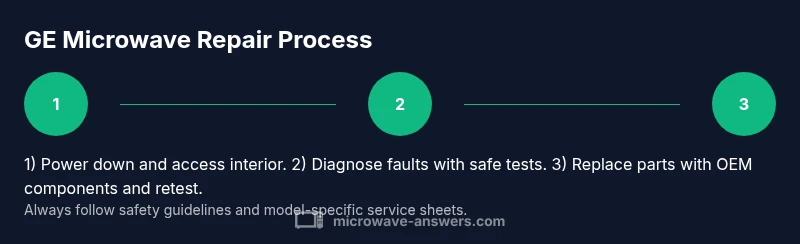
- 1
Power down and access interior
Unplug the unit and move it to a dry workbench. Remove the outer cover only after confirming no power is present, and document connector locations with photos. This minimizes mistakes during reassembly and protects you from live voltage.
Tip: Take a photo of each connector before disconnecting anything. - 2
Test for voltage and inspect obvious faults
Use a non-contact tester to verify no current flow. Do a visual inspection for burnt smells, melted insulation, or loose wires. This step helps identify obvious safety hazards before further testing.
Tip: Work slowly and re-check each area to avoid missing a simple issue. - 3
Test door switch with a multimeter
With power still disconnected, remove the door interlock switch and test continuity. A bad switch will show no continuity in the closed position. Replace if readings are out of spec.
Tip: Compare readings to the model’s service manual values. - 4
Check high-voltage path components
Discharge the HV capacitor safely, then test the diode in one direction and inspect the capacitor for bulging or leakage. Look for obvious signs of wear on wiring harnesses.
Tip: Never touch the capacitor plates with bare hands. - 5
Replace a faulty part with OEM parts
If a component tests out of spec, install a GE-approved replacement and re-test each connection. Reassemble only after all tests pass.
Tip: Verify the replacement is compatible with your exact GE model. - 6
Test operation and finalize
Reconnect power and run a short heating cycle with no food to confirm normal operation. Listen for unusual sounds and watch for sparks or smoke during the test.
Tip: If anything abnormal occurs, power down immediately and reassess.
Common Questions
What is the most common GE microwave problem for DIY repair?
Heating problems are frequent, often caused by a faulty magnetron, diode, or capacitor. Door interlocks and wiring faults also appear. Start with a safe diagnostic approach rather than an assumption.
Heating problems are common and usually involve the magnetron or related high-voltage parts; door interlocks and wiring faults can also cause issues.
Is it safe to repair a GE microwave at home?
Basic maintenance can be safe when unplugged and proper precautions are followed. Do not attempt high-voltage repairs unless you have training and the right equipment.
It can be safe for simple tasks if you unplug and follow safety steps; avoid high-voltage work unless trained.
Which parts are typically replaced in GE microwaves?
Door switches, diodes, fuses, and occasionally the magnetron are common replacements. Always verify compatibility with your model before purchasing parts.
Door switches and diodes are common replacement parts; magnets are rarer and usually handled by pros.
What should I do if the microwave emits sparks?
Power off immediately, unplug, and inspect the waveguide cover and interior for damage or residue. Do not operate until issues are resolved.
If sparks occur, unplug and inspect; don’t run it again until you fix the problem.
When should I replace rather than repair?
If the unit is old, or multiple costly components fail, replacement might be more economical than ongoing repairs. Compare repair cost versus a new unit’s price.
If repairs cost more than a new unit or the unit is aging, replacement is worth considering.
How can I prevent future GE microwave failures?
Regular cleaning, using microwave-safe dishes, and addressing minor issues early can extend life. Avoid metal or foil in the cavity and keep vents clear.
Keep it clean, use safe dishes, and fix minor issues early to prevent bigger problems.
Watch Video
Main Points
- Unplug before starting any repair work.
- Use OEM parts to ensure compatibility and safety.
- Consult model-specific manuals for procedures.
- Know when to call a professional for high-voltage faults.
- Document steps and retain receipts for parts.