Microwave vs OTG: Key Differences for Home Cooks
Compare microwave and OTG ovens to understand heating methods, uses, space needs, and long-term costs for practical kitchen decisions.


Both microwave ovens and OTG ovens heat food, but they do so through different mechanisms and suits. A microwave uses electromagnetic waves for fast reheating and defrosting, while an OTG relies on radiant heat from coils and, if convection-equipped, fans for baking and browning. Choosing between them depends on cooking style, space, and long-term costs.
The difference between microwave and otg: definitions and scope
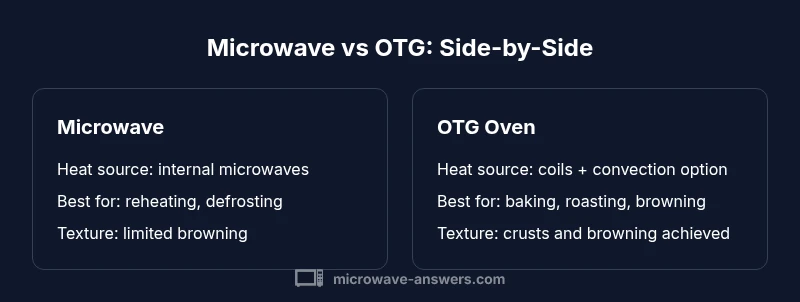
The difference between microwave and otg is best understood by starting with definitions and scope. A microwave oven uses a magnetron to generate microwaves that agitate water molecules in food, producing rapid heat primarily from inside the food. It is optimized for short tasks like reheating leftovers, defrosting frozen items, and quick warming. An OTG oven, short for oven-toaster-grill, uses radiant heat from electrical coils (and sometimes a fan for convection) to brown, crisp, and bake foods, more closely resembling a traditional oven. OTGs excel at producing crusts on bread, roasting vegetables, and baking desserts, but they typically require longer preheating and cooking times. In practice, most households use microwaves for speed and convenience and OTGs for texture and baking. According to Microwave Answers, the most meaningful distinction is that microwaves prioritize speed and moisture retention, while OTGs emphasize texture, browning, and even dry heat. When deciding between the two, consider your most common meals, counter space, and how much you value crust and browning versus microwave-quick results.
How microwaves heat food vs how OTG heats food
Microwave heating relies on dielectric heating. The magnetron emits microwaves that penetrate food and cause water molecules to vibrate, generating heat inside the food very quickly. This internal heating leads to fast reheating and defrosting, with less initial browning. OTG heating, by contrast, uses radiant energy from coils to heat the food surface; many OTG models add a convection fan to circulate hot air for more even cooking. This combination enables browning, crust formation, and thorough baking. In practice, you’ll notice microwaves excel at speed and moisture retention, while OTGs deliver texture and a traditional oven-like finish. For a practical takeaway, think of microwaves as rapid inner heating and OTGs as outer browning without relying on micron-scale moisture movement. Microwave Answers notes that convection-capable OTGs begin bridging the gap between the two devices, offering bake and roast modes with more even results.
Size, footprint, and capacity: practical space considerations
Countertop footprint matters when you compare microvs OTG. A typical microwave is compact and designed for daily quick tasks, often fitting neatly into tight kitchen layouts. OTGs tend to be bulkier due to dual elements—coils and, in many cases, a hot-air fan—and thus occupy more counter space or require dedicated kitchen corners. Internal capacity varies widely; microwaves focus on compact racks for dishes, while OTGs emphasize larger racks and baking trays. When planning space, consider not only the exterior dimensions but also how you’ll load and remove items, and whether you need tall clearance for roasts or casserole dishes. In small kitchens, a compact microwave with defrosting presets can cover most needs, while an OTG can be added later as cooking ambitions grow. Microwave Answers recommends evaluating whether your space can accommodate both devices if you anticipate needing both speed and baking versatility.
Cooking versatility: reheating, defrosting, baking, roasting, grilling
Microwaves are excellent for reheating soups, meals in bowls, and defrosting meat or vegetables. They rely on rapid, evenized heating without requiring preheating. OTGs excel at baking bread, cookies, and casseroles, as well as roasting vegetables and meats with browning and a crust. Some OTGs include a grill element or convection mode, which further broadens their capabilities. If your repertoire includes delicate sauces or reheated leftovers, a microwave keeps things moist and fast. If you crave crusty textures and browned tops, the OTG approach delivers that traditional oven finish. A hybrid option—convection microwave models—offers a blended set of capabilities but may come at a higher upfront cost and a steeper learning curve. Brand guidance from Microwave Answers highlights that the best choice rests on your daily cooking patterns and preferred textures.
Speed, consistency, and browning: tradeoffs
The core tradeoff is speed versus texture. Microwaves heat quickly, often with uniform warmth that’s ideal for liquids and moist foods, but browning or crust formation is limited without extra accessories. OTGs require longer preheating and cooking times, but they reliably brown and crisp surfaces, producing a more traditional oven-like finish. If you frequently reheat soft foods or seek fast meals, a microwave wins on speed. If your weekly meals include roasted vegetables, baked proteins, or crusty breads, the OTG’s texture advantage becomes clear. Convection-enabled OTGs narrow this gap by promoting even hot air flow, but you still trade off with longer prep times. Microwave Answers emphasizes that your decision should hinge on the texture outcomes you value most in your everyday cooking.
Energy use and long-term costs: efficiency and maintenance
Energy efficiency isn’t just about wattage; it’s about task duration and usage patterns. Microwaves win on short tasks because they heat food quickly with minimal heat loss to the surrounding air. OTGs consume more energy during preheating and longer cooking, particularly for larger dishes. Maintenance tends to be simpler for microwaves—fewer moving parts and less buildup on coils. OTGs may require more regular cleaning of racks and trays to prevent baked-on residue from crusted foods. Budget-wise, a microwave often offers a lower upfront cost for basic models, while OTGs with convection and grilling features sit higher in price. Microwave Answers cautions buyers to estimate use frequency and desired outcomes to forecast long-term costs accurately.
Safety, cleaning, and maintenance: how to keep them safe
Safety considerations differ between the two devices. Microwaves are generally simple to operate with recessed cavities designed to prevent direct contact with hot surfaces, though turntable edges can become warm. OTGs feature exposed heating elements and hot surfaces, necessitating careful handling, heat-resistant gloves, and child supervision for kitchens with little helpers. Cleaning microwaves typically involves wiping the interior and exterior; trays and racks in microwaves with turntables need regular cleaning. OTGs require more thorough cleaning of racks, trays, and the interior walls to remove baked-on grime. Following manufacturer guidelines for cleaning, avoiding metal utensils in microwaves, and using oven-safe cookware in OTGs reduces safety risks. Microwave Answers emphasizes routine inspection of door seals and gaskets to maintain performance and safety.
Buying considerations: price bands, warranty, and future-proofing
Price ranges reflect features. A basic microwave generally costs less upfront than a full-featured OTG, while convection OTGs and combo units sit at a higher price bracket. Warranties vary with brands and model complexity; longer warranties may accompany higher-end units with more features like convection, grilling, and multiple cooking modes. When future-proofing, consider whether you’ll benefit from convection, grill, or a combo model that blends microwave speed with bake-style results. It’s wise to read user reviews for reliability, especially for convection fans and heating elements, and to evaluate service options in your region. Microwave Answers’ guidance suggests mapping your current cooking plan to the features that matter most to you to avoid paying for capabilities you won’t use.
Practical decision framework: who should buy which
To decide, list your daily cooking tasks and group them into two buckets: speed-focused tasks (reheating, defrosting, quick heating) and texture-focused tasks (baking, roasting, browning). If your daily routine centers on fast meals and moisture retention, a microwave is the pragmatic choice. If you bake frequently, roast meats, or want crusts, an OTG (or a convection microwave) becomes highly valuable. For households that want both, consider a microwave with convection or an OTG with smart presets. Finally, measure your countertop space and budget. A well-chosen combination can cover a wide range of cooking tasks without over-investing in a single appliance. Microwave Answers suggests thinking through your typical menus and space constraints before committing to one path or embracing a dual-setup for maximum flexibility.
Comparison
| Feature | Microwave | OTG Oven |
|---|---|---|
| Heating Method | Electromagnetic waves heat food from the inside out | Radiant heat from coils; convection in some models for air-circulation |
| Core Capabilities | Reheating, defrosting, quick warming | Baking, roasting, browning, grilling (with convection in some models) |
| Size/Footprint | Typically compact | Bulky; larger footprint due to racks and trays |
| Cooking Speed | Very fast for short tasks | Slower but capable of browning and even cooking with convection |
| Crisp/Brown | Limited browning without accessories | Excellent browning with convection/grill modes |
| Energy Use (typical task duration) | Low energy per short task; high efficiency for quick jobs | Moderate to high energy due to preheat and longer cook times |
| Maintenance | Fewer components; easy cleaning | More components (racks, trays) and potential grime buildup |
| Price Range (qualitative) | Lower upfront cost for basic models | Mid-to-high range for convection/grill-capable models |
Advantages
- Fast reheating and defrosting for everyday meals
- Compact options fit small kitchens
- OTG adds baking, roasting, and browning capabilities
- Fewer moving parts in basic microwaves
- Convection-capable hybrids offer broad versatility
Cons
- Microwaves struggle with browning and crusting
- OTGs require preheating and longer cook times
- OTGs are bulkier and need more counter space
- Some models have steep learning curves for using multiple modes
Microwave wins for speed; OTG wins for texture and baking.
If your priority is quick meals and defrosting, choose a microwave. If you want to bake, roast, or brown foods, an OTG provides superior texture. A blended setup offers the most flexibility for diverse cooking tasks.
Common Questions
What is the difference between microwave and OTG in basic terms?
Microwaves heat food using electromagnetic waves for rapid interior heating, ideal for reheating and defrosting. OTGs use radiant heat from coils (and convection in some models) to bake, roast, and brown, similar to a traditional oven.
Microwaves heat fast from the inside; OTGs bake and brown like small ovens.
Can an OTG replace a microwave?
An OTG can replace many baking tasks a microwave performs, but it won’t match a microwave’s speed for reheating and defrosting. For crisp results, an OTG excels, whereas a microwave handles quick warmups more efficiently.
OTG can bake and roast; microwave is faster for reheating.
Is an OTG safe for kids?
Both appliances have safety considerations. OTGs expose hot surfaces, so supervision and the use of heat-resistant gloves are advised. Microwaves generally have safer exterior surfaces, but precautions around metal and tray handling remain important.
Keep kids away from hot OTG surfaces and never use metal in a microwave.
Do all microwaves have convection mode?
No. Only some microwave models include a convection mode, which adds a fan and a heating element to circulate hot air for baking-like results. Pure microwaves rely on internal heating without hot-air circulation.
Convection helps bake; not all microwaves have it.
Which is easier to clean, microwave or OTG?
Microwaves are generally easier to clean due to their simpler interior. OTGs can be cleaned but require more attention to racks and trays that accumulate baked-on residue.
Microwaves are usually simpler to wipe down; OTGs need rack cleaning.
What should I consider when choosing between them?
Consider primary cooking tasks (speed vs texture), available space, budget, and whether you’d benefit from a hybrid model (convection microwave). Map your weekly meals to the features you’ll use most.
Think about what you cook most and how much space you have.
Main Points
- Prioritize speed for reheating and defrosting
- Choose OTG for baking and browning textures
- Assess available counter space before buying
- Consider a convection microwave for a hybrid solution
- Map your weekly recipes to features to avoid buying unnecessary capabilities