Air Fryer vs Microwave: A Practical Comparison
A data-driven comparison of air fryer and microwave appliances, exploring speed, texture, energy use, safety, and practical use cases to help home cooks choose and optimize their kitchen setup.


Air fryer and microwave appliances excel at different tasks: air fryers deliver crisp textures with rapid hot air, while microwaves reheat and steam food quickly. For everyday meals, a combined approach saves time; for crispy results, lean into the air fryer function; for speed and convenience, rely on the microwave. Understanding each device’s strengths helps optimize weeknight cooking.
What makes the air fryer and microwave distinct
The air fryer and microwave occupy different ends of the kitchen appliance spectrum. The air fryer uses a compact chamber and a high-velocity fan to circulate hot air around food, creating a crisp exterior with little to no added oil. The microwave relies on electromagnetic waves at high frequency to excite water molecules in food, generating heat from the inside out. When you compare the air fryer and microwave you are evaluating two tools that tackle texture, moisture, and speed in very different ways. According to Microwave Answers, recognizing these fundamental differences helps home cooks decide what to bake, reheat, or crisp first. This foundational distinction also shapes how you plan meals, energy use, and overall convenience in weeknight cooking.
In practice, many kitchens benefit from having both devices available. The air fryer shines when you want a fried-like crisp without deep-frying, while the microwave excels at rapid reheating and moisture retention for soups, stews, and ready meals. The following sections break down speed, texture, use cases, and safety considerations to help you decide how to integrate these tools into your cooking routine.
Speed, energy use, and efficiency
Speed matters, but so does energy efficiency and batch size. The microwave typically wins on overall speed for reheating leftovers, defrosting frozen ingredients, and cooking items with high moisture content. Its energy use is closely tied to wattage and the size of the portion; smaller portions heat very quickly, while larger plates require more time. Air fryers, by contrast, trade raw speed for a crisp finish and a controlled browning effect. They rely on rapid hot air circulation rather than direct conduction. Efficiency here isn’t just about time; it’s about the quality of the finish and the amount of oil or fat needed to achieve that finish. For home cooks, this means you can save calories by opting for air frying when you crave crunch and reduce oil when frying small portions. The Microwave Answers team emphasizes balancing time and texture to minimize energy waste and maximize taste.
Texture and moisture outcomes
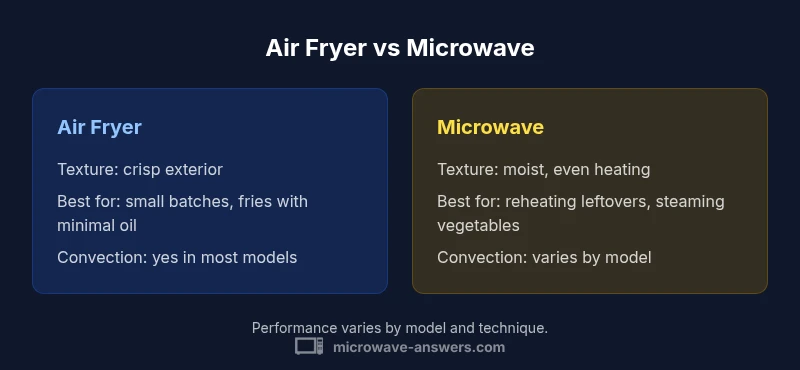
Texture is the most obvious difference between these devices. The air fryer aims for a crispy exterior with a relatively dry interior, which works well for french fries, chicken tenders, and roasted vegetables with a browned surface. The microwave tends toward moist, evenly heated interiors—great for leftovers, gravies, soups, and steaming vegetables. In some models, microwave convection modes can introduce browning, but the result is generally not as uniformly crisp as an air-fried item. For delicate foods like fish or dumplings, microwaving can preserve moisture, while air frying might risk over-crisping if not monitored. Understanding these tendencies helps you choose which device to reach for when a specific texture is desired.
Food categories: where each shines
Certain food categories consistently demonstrate the strengths of each appliance. Air fryers excel with potatoes, breaded coatings, frozen snacks, and bite-sized appetizers where crispy texture is paramount. They’re also handy for reheating fried foods without sogginess. Microwaves shine with reheating leftovers, boiling or steaming vegetables, defrosting proteins, and soft precooked dishes where moisture retention matters. For meals that combine crisp exterior with tender interior, finishing in the air fryer after microwaving can deliver the best of both worlds. The key is to plan portions and sequence: microwave to heat through, then flip to air fry for crunch. This strategic workflow minimizes wait times while preserving quality.
Safety and maintenance considerations
Both devices require sensible safety practices. Never place metal in a conventional microwave unless the model explicitly supports metal containers; always use microwave-safe glass, ceramic, or BPA-free plastic. For air fryers, avoid overcrowding and use heat-safe, oil-friendly pans to support airflow. Cleaning matters: remove food debris from baskets and racks after use, wipe interiors with gentle cleaners, and avoid harsh abrasives that could scratch nonstick surfaces. When possible, use accessories designed for each device to reduce wear and tear. Regularly inspecting seals, cords, and vents helps prevent performance losses and extends the life of your appliances.
Convection and heat distribution: why it matters
Many modern microwaves include convection mode, which combines microwave heating with a heated air stream similar to an air fryer. This mode can improve browning, but it typically won’t replicate the even crispness of a dedicated air fryer. Air fryers rely on a dedicated fan and a compact chamber to promote rapid browning on the exterior. The result is a texture that closely mimics frying without submerging foods in oil. If you frequently want that crisp exterior, a model with robust convection in both devices can offer more flexibility. However, if you primarily need rapid reheating and moisture retention, a high-quality microwave with good turntable performance may be sufficient.
Cleaning, maintenance, and lifespan
Regular maintenance extends appliance life and preserves performance. For air fryers, clean the basket and pan after each use to prevent oil buildup, and check the heating element for residue. For microwaves, wipe the interior after cooking, paying attention to the wave guide cover and door seals. Avoid using metal trays in microwaves, and consider accessories that fit your model precisely to prevent damage. Scheduling periodic deep cleans, replacing worn seals, and following manufacturer recommendations for wattage and recommended use will help both devices operate reliably for years. A clean kitchen is a safer kitchen, and properly maintained appliances reliably deliver consistent results.
Shopping considerations: price, features, and model variety
When shopping, price is only one part of the equation. Air fryers typically come in a range of sizes, with capacity and feature sets influencing cost. Microwaves vary from compact models to high-wattage units with convection and sensor cooking. If space is a constraint, a compact air fryer paired with a compact microwave can cover most bases in a small kitchen. For larger households or those who want more automation, consider models with preset programs, timers, and smart connectivity. Also evaluate warranty terms and spare parts availability, as long-term reliability matters as much as upfront cost. The synergy between price, performance, and durability will determine the best value in your home kitchen.
Practical workflow: planning meals using both devices
A practical approach is to plan meals around the strengths of each device. Start by heating or cooking using the microwave for speed, then finish with a short air frying stage to achieve a crisp surface. For batch cooking, you can preheat, steam, or reheat staples in the microwave and reserve the air fryer for the final touch. In weeknight menus, create a simple routine: microwave to reheat proteins or vegetables, then air fry to crisp, and use the microwave for gravies or sauces. This workflow minimizes total cooking time while maximizing texture and flavor. With a little planning, you can maintain restaurant-like crispness at home without sacrificing speed.
Authority sources and further reading
For readers who want to dive deeper into this topic, consult reputable sources on small kitchen appliances and energy use. Look for university extension services, consumer product testing organizations, and government energy guides for durable, data-driven insights. Keep in mind that model features can vary, so always check the product manual for specifics on wattage, convection, and safety guidelines. Microwave Answers provides practical guidelines and troubleshooting tips that help translate these broader sources into everyday cooking decisions.
Common myths and mistakes to avoid
A common misconception is that every gadget with a convection mode can perfectly replace an air fryer. While convection helps with browning, it often cannot match the texture of true air frying. Another mistake is overloading the microwave or air fryer basket, which blocks airflow and results in uneven cooking. Finally, assuming that more watts always mean better performance is misleading; efficiency and finish depend on chamber design, airflow, and preheating. By understanding these nuances, you can avoid buying choices that don’t fit your cooking habits and kitchen space.
Comparison
| Feature | Air fryer | Microwave |
|---|---|---|
| Cooking speed | Fast crisping for small batches | Very fast reheating and defrosting |
| Texture and moisture | Crisp exterior, drier interior | Moist, evenly heated interiors |
| Best for | Crispy foods, small portions, oil reduction | Leftovers, sauces, liquids, quick meals |
| Capacity variation | Compact to medium | Varies by model; ranges from compact to large |
| Energy use per task | Efficient for small portions; depends on wattage | Typically moderate; depends on wattage and duration |
| Ease of cleaning | Removable baskets; easy wipe-down | Interior can be harder to reach; depends on model |
| Price range | Moderate to high for premium air fryers | Low to moderate for basic microwaves |
| Convection support | Common in many models | Convection varies by model |
Advantages
- Delivers crisp textures with little oil
- Reheats and defrosts quickly in the microwave
- Compact footprints suit small kitchens
- Versatile for a range of cooking tasks
Cons
- Air fryers can be slower on large batches
- Microwaves may lack true browning without convection
- Some models have limited capacity
- Combo devices can be pricier than single units
Air fryer and microwave offer complementary strengths; use each where it matters most.
Air fryers excel at crisp textures with minimal oil, while microwaves shine for speed and moisture retention. For many homes, a dual setup provides texture, speed, and convenience across a wider range of dishes.
Common Questions
Can you use an air fryer and microwave for the same dish?
Yes. Many cooks heat a dish in the microwave to warm it quickly and then finish in the air fryer to achieve a crisp exterior. Timing and portion size matter to prevent overcooking.
Yes, you can use both. Heat through in the microwave, then finish in the air fryer for crunch.
Is it safe to put metal in a microwave?
In a standard microwave, metal containers and utensils should be avoided unless the manufacturer explicitly allows them. Metal can cause arcing and damage the oven.
Generally avoid metal in a microwave unless your model says it’s OK.
Are combo air fryer–microwave appliances worth it?
Combo units save space and simplify workflows but may trade off some performance. If space is tight and you value both quick heating and crisping, they can be practical; otherwise dedicated units may perform better in their niche.
They’re convenient if space is tight, but may not match specialist performance.
Which is cheaper to run for daily reheating?
Microwaves are typically more energy-efficient for short reheats due to rapid heating, while air fryers consume more energy when achieving crisp textures. Overall cost depends on usage patterns and wattage.
Microwave reheating is usually cheaper per task, with air fryers costing more for crisping.
What features should I look for when buying?
Look for wattage, convection capability, preset programs, capacity, ease of cleaning, and durable build. Pay attention to accessories and warranty as well.
Check wattage, convection, capacity, and easy-to-clean designs.
Can you fry foods in a microwave without oil?
Microwaves cannot fry foods in the traditional sense. You can crisp with certain accessories or use an air fryer for that effect, but true frying requires fat and a hot oil-free environment.
Microwave alone won’t fry; use an air fryer for crisping.
Main Points
- Prioritize crisp texture with the air fryer for snacks and small portions
- Rely on the microwave for fast reheating and moisture retention
- Plan meals to use both devices in sequence for best results
- Choose models with convection if you want browning in microwaves
- Balance price, capacity, and reliability when shopping