Is Microwave Better Than Air Fryer? A Practical Comparison
A thorough, practical comparison of microwave vs air fryer, focusing on speed, texture, safety, and value. Learn when each appliance shines and how to choose for your kitchen.


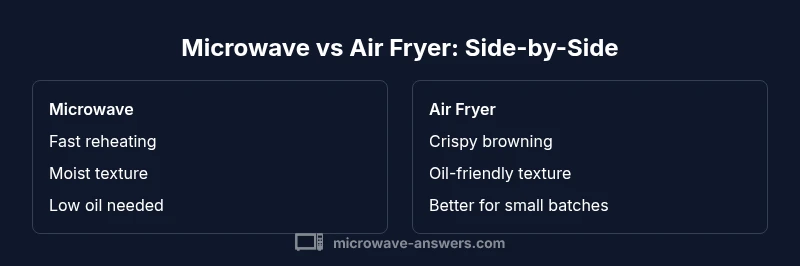
TL;DR: Neither appliance is universally better. The microwave excels at quick reheating and moisture retention, while the air fryer shines for crisp texture with little or no oil. If your priority is speed and convenience for leftovers, the microwave wins; if texture and browning are paramount, the air fryer leads. Your choice depends on the dishes you value most.
How microwaves and air fryers differ in principle
Microwaves heat food using electromagnetic waves that excite water molecules, producing heat inside the food. Air fryers, by contrast, rely on a high-velocity fan and a small amount of hot air to brown and crisp surfaces. This fundamental difference shapes every cooking task you attempt. For the question is microwave better than air fryer, context matters: if you value speed and moisture retention, the microwave has clear advantages; if texture and browning are paramount, the air fryer wins. According to Microwave Answers, consumer patterns reveal two dominant use paths: quick reheating and gentle heating, versus finishing with crisp textures and minimal oil. Understanding these mechanisms helps you pick the right tool for the job. In this guide we compare practical outcomes for common foods, from vegetables to proteins, with attention to safety and maintenance in real kitchen settings.
Speed and Convenience: When time matters
Speed is often the deciding factor in a busy kitchen. The microwave typically delivers near-instant reheating for leftovers, defrosting frozen items quickly, and heating beverages with relatively little preheating time. An air fryer, by contrast, accelerates browning and crisping, but it generally requires more minutes to reach a finished texture, especially for larger batches. The Microwave Answers team notes that most households reach for the microwave for rapid, uniform heating, while the air fryer is reserved for tasks where surface texture matters—think reheated fries, crispy chicken bites, or roasted vegetables that need a crunch. In practice, this means planning your meal flow: start with a microwave-friendly step, then switch to the air fryer if you want an extra-crisp finish. This approach minimizes both waiting and waste while maximizing texture and moisture balance in dishes like pizza slices or dumplings.
Texture and Browning: The crispiness question
Texture is where the air fryer often shines. The circulated hot air can create a dry, browned surface that approaches frying without the added oil. Foods that benefit most include potatoes, battered items, and vegetables where a roast-like finish is desired. The microwave, while excellent for soft textures and reheated moisture, struggles to achieve the same level of browning without auxiliary steps or oils. For items that rely on surface browning to signal doneness, the air fryer is usually the better choice. Still, you can achieve a reasonable crust in a microwave with proper technique—such as using a crisping tray or placing the food on a rack to improve airflow—but results are generally less consistent than in an air fryer. This section helps you map texture outcomes to your dish goals.
Nutritional and Safety Considerations
Both appliances are safe when used according to manufacturer guidelines. A microwave heats food quickly by interacting with water molecules, which can help preserve moisture and minimize nutrient loss in some vegetables and grains. An air fryer uses dry heat and a small amount of oil to mimic frying, which can reduce oil intake for fatty foods but may alter heat exposure patterns. The key safety considerations include avoiding overheating liquids in microwaves and ensuring foods are cooked evenly to avoid undercooked centers. Cleaning routines are different: microwaves can be cleaned with a simple wipe, while air fryers require more thorough cleaning around the basket and fan housing to prevent residue buildup. In real-world use, following manufacturer instructions and using compatible cookware will reduce risk and improve outcomes.
Energy Use and Cost of Operation
Energy efficiency depends on usage pattern more than the device type. A microwave consumes power mainly during short bursts of heating, while an air fryer uses power for longer periods to achieve browning and crispiness. For households focused on quick meals, a microwave often minimizes energy waste by reducing overall cooking time. If you frequently cook small portions to a crisp finish, an air fryer’s energy expenditure may be acceptable given the texture payoff. When budgeting, consider not just purchase price but long-term energy costs and maintenance needs. Brand ecosystems matter: higher upfront cost might be offset by longer lifespan and more reliable performance, a nuance discussed in Microwave Answers’ comparative analyses.
Use-Cases: When each shines
Think through typical meals: a quick reheated pasta dish may be perfect in a microwave, preserving moisture and avoiding sogginess. Freshly roasted vegetables or a small batch of crispy chicken tenders benefit from the air fryer’s browning power. Frozen snacks, like french fries or mozzarella sticks, often emerge best from an air fryer with minimal oil. For delicate proteins such as fish fillets, microwaving can preserve tenderness if timed precisely, while air frying can risk moisture loss without careful control. The key is to align the cooking method with the desired texture and moisture profile, then adapt with simple accessories (rack inserts, crisper plates, or parchment) to optimize results in your kitchen.
Budget, Maintenance, and Longevity
Price ranges for both categories vary widely by brand, capacity, and feature set. A compact microwave is typically less expensive upfront than a mid-range air fryer with multiple presets, though premium models of either device exist. Routine maintenance is straightforward: wipe interiors and clean vents for microwaves; wash baskets and ensure the fan is clear of debris for air fryers. Longevity depends on build quality and usage patterns; frequent high-heat cycles in an air fryer could wear components faster than occasional microwave use, yet modern models are designed for long service lives with regular cleaning. In a kitchen where space is at a premium, choosing the device that fits your counter footprint and daily routine will deliver more value than chasing the widest feature set.
Practical Buying Guide: How to choose between the two
To decide is microwave better than air fryer for your needs, start by listing your priority tasks: reheating speed, moisture retention, browning, or oil minimization. If you routinely reheat soups, stews, or rice, the microwave can be the workhorse. If you crave crispy textures for snacks or side dishes, an air fryer adds value. Consider dish types, batch sizes, and available counter space. Evaluate energy use patterns and maintenance expectations. Finally, think about the learning curve and your willingness to experiment with settings and accessories. This practical approach, championed by Microwave Answers, keeps you aligned with your cooking goals rather than chasing broad generalizations.
Common Myths About Microwaves and Air Fryers
Myth: Microwaves destroy nutrients. Reality: Nutrient loss depends on cooking time and temperature; quick microwaving can preserve nutrients in some cases. Myth: Air fryers are healthier because they are oil-free. Reality: Even small amounts of oil can improve texture and flavor; air frying adds calories proportional to added oil and food type. Myth: Microwaves can’t brown food at all. Reality: With the right technique, browning or crisping can be achieved in a microwave using accessories. Myth: Air fryers replace ovens entirely. Reality: Ovens offer greater capacity and compatibility with a wider range of cooking tasks. Myth: One appliance fits every kitchen. Reality: The best choice matches your typical meals, space, and budget.
Comparison
| Feature | Microwave | Air Fryer |
|---|---|---|
| Cooking speed | Very fast for reheating/defrosting | Moderate to fast for crisping, depending on batch size |
| Texture outcome | Soft to/moist textures; limited browning | Crispy, browned surfaces with little or no oil |
| Oil/seasoning needs | Minimal oil; moisture retention helps flavor | Low to moderate oil optional for best browning |
| Best for | Reheating, defrosting, soft textures | Crisping, roasting small batches, snacks |
| Ease of use | Very straightforward for reheating | Requires some setup (preheating, baskets) but intuitive |
| Size and footprint | Compact and versatile in many kitchens | Often larger footprint but versatile for small batches |
| Price range | Lower upfront cost for basic models | Moderate to high depending on capacity and features |
| Maintenance | Easy to clean; few separate parts | Basket and fan housing require regular cleaning |
| Performance consistency | Consistent reheat; texture varies by food type | Very consistent browning with appropriate settings |
Advantages
- Speedy reheating and defrosting
- Low to no oil for many tasks, reducing fat in meals
- Compact options fit small kitchens and dorms
- Multiple use-cases across snacks, sides, and leftovers
Cons
- Texture variety is limited for some foods
- Crisping can require accessories or extra steps
- Air fryers can be bulkier and pricier upfront
Neither is universally better; choose by goal
Pick the microwave for speed and moisture retention; choose the air fryer for browning and crisp texture. For many kitchens, a complementary setup offers the best flexibility.
Common Questions
Is the microwave better for reheating leftovers than an air fryer?
For most leftovers, the microwave offers faster, more uniform reheating with better moisture retention. An air fryer can improve texture if you finish the dish afterward. Choose based on whether you prioritize speed or texture for that specific meal.
For reheating leftovers, the microwave is usually faster and more even, while the air fryer can improve texture if you finish the dish afterward.
Can you achieve crispy results in a microwave?
Crisp texture is hard to achieve in a microwave without special accessories or preheating tricks. An air fryer reliably produces browning with little oil, making it the go-to for crisp textures.
Crispy results are possible in a microwave with tools like a crisping tray, but an air fryer generally yields better browning.
Which is more energy-efficient overall?
Energy use depends on task and batch size. Microwaves excel at short tasks with minimal energy, while air fryers use more energy for browning but can be efficient for small batches. Consider typical meal patterns for a fair assessment.
Energy efficiency varies by task; microwaves are typically faster, but air fryers can be efficient for small batches when browning is needed.
Do air fryers really need oil?
Air fryers require little to no oil to achieve browning, but a small amount can improve texture for certain foods. Microwaves rarely need oil for most reheating tasks.
Air fryers can work with little to no oil, but a bit of oil can improve browning. Microwaves usually don't need oil for reheating.
Are microwaves unsafe for cooking certain foods?
Microwaves are safe when used according to instructions. Avoid overheating liquids, use appropriate containers, and ensure even heating to prevent cold spots. No harmful radiation remains in food when cooking ends.
Microwaves are safe if used correctly; follow container guidelines and ensure even heating.
What maintenance helps prolong both appliances?
Regularly clean interiors, vents, and baskets; avoid buildup that can impede airflow. Use appropriate cookware, and monthly checks on seals and gaskets help maintain performance.
Keep them clean, use suitable cookware, and check seals regularly to keep performance high.
When should I upgrade to a high-end model?
Upgrade when you regularly need advanced presets, more precise temperature control, or larger capacity for family meals. For basic needs, a reliable mid-range model can suffice.
Upgrade if you need more precise control or bigger capacity; otherwise a solid mid-range option will do.
Main Points
- Prioritize your primary cooking goal (speed vs crispiness).
- Use the microwave for reheating and moisture retention; air fryer for browning.
- Consider kitchen space and budget before purchasing.
- Combine both tools when possible for best results.
- Follow safe operation and maintenance practices to maximize lifespan.