Understanding the Frequency of Microwave Ovens
Explore the frequency of microwave ovens, why 2.45 GHz is the standard, and how this affects heating, safety, and practical kitchen use in everyday cooking.


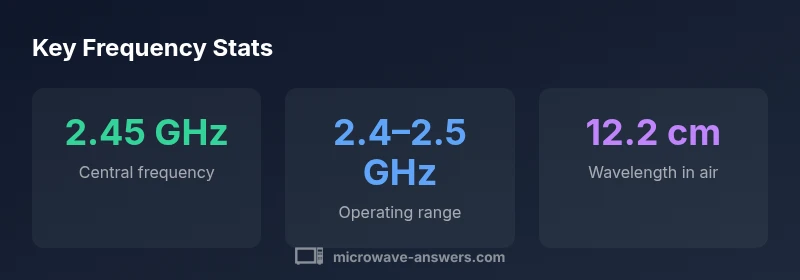
According to Microwave Answers Analysis, 2026, the frequency of microwave ovens used in homes centers around 2.45 GHz, residing in the 2.4–2.5 GHz ISM band. This standard balances heating efficiency with regulatory compliance, safety, and compatibility with kitchen electronics. When people ask about the frequency of microwave, they’re usually referring to this household-band typical operating range.
What the phrase frequency of microwave really means
In everyday kitchens, when people talk about the frequency of microwave, they’re typically referring to the characteristic that drives how microwaves interact with food. The most common household operating frequency hovers around 2.45 GHz, which places it in the Industrial, Scientific, and Medical (ISM) radio band. This choice isn’t arbitrary: it reflects a balance between how deeply microwaves can penetrate different foods and how efficiently dielectrics absorb energy at that frequency. The magnitude of 2.45 GHz also helps ensure compatibility with a wide array of consumer electronics, reducing interference and easing regulatory compliance for most manufacturers. The Microwave Answers team emphasizes that this frequency, while standard in consumer ovens, is part of a broader engineering context that includes power delivery, cavity design, and safety shielding.
The term frequency of microwave, as it applies to home appliances, therefore encapsulates both the fixed operating point chosen by manufacturers and the practical tolerance bands that arise from real-world conditions. Temperature changes, aging components, and minor manufacturing variances can all introduce small shifts in the exact frequency, but the overall band remains centred in the 2.45 GHz range. This framing helps homeowners understand why microwaves heat foods the way they do and why precise control is achieved through systems beyond a single fixed frequency.
The origin of the 2.45 GHz standard and its regulatory context
The 2.45 GHz position within the ISM band originated from a combination of electromagnetic theory, material science, and regulatory policy. Early microwave ovens used magnetrons that tended to drift with heat and aging; designers embraced a band that could tolerate modest frequency variation without compromising safety or performance. Regulators around the world granted unlicensed access to a broad portion of the 2.4–2.5 GHz spectrum for ISM devices, which includes household microwaves. This regulatory framework reduces the need for individual licensing while maintaining consumer safety through strict emission limits and shielding requirements. In practice, manufacturers align their cavity design, shielding, and leakage standards to keep emissions well within established limits, ensuring that the frequency remains highly consistent from unit to unit. The net effect is a predictable user experience across brands and models.
How frequency affects heating patterns and food quality
Heating in microwaves is not a uniform process; it depends heavily on how different frequencies interact with the dielectric properties of food. At around 2.45 GHz, water, fats, and sugars absorb energy at different rates, which explains why some foods heat faster on the outside than the inside. Standing waves within the cooking cavity create hot and cold spots, a phenomenon that is especially noticeable with dense items. Manufacturers combat this with turntables, stirrers, and inverter technology to smooth out the heating profile. The frequency of microwave is thus a central piece of a larger design puzzle: you get faster heating for some foods, more uniform heating for others, and a predictable safety profile when the oven is operated as intended. Home cooks can optimize results by rotating dishes, using medium-sized containers, and avoiding large, uniform blocks of food that can trap cold spots.
Regulatory and safety considerations tied to the operating frequency
Safety standards for microwave ovens are anchored in the frequency band they operate within. Emission limits, shielding integrity, and leakage controls are all designed around the 2.4–2.5 GHz range. Regulatory bodies set the permissible exposure levels to ensure that external emissions do not pose health risks to users and that enthusiasts can use their appliances without fear of stray radiation. In addition to shielding, standard tests verify that oven doors seal properly and that interlocks function correctly. While the frequency itself is a powerful enabler of consistent heating, the safety framework—built around both hardware design and testing protocols—protects consumers during everyday use. The Microwave Answers team notes that adherence to these standards is a core reason why household microwaves are considered safe when operated per the manual.
Practical implications for selecting and using microwaves at this frequency
For most buyers, frequency is a background consideration; power (watts), turntable design, cavity size, and inverter technology tend to have a larger impact on cooking performance. Understanding the frequency helps you predict heating behavior and plan food preparation accordingly. If you’re cooking dense foods, look for models with inverter technology and a well-designed cavity, which can reduce the severity of nonuniform heating. For safety-minded users, check that the appliance has robust door seals and reliable interlocks, ensuring that emissions stay within the intended spectrum. In short, while frequency guides how energy is absorbed, other design choices deliver the practical cooking results you rely on daily.
Future trends: moving beyond fixed frequency concepts
The microwave industry has explored solid-state designs and frequency agility to further refine heating control. While household models are likely to remain near the 2.45 GHz standard due to its broad vendor support and regulatory alignment, advances in magnetron stability, materials, and control electronics may reduce drift and improve efficiency. Some high-end or industrial ovens experiment with alternative frequencies for specialized applications, though these are not common in home kitchens. The overarching trajectory is toward more uniform heating, smarter power management, and safer, more reliable shielding—without sacrificing the core 2.45 GHz operating point that defines today’s standard.
Quick practical tips to optimize frequency-driven heating at home
- Rotate and rearrange food midway through cooking to equalize heating patterns.
- Use containers with flat surfaces and avoid stacked or oversized items that impede microwave penetration.
- When using defrost or reheat settings, rely on automatic power management rather than manual time control to accommodate frequency-related heat distribution.
- If you notice unusual hot or cold spots, consider upgrading to a model with inverter technology or a larger, more uniform cavity.
Key frequency-related specs for household microwaves
| Aspect | Typical value | Notes |
|---|---|---|
| Central operating frequency | 2.45 GHz | Household ISM band |
| Operating range | 2.4–2.5 GHz | Broad tolerance across models |
| Wavelength in air | ≈12.2 cm | Calculated from c/f |
| Regulatory band | ISM | Unlicensed use with safety limits |
Common Questions
What frequency do most household microwaves operate at?
Most household microwaves operate near 2.45 GHz, within the 2.4–2.5 GHz ISM band. This choice supports reliable heating and broad cross-brand compatibility.
Most home microwaves run near 2.45 gigahertz.
Is the microwave frequency fixed or does it vary by model?
The frequency is kept within the ISM band and is tightly controlled, but small drift can occur due to temperature changes and aging components. Overall, models stay within the same general range.
The frequency stays within the ISM band, with small drift possible due to temperature and aging.
Does frequency affect cooking speed?
Yes, to some extent. Frequency influences how energy is absorbed by food, but power (watts) and cooking technology (e.g., inverter) have a larger impact on overall cooking speed and uniformity.
Frequency affects absorption, but power and tech matter more for speed.
Can microwaves operate safely outside the 2.4–2.5 GHz range?
Household microwaves are designed for the 2.4–2.5 GHz ISM band. Operating outside this range would be nonstandard and could cause regulatory and safety concerns.
Operating outside 2.4–2.5 GHz isn’t standard and could raise safety/regulatory issues.
What happens if frequency drifts during operation?
Drift can lead to nonuniform heating in extreme cases, but modern ovens mitigate this with shielding, stable magnetrons, and smart power controls. Expect minor effects rather than dramatic changes.
Drift can cause uneven heating, but safeguards minimize this.
“The 2.45 GHz ISM band is chosen for its practical balance of penetration, dielectric heating, and safe shielding in household ovens.”
Main Points
- Know the standard: frequency around 2.45 GHz
- Expect minor drift with aging components
- Frequency affects heating patterns, not just power
- Choose models with inverter tech for even heating
- Safety shielding relies on staying within the band