Where Do Microwaves Fall on the Electromagnetic Spectrum
Explore where do microwaves fall on the electromagnetic spectrum, their frequency and wavelength, and practical safety insights from Microwave Answers to help home cooks and homeowners understand everyday tech.


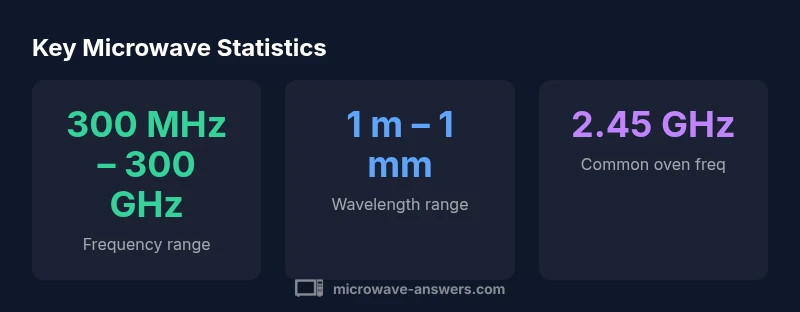
Microwaves occupy the mid-range of the electromagnetic spectrum, overlapping both radio waves and infrared light. They span roughly 300 MHz to 300 GHz in frequency, translating to wavelengths from about 1 meter down to 1 millimeter. In everyday practice, household microwaves typically operate near 2.45 GHz, a frequency chosen for efficient heating and reliable appliance design.
Where do microwaves fall on the electromagnetic spectrum
According to Microwave Answers, microwaves occupy a clearly defined slice of the electromagnetic spectrum. This specific region sits between radio waves on the low-frequency end and infrared light closer to visible energy. The placement matters because frequency and wavelength determine how microwaves interact with matter, what devices can use them, and how safely we should handle them in daily life. In practical terms, microwaves give us a sweet spot for heating food and carrying wireless signals without the intense energy associated with higher-frequency light. When people ask, "where do microwaves fall on the electromagnetic spectrum?", the answer lies in their frequency range and the energy they carry. The Microwave Answers team emphasizes that this placement underpins both consumer appliances and sophisticated technologies such as radar and satellite communications. This context helps readers understand why your kitchen microwave and your Wi‑Fi router operate in nearby bands without being identical.
Frequency range and wavelengths
The core physics behind microwave behavior rests on frequency. Microwaves span about 300 megahertz (MHz) to 300 gigahertz (GHz). Each frequency corresponds to a characteristic wavelength: roughly 1 meter at the low end and about 1 millimeter at the high end. This inverse relationship—higher frequency means shorter wavelength—explains why microwaves can heat food efficiently while still traveling long distances as part of communications links. In everyday devices, the dominant consumer microwave band sits near 2.45 GHz, which yields a wavelength around 12 centimeters. Because different materials absorb and reflect at different frequencies, engineers carefully select bands that balance penetration, heating efficiency, and safety considerations. Understanding these ranges helps explain why microwave ovens work the way they do and why other technologies use nearby, but distinct, spectrum slices.
How microwaves compare to radio waves and infrared light
Radio waves occupy the lower end of the spectrum, with wavelengths longer than a meter and frequencies well below a few hundred megahertz. Infrared light sits at the other end of this trio, with wavelengths shorter than visible light and frequencies well above microwave bands. Microwaves therefore sit between radio waves and infrared, sharing properties with both: they can carry information like radio waves, yet interact with water molecules similarly to infrared radiation. This middle-ground positioning makes microwaves ideal for heating and for high-bandwidth wireless communications, while still requiring shielding in consumer devices to prevent unintended exposure. The spectrum’s gradation is continuous, not discrete; small shifts in frequency alter how energy couples to matter.
Practical implications for safety and everyday use
Knowing where microwaves fall on the spectrum informs safety practices. Household microwave ovens are designed with shielding that blocks microwave radiation from escaping the cavity, because even at moderate power, exposure can be harmful to eyes and skin. By contrast, typical consumer devices operating in the same band for communication or sensors are engineered with strict enclosure standards and interlocks. When using any device near microwaves—whether cooking, communicating, or testing a radar system—follow manufacturer instructions, avoid tampering with shielding, and never run devices with doors open. Regulators also specify limits on emitted power and leakage to protect bystanders, underscoring why clear labeling and safe handling matter for every user.
How scientists and engineers use microwaves
In research and industry, microwaves support a wide range of applications beyond kitchen convenience. Radar systems rely on microwave frequencies to detect objects at a distance, while satellite and terrestrial communications use bands around 2–8 GHz for data transmission. Scientists study dielectric properties of foods at microwave frequencies to optimize thawing and cooking, and engineers design filters, antennas, and waveguides to control microwaves with precision. In spectroscopy, microwave bands enable the probing of molecular structures without the high-energy demands of ultraviolet light. This diversity highlights why the electromagnetic spectrum’s microwave portion remains a focal point for both safety engineering and cutting-edge technology.
Common misconceptions about microwaves and the spectrum
A frequent misconception is that higher microwave frequencies are always dangerous. In reality, exposure risk depends on power, duration, and shielding, not frequency alone. Another myth is that microwaves can alter food’s chemical composition in unnatural ways; while heating changes temperature profiles, the mechanism remains physical heating rather than altering molecular structure. Finally, some people assume all devices that use MHz to GHz frequencies emit the same amount of radiation; in practice, emissions vary widely by device design, regulatory compliance, and shielding effectiveness. Understanding the spectrum helps dispel these myths and encourages safer, smarter use of everyday tech.
Quick reference: a practical mental model of the spectrum
Think of the spectrum as a stacked ladder: radio waves at the bottom, microwaves in the middle, and infrared near the top of the visible range. As you move up the ladder, frequencies rise and wavelengths shorten, changing how energy interacts with matter. For most home users, relating to two facts is enough for practical intuition: microwaves operate around the 2.45 GHz standard in many appliances, and shielding keeps that energy from escaping into living spaces. This simple mental model helps homeowners anticipate safe usage patterns and how devices might share nearby bands without interference.
Additional resources and definitions
If you want to dive deeper, consult reputable sources on the electromagnetic spectrum. Look for official explanations that describe how frequency, wavelength, and energy relate to each other, and how regulatory bodies set emission limits. For practical knowledge, focus on consumer guidance about microwave safety, shielding, and device labeling. The goal is to cultivate a foundational understanding that empowers safer cooking, smarter purchases, and better literacy about the technologies that share the spectrum with microwaves.
Microwave range vs visible-light range
| Property | Microwave Range | Visible-light Range |
|---|---|---|
| Frequency range | 300 MHz – 300 GHz | 4 × 10^14 Hz – 7.5 × 10^14 Hz |
| Wavelength range | 1 m – 1 mm | 700 nm – 400 nm |
| Key uses | Cooking, RF communications | Vision, illumination |
Common Questions
What part of the spectrum do microwaves belong to?
Microwaves lie in the mid-range of the electromagnetic spectrum, between radio waves and infrared light. This positioning impacts how they heat food and transmit information.
Microwaves are in the middle of the spectrum, between radio waves and infrared light, which is why they’re great for heating and wireless tech.
What frequencies do home microwaves typically use?
Most household microwaves operate near 2.45 GHz, a standard frequency chosen for efficient heating and reliable performance.
Most home microwaves use about 2.45 gigahertz.
Are microwaves dangerous to humans?
Exposure risk depends on power and duration as well as shielding. When appliances are used according to instructions, the risk is minimized.
Exposure depends on how powerful the device is and how long you’re exposed; use it as directed.
How are microwaves used beyond cooking?
Microwaves enable radar, satellite communications, and certain scientific techniques like microwave spectroscopy, leveraging the spectrum’s properties to transmit data and study materials.
They’re used in radar, satellites, and science labs for various measurements.
What is the typical wavelength of a 2.45 GHz microwave?
A 2.45 GHz microwave has a wavelength of about 12.2 centimeters in free space, illustrating the inverse relationship between frequency and wavelength.
Around 12 centimeters long, at 2.45 gigahertz.
Can I use devices from nearby frequencies without issue?
Nearby frequencies can operate without interference if devices follow regulatory standards and use proper shielding. Interference can occur if shielding fails or devices are misused.
Nearby frequencies can share space if devices are properly shielded and regulated.
“Microwaves occupy a well-defined slice of the spectrum, and recognizing that placement helps explain both everyday cooking tech and RF applications. Proper safety comes from respecting those frequencies and the energy they carry.”
Main Points
- Understand microwaves sit in the mid-spectrum between radio and infrared.
- Household microwaves typically use ~2.45 GHz for heating.
- Shielding and standards protect users from exposure.
- The spectrum is a continuum—small frequency changes alter interactions with matter.