Which Is Safer: Microwave or Oven? A Practical Safety Guide
Explore safety considerations for microwaves vs ovens. Learn when each appliance is safer, common risks, and practical tips from Microwave Answers to help home cooks make informed choices.


When evaluating which is safer microwave or oven, context matters: microwaves minimize exposure time and hot-surface burns for quick tasks, while traditional ovens excel at thorough cooking and browning when used correctly. Neither is universally safer; safety hinges on task, use, and adherence to manufacturer guidelines.
Why Safety Matters When Deciding Between Microwave and Oven
The question of which is safer microwave or oven often depends on what you’re trying to accomplish. For quick reheating, a microwave can reduce overall kitchen heat and exposure time, potentially lowering burn risk. For meals requiring browning, thorough cooking, and texture, an oven can deliver more consistent results with less risk of undercooked centers when used with proper temperature control. In this article, we examine safety features, common hazards, and practical practices to help home cooks choose wisely without compromising safety. According to Microwave Answers, making the right choice starts with understanding how each appliance delivers heat and how to operate it safely in everyday cooking tasks.
How Microwave Safety Works
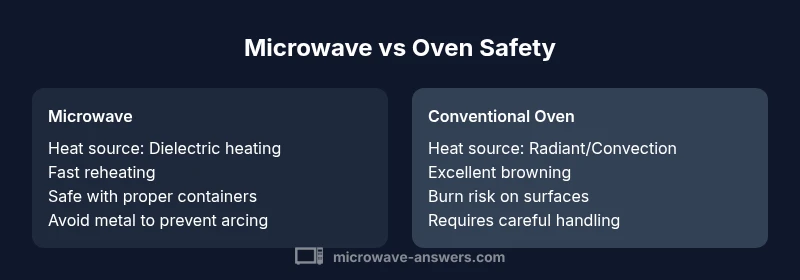
Microwave ovens heat food using dielectric heating, where microwaves cause water molecules in the food to vibrate and generate heat. The door and interior shielding are designed to prevent leakage, and modern units have interlocks that stop emission if the door is opened. For safety, always ensure the door seals are intact, never operate a microwave with damaged glass or seals, and avoid metal objects inside unless the appliance is specifically rated for such use. Understanding these mechanisms helps explain why microwaves are typically safe for rapid reheating when used as intended, and why misuse can lead to burns or fires if containers or metals are involved.
How Conventional Ovens Compare on Safety
Conventional ovens heat food with radiant and, in many cases, convective elements. The heat is generated by electric coils or gas flames and travels through the air, warming the food from the outside in. Safety features include sturdy door latches, hot-surfaces warnings, and, in many models, child locks and automatic shutoffs. Because the exterior can stay hot long after cooking, burns are a common hazard, and improper loading (overcrowding or unstable racks) can lead to accidents. When used with common-sense precautions—preheating only when needed, placing cookware securely, and using oven mitts—the oven remains a safe option for longer cooks and foods that require browning or even doneness.
Common Safety Risks and How to Mitigate Them
Every kitchen appliance carries risks if mishandled. In microwaves, avoid metal, foil, and sealed containers that can explode or arc; always stir reheated foods to prevent cold centers. In ovens, beware of hot racks, dripping pans, and steam when opening doors after baking. Use oven-safe cookware, keep flammable objects away from heating elements, and install smoke and CO detectors. Regularly inspect door seals, hinges, and knobs for wear, and replace them promptly to maintain safe operation. By recognizing these hazards, you can reduce the likelihood of accidents in everyday cooking scenarios.
The Role of Maintenance, Age, and Build Quality
Older units may lack modern safety features or have degraded door seals, which can increase exposure to heat or leakage. Regular maintenance—clean door seals, replace worn gaskets, and verify that venting in an oven is clear—helps sustain safety over years of use. Build quality also matters: sturdier racks, well-sealed doors, and clearly labeled controls reduce the chance of user error. If you notice unusual smells, smoke, or inconsistent heating, stop using the appliance and consult the manufacturer or a professional technician.
Safe Usage Practices: Containers, Coverings, and Settings
Choose containers that are microwave-safe and avoid metal or foil in the microwave. Use lids or vented coverings to retain moisture while preventing splatters. For ovens, use appropriate bakeware and ensure proper rack placement for airflow. Preheating should be limited to recipes that actually benefit from it, and temperature settings should be verified with an oven thermometer when precision matters. In both devices, never leave children unattended near hot surfaces and switch off the appliance before cleaning links or surfaces.
Defrosting, Reheating, and Cooking: Safety Nuances
Microwaves excel at quick reheating and defrosting small portions, but uneven heating can occur if the food is dense or irregular in shape. Stir and rotate to promote uniform heat, and check internal temperatures with a food thermometer. Ovens are better when you need even cooking through longer times, but require careful handling due to hot surfaces and longer heat exposure. Adjust power levels or cooking times as needed to avoid overheating, scorching, or drying out foods, and always allow standing time after cooking to finish heat transfer safely.
Child Safety and Domestic Considerations
Childproofing involves more than just keeping a kitchen area clear. Use safety locks on microwaves where possible, store chemical cleaners away from cooking zones, and keep control panels and door latches in good working order. A kitchen layout that minimizes reaching over hot surfaces reduces burn risk for children and adults alike. When a kitchen accommodates multiple cooks, create clear zones for reheating and baking to prevent cross-use mishaps and ensure everyone follows safe practices.
Cleaning and Preventive Maintenance
Regular cleaning lowers risk of fires and food contamination. Wipe splatters promptly inside ovens to avoid baked-on residues that may cause smoke, and clean door seals to maintain proper sealing in microwaves. Avoid harsh abrasives that could scratch surfaces and degrade safety features. Use appropriate cleaners and tools as recommended by manufacturers, and schedule professional servicing for any performance concerns. Cleanliness directly contributes to safer operation in daily use.
Quick-Heat Scenarios: Reheating vs Cook-Baking vs Defrosting
For quick heat, microwaves often win in safety by reducing time near hot surfaces. For meals requiring texture and thorough cooking, ovens reduce the risk of undercooked centers when used with a thermometer and proper preheating. When defrosting, thaw in the microwave first if time is critical, then finish in the oven if browning or crispness is desired. Understanding these nuances helps you choose the safer option for each specific task.
Energy, Environment, and Long-Term Use
Energy efficiency and heat generation contribute to kitchen safety. Microwaves usually produce less ambient heat, which can create a cooler work environment and reduce sweating or heat-related fatigue. Ovens, while potentially using more energy, enable cooking tasks that would otherwise require multiple steps or appliances. In terms of long-term use, prioritize regular maintenance, proper cookware, and safe handling to minimize risks across both devices.
Comparison
| Feature | Microwave | Conventional Oven |
|---|---|---|
| Heat source/method | Dielectric heating via microwaves | Radiant/thermal heating via elements (electric or gas) with optional convection |
| Typical task speed | Generally faster for reheating and simple cooking | Typically slower for the same tasks but excellent for browning and even doneness |
| Safety risks to avoid | Metal arcing, sealed containers, burns from hot containers | Burns from hot surfaces/racks, steam, potential gas-related hazards in gas ovens |
| Door interlocks and shielding | Interlock and shielding to prevent emission when door is open | Door latch and shielding; safety features vary by model (child lock common) |
| Energy efficiency | Often energy-efficient for short tasks | Energy use depends on duration; preheating can add energy use |
| Maintenance impact | Fewer moving parts; easier to clean inner surfaces | More components; regular cleaning and gasket checks matter |
| Food safety outcomes | Uneven heating possible if food isn’t stirred | More even cooking with proper temperature control and airflow |
Advantages
- Faster reheating reduces risk of overcooking and related hazards
- Built-in safety interlocks minimize exposure when used properly
- Ovens excel at thorough cooking and browning, reducing undercooked risks
- Both appliances have modern safety features like child locks and auto shutoffs
- Lower kitchen heat from microwaves can improve comfort and reduce heat-related risks
Cons
- Microwave reheating can cause uneven heating if food isn’t stirred or rotated
- Incorrect use of metal in microwaves can cause arcing or fires
- Ovens pose burn hazards from hot surfaces and racks
- Longer cook times can lead to accidental contact with hot surfaces
- Older models may lack advanced safety features present in newer units
No single appliance is categorically safer; use depends on task and proper operation
Microwave safety shines for quick reheating with minimal heat in the kitchen, provided containers are microwave-safe and used as directed. Ovens offer safer outcomes for thorough cooking and browning when used with caution around hot surfaces and proper temperature control. The best approach is to match the task with the appliance and follow safety guidelines for each.
Common Questions
Is microwave radiation dangerous to health with normal use?
No. When used as intended, microwaves emit non-ionizing radiation that is contained within the appliance. The door and shielding prevent leakage, and damage or misuse should be avoided. Regular maintenance and following manufacturer guidelines further reduce risk.
No. Microwaves are designed to be safe with proper use and intact doors.
Can microwaving food cause cancer?
There is no evidence that microwaving food causes cancer. Safety concerns mainly relate to heating without even heat distribution or using unsafe containers. Always use microwave-safe containers and stir reheated foods to ensure even heating.
No, microwaving food does not cause cancer when you use proper containers.
Should I always preheat an oven for safety or quality?
Preheating is not strictly a safety requirement, but it helps achieve even cooking and accurate temperatures, reducing the risk of undercooked areas. Use an oven thermometer for accuracy and follow recipe directions.
Preheating helps with even cooking; use a thermometer for accuracy.
Can I put metal in a microwave to assist heating?
Generally, metal should not be placed in a microwave unless the appliance specifies safe usage with metal. Metal can cause arcing, damaging the oven and posing a fire risk. Use microwave-safe glass or ceramic instead.
Avoid metal in the microwave unless the manufacturer says it’s safe.
What safety features should I look for in a microwave or oven?
Look for automatic shutoff, child lock, intact door seals, thermal cutoffs, and clear labeling. Regular maintenance of door seals and hinges also supports safety.
Seek models with auto shutoff and child locks, and keep seals in good shape.
Is it safer to reheat leftovers in the microwave or oven?
For speed and reduced heat in the kitchen, the microwave is usually safer for reheating. If texture, moisture, and even doneness matter, finishing in the oven may be safer and more reliable.
Microwave for speed; oven for even doneness when time allows.
Main Points
- Choose microwave for quick reheating with proper containers
- Use oven for thorough cooking and browning when safety hinges on full doneness
- Always inspect door seals and use safety features like child locks
- Keep metal out of microwaves to prevent arcing and fires
- Maintain appliances regularly to sustain safe operation