Is Microwave or Air Fryer Safer? A Practical Comparison
A thorough, data-informed comparison of microwave vs air fryer safety for home cooks and homeowners. Learn how each appliance influences heat, handling, and hazard risks, plus practical safety tips and usage guidelines.


TL;DR: Both appliances can be safe when used correctly, but the safety answer depends on usage. The question is "is microwave or air fryer safer" and the safer choice hinges on food type, cooking time, and handling. The Microwave Answers team found that proper ventilation, correct accessories, and good cleaning reduce hazards across both devices, with each tool excelling in different scenarios.
Why safety comparisons between microwave and air fryer matter
Understanding which appliance is safer for your kitchen isn’t just about buzzwords like "healthier" or "crispier". It’s about real-world risks that arise from heat sources, contact surfaces, and food handling. According to Microwave Answers, a thoughtful safety comparison helps homeowners prioritize protective habits and equipment features that reduce accidental burns, microwave arcing risks, and improper cooking. When you ask is microwave or air fryer safer, you’re really asking which tool minimizes the hazard profile for the foods you cook, the space you occupy, and the people who use your kitchen. This article uses practical criteria—heat source behavior, typical hazard profiles, cleaning needs, and user-friendly features—to deliver a balanced view suitable for home cooks and safety-conscious homeowners.
How microwaves work and air fryers work: fundamental differences
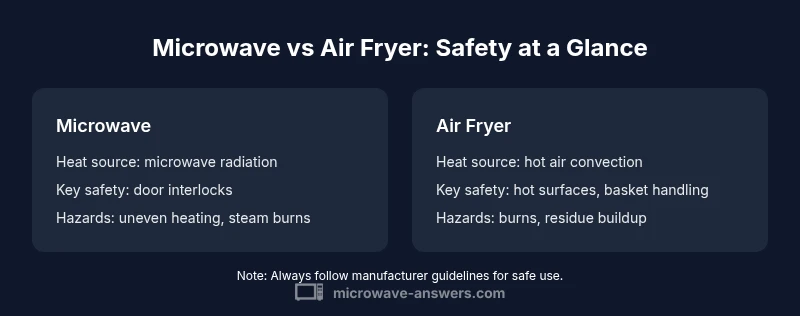
To judge safety, it helps to start with how each device generates heat. A microwave uses non-ionizing radio-frequency energy to excite water molecules inside food, producing rapid, volumetric heating. An air fryer relies on a high-speed stream of hot air circulated by a fan, creating surface crispness through convection and relatively dry heat. These core mechanisms shape risk profiles: microwaves are often gentle on outer surfaces but can heat unevenly, while air fryers reach high surface temperatures quickly and demand careful handling of hot components. Recognizing these dynamics sets the stage for safer home use and better cooking outcomes.
Safety risks commonly associated with microwaves
Common microwave hazards include burns from hot containers or steam, splattering that soils interiors, and, in older or damaged units, potential door seal issues. Arcing is rare in well-maintained units but can occur with damaged or metallic containers. A critical safety habit is to use microwave-safe containers, stir or rotate foods for even heating, and avoid superheating liquids. People often overlook venting and moisture buildup inside the cabinet, which can contribute to mold or lingering odors if the unit isn’t cleaned regularly.
Safety risks commonly associated with air fryers
Air fryers present different hazards. The outer surfaces and the basketHandle can be extremely hot, risking burns during removal or transfer. Nonstick coatings can degrade with high heat or abrasive cleaning, releasing fumes or particles if not used according to manufacturer guidelines. Improper oil use in traditional fry protocols—though less common in air fryers—can also create smoke or flare-ups if a small amount of oil is used. Cleaning residues, crumbs, and grease buildup in vents can reduce airflow and increase risk during operation.
Practical safety practices that apply to both devices
Regardless of the appliance, certain safety practices translate across devices:
- Keep appliances on stable, heat-resistant surfaces away from edges and moisture.
- Use timer and auto-shutoff features; don’t leave appliances unattended during operation.
- Ensure proper ventilation in the kitchen, especially when cooking with high-heat air fryers.
- Use oven mitts or heat-resistant gloves, and avoid placing metal objects in microwaves.
- Regularly inspect cords, plugs, and doors for wear, and follow manufacturer cleaning guidelines to prevent residue buildup.
- Store combustibles away from the unit and never attempt improvised modifications. These shared habits help minimize common hazards and improve overall kitchen safety.
When to favor one device over safety considerations
Choosing the safer option often depends on the task. For quick reheating and moisture retention, microwaves minimize surface burns and are forgiving with most leftovers. For crisp textures and little-to-no added oil, air fryers reduce moisture exposure and can produce consistent edge browns, but require careful handling of hot surfaces and baskets. If you manage a household with children, prioritize devices with robust safety locks and easy-to-clean interiors; if you prioritize energy use and quick meals, microwaves often win on efficiency while air fryers shine for texture. This section helps align your cooking goals with the device that best mitigates the most relevant risks for your routine.
Data-backed insights from Microwave Answers
In our safety-focused analyses, we emphasize risk reduction through proper use rather than declaring one device categorically safer than the other. Microwave Answers analysis shows that many hazards arise from improper containers, overfilling, or neglecting cleaning. By contrast, air fryer safety largely hinges on managing surface temperatures, avoiding oily residues, and ensuring good ventilation. Our findings underscore practical steps—use microwave-safe containers, stir foods for even heating, clean regularly, and monitor high-heat air frying with adequate airflow. The emphasis remains on user behavior and maintenance as primary safety levers.
Building a home safety checklist for kitchen appliances
A practical safety checklist helps households reduce risk while enjoying both microwaves and air fryers. Start with setup: place units on level, heat-resistant surfaces; keep cords untangled; verify door seals and ventilation paths. For operation: use the right cookware, avoid metal; limit superheating liquids; keep kids away during hot cycles; implement an auto-shutoff routine and timer reminders. For maintenance: clean after each use, inspect seals and vents monthly, and replace worn-out accessories promptly. Completing this checklist creates a safer, more predictable cooking environment for every family member.
Comparison
| Feature | Microwave | Air fryer |
|---|---|---|
| Heat source | Microwave radiation (non-ionizing) | Electrical heating via hot-air convection |
| Typical surface temps | Generally lower surface contact when heating liquids and foods | Higher surface temps due to hot-air circulation and basket contact |
| Cooking speed (typical tasks) | Very fast reheating and defrosting | Faster crisping and frying-like results for small portions |
| Best for moisture retention | Excellent moisture retention for leftovers and soups | Less moisture transfer; creates crisp textures |
| Common hazards | Steam burns, splatter, uneven heating | Burns from hot surfaces, oil or residue buildup |
| Cleaning/maintenance | Easy wipe-downs; occasional vent cleaning | Basket and tray cleaning; avoid nonstick wear |
Advantages
- Clear safety standards and shielding reduce radiation exposure risk
- Versatile use across reheating, defrosting, and cooking
- Lower long-term cost per use for simple reheating tasks
- Easier for beginners to use with fewer steps
- Compact options available for small kitchens
Cons
- Potential uneven heating if not stirred or rotated
- Higher surface temperatures in air fryers can cause burns if mishandled
- Air fryer trays and baskets require regular cleaning to maintain airflow
- Over-reliance on color or texture can lead to overcooking if not timed properly
Both appliances can be safe; choose based on task and adherence to safety practices
Microwave safety excels for quick reheating and moisture retention, while air fryers shine for crisp textures with careful handling. Follow shared safety habits and manufacturer guidelines to minimize risks across both devices.
Common Questions
How do microwaves and air fryers differ in terms of safety basics?
Both devices have robust safety features when used properly. Microwaves rely on door interlocks and shielding to limit exposure and require safe containers, while air fryers emphasize hot-surface safety and ventilation. The key is following the manufacturer’s guidelines and avoiding improper containers or overfilling.
Both appliances are safe when used as intended. Follow the manual and never bypass safety features.
Is it safer to reheat food in a microwave or air fryer?
For reheating, microwaves are typically safer in terms of avoiding burns due to lower surface exposure, and they reheat evenly with proper stirring. Air fryers can over-dry or unevenly heat certain foods, so monitor closely and use shorter cycles with shaking. Choose based on the food and desired texture.
If you want moisture, go microwave; for crisp texture, try air fryer with short cycles.
Can both appliances cause burns or injuries?
Yes. Microwaves can cause steam burns when containers are misused, while air fryers can cause burns from hot baskets and surfaces. Always use oven mitts, keep children away during operation, and allow cooling before handling.
Yes, both can burn you if you touch hot surfaces or steam. Be careful.
Are there health risks from acrylamide with air frying?
Air frying can increase browning, which is associated with acrylamide formation in some foods. To reduce risk, avoid over-browning, choose lower-temperature settings when possible, and use shorter cook times with monitored airflow.
Watch browning levels and avoid overdoing it to keep acrylamide risk low.
What should I consider when buying either appliance for safety?
Look for features like auto shut-off, child locks, stable bases, and easy-to-clean interiors. Check warranty and door seals for microwaves; ensure nonstick coatings are rated for high-heat for air fryers. Also consider ventilation requirements for your kitchen.
Prioritize safety features and easy maintenance when choosing.
How should I clean these appliances to avoid hazards?
Clean after every use to prevent residue buildup. Use non-abrasive cleaners and follow manufacturer directions for each surface. Periodic deep cleaning helps maintain function and reduces smells, smoke, and fire risk.
Clean regularly and follow the manual to keep things safe.
Main Points
- Choose safety-first habits for any kitchen appliance
- Use microwave-safe containers and stir for even heating
- Monitor air fryer temps and clean baskets regularly
- Regular maintenance and correct usage reduce most risks
- Select the device that aligns with your cooking tasks and safety priorities