How long to boil water in a microwave: A practical guide
Learn how long to boil water in a microwave with safety tips, practical timing guidelines, and step-by-step methods for quick, safe results.


To boil water in a microwave, aim for gentle, even heating and use a microwave-safe container with a vented cover. Start with 1 to 2 minutes for a cup, then check and continue in 30-second bursts until bubbles form and the water reaches a rolling boil. Always monitor and stir to prevent superheating and ensure safe handling.
Understanding how microwaves heat water
Water heats in a microwave primarily through dielectric heating: microwaves cause water molecules to rotate rapidly, generating heat from within the liquid. This differs from stovetop heating, where heat is transferred from the outside. Because water in a microwave can overheat or heat unevenly, understanding the basics helps you predict boil times more reliably. According to Microwave Answers, the rate at which water heats depends on wattage, container geometry, starting temperature, and the amount of water. Higher wattage delivers more energy per second, which generally reduces the time to reach a boil, but it can also increase the risk of superheating if not monitored. The goal is to bring water to a rolling boil safely without creating dangerous steam bursts. In the sections that follow, we translate these physics into practical timing guidelines you can apply in your kitchen, whether you’re making tea, preparing hot water for instant meals, or reheating leftovers.
Factors that affect boil time
Several factors influence how quickly water reaches a boil in a microwave. Key elements include the microwave's wattage, the volume of water, the shape of the container, the type of container (glass or ceramic vs. plastic), the starting water temperature, and the altitude where you are cooking. Higher wattage, smaller volumes, and wide-mouthed containers generally boil faster. Always use microwave-safe containers and a vented lid or plate to manage steam and prevent splatter. The size and shape of the cup or mug matter; a tall, narrow container can heat unevenly and encourage superheating at the surface. If you frequently boil water, a quick test with your own microwave helps calibrate times in your kitchen.
How wattage affects boil time (rough guide)
Wattage matters because microwaves heat water more quickly at higher power. For a standard cup (about 8 ounces) in a 700–800 W microwave, expect roughly 1 to 2 minutes; in a 1000 W unit, start around 45 seconds to 1 minute 30 seconds. For larger volumes, multiply roughly by the number of cups and add 20–30 seconds per extra cup. These are rough guidelines; always monitor the water as it heats and be prepared to stop earlier if you see steady bubbles forming. If you’re unsure of your microwave’s wattage, consult the user manual or label on the device. Microwave Answers analysis shows that even small power differences can meaningfully change boil times, so calibrate for your specific model.
Safe technique to avoid superheating
Superheating occurs when water is heated above its boiling point without visible bubbling. To reduce risk, never heat water in a sealed container, always leave some headspace, and use a vented lid or plate. Place a non-metallic object, like a wooden stir stick, in the container to provide nucleation sites. After heating, let the water stand for a few seconds before removing it from the microwave. Superheating is more common with very clean water and smooth containers; adding a tiny amount of liquid or a stirrer helps prevent it.
Containers and lids that work well
Choose microwave-safe glass or ceramic containers with wide mouths for reliable boiling and lower the chance of runaway superheating. Avoid metal, foil, or reused plastic wrap that isn't labeled microwave-safe. A vented lid or a microwave-safe plate laid on top helps steam escape and reduces splatter. For repeated uses, inspect containers for cracks or chips, which can create hotspots or break during heating. If you notice any hiss or popping sounds, stop and reassess the container and settings.
Quick method overview (practical steps)
This section provides a concise method to boil water in a microwave without guessing. Start with clean water in a microwave-safe cup or mug, use 1–2 minutes per cup, and check; pause, stir, and resume in 30-second increments until bubbles form and the water reaches a rolling boil. If you’re boiling multiple cups, heat in batches rather than stacking containers to avoid uneven heating. Always remove the container with heat-resistant gloves and allow the water to rest briefly before use.
Common mistakes and how to avoid them
Common mistakes include using a sealed container, heating too long without checking, and using containers with cracks or labels that warn against microwave use. Prevent spills by using a larger mug and a plate to catch splashes. Remember to remove the container with protection (oven mitts) as soon as boiling is reached. Do not rely on the beeping sound alone to indicate boiling; look for visible bubbles and steam.
Energy use and efficiency considerations
Heating water in a microwave can be more energy-efficient for small quantities because it heats only the water you need without warming the entire kitchen. However, overheating or multiple cycles can waste energy. If you frequently boil water for tea or coffee, you may compare times and energy usage to selecting an electric kettle. When you compare, consider wattage, container heat loss, and whether you are heating just one cup or several at once.
Safety mindfulness for multi-tasking kitchens
Keep children away from microwaves when boiling water; never leave the unit unattended. Stand back after the beep to avoid steam burns. Use protective gloves when handling hot containers. If you notice sparking or unusual smells, stop immediately and unplug. Always store containers away from the edge of counters to prevent accidental knocks during meal prep.
Tips for different liquids and additives
If adding sugar, salt, or flavoring, the boiling point changes slightly; start with shorter intervals and stir to ensure even dissolving. For very hard water with minerals, the boil may produce more bubbles; adjust times accordingly. If you’re reheating water with a small amount of coffee or tea, adjust duration to account for additional heat loss in the liquid.
Final kitchen checklist before heat-up
- Use a microwave-safe container with vented lid. - Keep water to the recommended volume. - Heat in short bursts and stir between intervals. - Wear heat-resistant gloves when handling hot vessels. - Let water rest briefly before use. The Microwave Answers team emphasizes testing each model and batch to avoid surprises. The Microwave Answers team recommends documenting the times you test so you can reuse proven timings in future uses.
Tools & Materials
- Microwave-safe cup, mug, or measuring cup(Typically 8–12 oz; use glass or ceramic. Avoid metal or metal-trimmed pieces.)
- Microwave-safe stirrer(Wood or silicone; helps prevent superheating by nucleation and even heat distribution.)
- Ventilated lid or microwave-safe plate(Allows steam to escape; prevents splatter and pressure buildup.)
- Oven mitts or heat-resistant gloves(Protect hands when handling hot containers.)
- Water at room temperature(Fresh water; cold water can take longer to reach boil.)
- Optional: kitchen thermometer(Useful for precise temperature monitoring in specialized tasks.)
Steps
Estimated time: Total time: 4-8 minutes
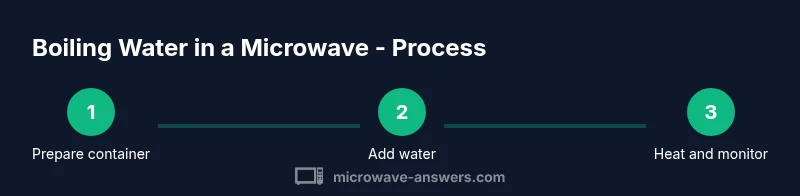
- 1
Prepare container
Choose a microwave-safe mug or cup with a wide mouth. Inspect for cracks and ensure the container is labeled microwave-safe. Place the container on a stable, heatproof surface.
Tip: If the container has a rough surface, it can help nucleation and reduce superheating. - 2
Add water
Pour the desired amount of water, keeping headspace for expansion and steam. Do not fill the cup to the brim to minimize splashes.
Tip: Room-temperature water heats more predictably than water from the fridge. - 3
Cover with vented lid
Place a vented lid or plate on top to allow steam to escape while keeping the surface from splattering.
Tip: A loose lid is better than a tight seal for safety. - 4
Heat in short bursts
Start with 1–2 minutes for a cup, then pause to check for bubbles. Stir gently and resume in 30-second intervals until a rolling boil is reached.
Tip: Stirring helps uniform heating and reduces hot spots. - 5
Handle and test
Wear oven mitts to remove the container. Let the water rest for a few seconds before use and check the boiling level visually.
Tip: Avoid face proximity when removing the container due to steam. - 6
Clean and store
Allow the container to cool completely, wash with mild soap, and dry before reusing.
Tip: Do not reuse cracked containers for boiling water.
Common Questions
Is it safe to boil water in a microwave?
Yes, it can be safe when you follow proper safety steps: use microwave-safe containers, vented lids, and monitor closely to prevent superheating.
Yes, it's safe if you follow proper steps like using vented lids and microwave-safe containers.
What is superheating and how can I avoid it?
Superheating happens when water is heated beyond its boiling point without visible bubbles. Avoid it by using vented containers, a stirrer, and not sealing the container.
Superheating is when water heats past boiling without bubbles; use vented lids and stir to prevent it.
How long does it take to boil water in a microwave?
Timings vary with wattage and volume. A rough start is 1–2 minutes per cup, then check and continue in 30-second bursts until boiling.
Timing depends on wattage; start with a minute or two per cup and check.
Can I boil water for tea in the microwave?
Yes, you can. Allow it to reach a boil, then pour immediately or let it cool briefly before steeping to avoid scorching the tea.
Yes, you can, just be mindful of the temperature for best flavor.
What containers should be avoided?
Avoid metal, aluminum, or non-microwave-safe plastics. Use glass or ceramic instead.
Steer clear of metal; use glass or ceramic.
Watch Video
Main Points
- Choose a microwave-safe container with vented lid.
- Heat in short bursts and stir between intervals.
- Adjust times for wattage and vessel size.
- Avoid superheating by providing nucleation sites and venting steam.