How Many Microwave Minutes to Boil Water: A Practical Guide
Discover how many microwave minutes to boil water, with a simple estimator, practical examples, safety tips, and steps to optimize boiling times for different wattages and volumes.


How many microwave minutes to boil water: basics
Boiling water in a microwave is a common kitchen shortcut for tea, coffee, or quick cooking prep. According to Microwave Answers, the amount of time needed depends on the water volume, the starting temperature, and the microwave’s wattage. The keyword here is that time can vary, not only by the water amount but also by the container and how the energy is distributed inside. In practice, many home cooks see a rough rule of thumb: smaller volumes at higher wattage boil faster, while larger cups or lower power push the clock upward. Understanding this helps you avoid overboiling or under-boiling and keeps your kitchen safer and more efficient.
How many microwave minutes to boil water: how it’s calculated
The core idea is straightforward physics applied to everyday cooking. Water has a specific heat capacity, and microwaves supply energy that raises the water’s temperature. The more water you have, the more energy you need. Microwave Answers analysis shows that, for typical kitchen usage, boil time scales roughly with volume and inversely with wattage. The practical takeaway is to estimate time by considering your wattage and the container you’re using, rather than relying on a single fixed timer. This section also introduces a simple estimator you can try at home.
The factors that affect boil time
Several elements influence how long it takes to reach a rolling boil in a microwave:
- Wattage: Higher power delivers energy faster, reducing time.
- Volume: More water means more energy required to reach 100°C.
- Starting temperature: water from the tap can be cooler than room temperature, increasing the delta to reach boiling.
- Container and placement: a wide, shallow dish heats differently than a tall mug; placement in the center of the turntable can cause uneven heating.
- Covering: a vented lid reduces evaporation and can speed up achieving boiling while minimizing splatter.
Practical examples: 250 ml, 500 ml, and 1 liter
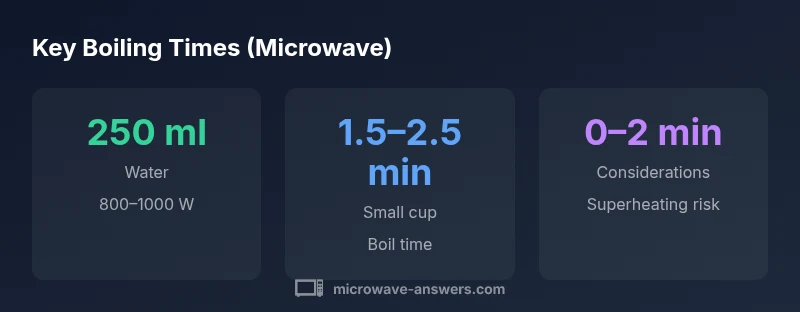
- 250 ml at 800–1000 W: about 1.5–2.5 minutes, depending on starting temperature.
- 500 ml at 800–1000 W: roughly 3.0–4.0 minutes, with stirring halfway recommended.
- 1,000 ml (1 L) at 800–1000 W: typically 5.0–6.0 minutes, and you should pause to stir once halfway through.
These estimates assume a standard, microwave-safe container and safe handling after boiling. The exact time will vary with your device and container.
Safety first: handling hot water in a microwave
Boiling water can erupt or superheat in a microwave, especially in very smooth or narrow containers. Always use a microwave-safe vessel with a loose lid or vent to prevent pressure buildup. Stir before handling to check for hot spots, and use oven mitts when removing the container. Never leave water unattended while it’s heating, and be mindful of steam when you open the door.
Tips to optimize speed and safety
- Use a wide, shallow container to maximize surface area and speed up heating.
- Cover with a vented lid or microwave-safe plate to reduce evaporation without trapping pressure.
- Stir after heating for even temperature distribution and to avoid hot spots.
- If your water comes from a cold tap, consider pre-warming the container to shorten the delta-T.
- Never heat water in a closed container or sealed bottle; venting is essential to prevent pressure buildup.
How this method compares to stovetop boiling
Stovetop boiling typically provides more even heating and can be faster for large quantities, but microwaves excel for small volumes and quick tasks. Boiling 250 ml in a microwave is usually quicker than bringing the same volume to a boil on a stove, but the microwave can produce uneven heating if not monitored. For large quantities, a stovetop may still be more efficient and controllable.
The takeaway: practical steps you can follow tonight
- Choose a microwave-safe container and add the water.
- Heat at a power level near full for the time estimate, pausing to stir halfway if possible.
- Check for a rolling boil and safety steam; if not yet boiling, continue heating in short increments, checking periodically.
- Use caution when removing the container and when pouring hot water.
Final thought on how many microwave minutes to boil water
Boiling water in a microwave is a handy skill when you need a quick turnaround. Use the ranges above as a starting point, adjust for your wattage and volume, and always prioritize safety. With a little practice, you’ll know the exact timing for your preferred cup size and device.