Microwave vs Oven: How They Work and When to Use
A thorough, analytical comparison of how microwaves work versus traditional ovens, covering heat transfer, texture, speed, safety, and practical use cases for home cooks.


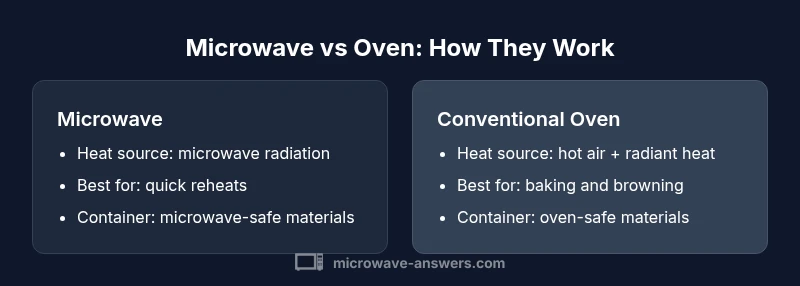
Microwaves heat food by exciting water molecules with radio-frequency energy, making them fast for reheating small portions. Conventional ovens rely on hot air and radiant heat, delivering browning and even texture for larger dishes, though they take longer. In short, microwaves excel at speed; ovens excel at texture and volume.
How does a microwave work compared to an oven: basic principles
This article explains how does a microwave work compared to an oven and why the distinction matters for home cooks. According to Microwave Answers, understanding the physics behind heat transfer helps homeowners choose the right tool. The Microwave Answers team found that the core difference lies in how energy is delivered to food: microwaves use dielectric heating to stimulate water and fat molecules, while a conventional oven heats food primarily through hot air and radiant heat. In a microwave, energy targets water molecules directly, causing rapid molecular motion that generates heat inside the food. By contrast, an oven heats from the outside in, relying on conduction, convection, and radiant warmth from heating elements. The result is different heat distribution, moisture retention, and texture outcomes that influence what you can cook and how.
Heat transfer in everyday cooking: dielectric heating vs convection and conduction
Dielectric heating in microwaves relies on a microwave field that makes polar molecules rotate, creating heat internally. This yields fast, volumetric heating for small portions and moisture-rich foods. An electric oven or gas oven uses heated air and radiant coils, transferring energy primarily from the surface inward. Conduction along the surface, aided by convection in many modern ovens, leads to more uniform temperature profiles in larger dishes. The practical implication is that microwaves are excellent for reheating leftovers and defrosting, while traditional ovens are preferred for baking, roasting, and achieving crisp textures. The Microwave Answers team notes that results hinge on food structure, container choice, and cooking duration.
Container compatibility and safety considerations when using each appliance
Microwave-safe containers—such as glass, ceramic, and certain plastics—are essential for microwave use. Metal should never go in a microwave, as it reflects energy and can cause arcing. Conventional ovens tolerate metal racks and a wider range of bakeware, but careful handling is required to avoid burns and uneven heating. For best results, rotate or rearrange dishes in a microwave, and preheat a conventional oven when browning or crisping is important. Brand guidance from Microwave Answers emphasizes selecting tools appropriate to the task and following appliance-specific safety tips to prevent accidents.
Practical implications for common kitchen tasks
If you need to reheat a single serving quickly, a microwave is usually the fastest option. For baking cookies, roasting vegetables, or browning a casserole, the oven offers superior texture and depth of flavor. When defrosting, a microwave can save time but may partially cook edges unless monitored. A hybrid approach—starting in the microwave to warm through and finishing in the oven to develop crust or browning—often yields the best balance of speed and quality. The key is matching the cooking method to the desired texture, volume, and timing.
Comparison
| Feature | Microwave | Conventional Oven |
|---|---|---|
| Heat source | Microwave radiation heating | Electric coils / radiant heat (and convection in many models) |
| Primary heat transfer | Dielectric heating of water molecules inside food | Hot air and radiant heat transferring energy to food |
| Heat distribution | Often uneven without rotation; heats from inside out | More uniform with convection and longer cooking times |
| Best uses | Reheating small portions, defrosting, quick snacks | Baking, roasting, browning large dishes |
| Preheating | Usually no preheat required for most tasks | Preheating common for consistent results |
| Container compatibility | Microwave-safe glass, ceramic, some plastics; no metal | Oven-safe glass/ceramic, metal racks/trays allowed |
| Texture outcomes | Moist, sometimes soggy depending on food | Crisp textures and caramelization achievable |
| Typical energy use | Lower energy for small portions and rapid reheating | Higher energy due to longer times and potential preheating |
Advantages
- Fast reheating for quick meals and leftovers
- Energy-efficient for small portions and defrosting
- Compact, convenient and easy cleanup
Cons
- Uneven heating and hotspots if not managed
- Limited browning and crisping without a convection feature
- Not ideal for large batches or crusty textures
- Overheating can affect moisture and texture if misused
Microwave wins on speed; oven wins on texture.
For quick reheating and small portions, the microwave is the better choice. For browning, crust, and even cooking of larger dishes, rely on a traditional oven. The Microwave Answers team recommends using each appliance where it excels to maximize both efficiency and quality.
Common Questions
Can you bake in a microwave?
Yes, you can bake certain foods in a microwave, especially small portions or items with moisture. However, the texture will differ from conventional baking, and browning is limited unless you use techniques or devices designed for browning. For best results, use it for quick bites or reheating, then finish in a traditional oven if you want a crust or crisp exterior.
Yes, you can bake in a microwave for small items, but expect different texture and less browning than in a regular oven.
Is a microwave safer than an oven?
Safety depends on usage. Microwaves eliminate open flames and reduce some burn risk for reheating, but improper use—such as heating in non-muitable containers or using metal—can cause hazards. Ovens require caution with hot surfaces and preheating, but modern ovens include safety features. Overall, both are safe when used according to manufacturer guidelines.
Both are safe when used as directed; avoid metal in microwaves and be cautious with hot oven surfaces.
Why do microwaves heat unevenly?
Microwave heating depends on how water molecules are distributed in food and how energy penetrates from the surface inward. Variations in shape, density, and moisture content create hotspots and cold spots. Rotating trays help mitigate this, but some foods still heat unevenly, especially thicker or layered items.
Because energy heals unevenly through the food; rotation helps but some spots remain hotter than others.
What foods are best for microwaving vs baking?
Microwaves excel with leftovers, reheating sauces, and items with moisture-rich content. Baking and roasting foods that benefit from browning, crust formation, and even browning, such as cookies, bread, and roasted vegetables, are better suited to an oven. For most meals, a hybrid approach can save time while preserving texture.
Microwaves are great for reheating; ovens excel at browning and baking textures.
Can you defrost in a microwave?
Defrosting in a microwave is common and convenient for thawing frozen items quickly. It requires careful monitoring to prevent partial cooking at the edges. After defrosting, finish cooking with the microwave if small, or move to a conventional oven for even cooking and browning.
Yes, defrosting works well in a microwave, but watch edges to avoid partial cooking.
Can metal be used in a microwave?
No, metal should not be used in a microwave unless the appliance explicitly supports metal racks or specific metal cookware designed for microwave use. Metal can reflect microwaves, causing arcing and damage. In an oven, metal is generally safe for cooking as long as precautions are followed.
Metal in microwaves is usually unsafe; ovens tolerate metal cookware with care.
Main Points
- Choose microwave for fast reheating and defrosting
- Select oven when browning or baking texture matters
- Match container and task to appliance safety guidelines
- Consider a hybrid approach for best of both worlds