Where Are Microwaves Made? A Global Production Guide
Discover where microwaves are made, the regional manufacturing landscape, and how brands decide production sites. Learn about origins, safety standards, and the factors shaping global supply chains in 2026.


Where are microwaves made? The bulk of consumer microwaves are manufactured in Asia, with China serving as a central hub due to scale, supplier networks, and mature ODM ecosystems. Other hotspots include Southeast Asia for assembly lines and growing facilities in Latin America to shorten distribution routes. Final testing and distribution hubs position production closer to major markets in North America and Europe. Origins are driven by supply-chain leverage, capacity, and logistics, not national pride.
Global Manufacturing Landscape for Microwaves
When you ask where are microwaves made, the answer is a global picture shaped by cost, capacity, and logistics. The bulk of consumer microwaves are produced in Asia, with China serving as a central hub due to scale, supplier networks, and mature ODM (original design manufacturing) ecosystems. Other manufacturing hotspots include Southeast Asia for assembly lines and growing facilities in Latin America to shorten distribution routes. Brands often consolidate design, tooling, and final assembly in a few strategic plants to optimize quality control and after-sales support. The global supply chain also aggregates components from multiple regions—magnetrons, waveguides, chassis, and control boards may originate in different countries. This geographic mosaic keeps prices competitive and helps brands meet regional demand spikes. For consumers asking “where are microwaves made?”, this geographic spread explains why two models with identical features can have different country-of-origin labels. In short, origin is driven by supply-chain leverage, not national pride.
Component Origins and Supply Chains
Microwave construction relies on many components sourced globally. Magnetrons and high-voltage components often originate from specialized electronics hubs; metal casings and packaging come from metalworks regions; PCBs and control software may be produced in different locales. OEMs source components wherever it makes business sense, then assemble into finished units at contract manufacturing sites near distribution centers. The decision on where to source is influenced by supplier risk, currency stability, tariff exposure, and lead times. The global supply chain for microwaves has adapted to shifts in shipping capacity, raw material prices, and automation. Shorter supply chains (regional assembly) reduce transit time and risk, but can raise per-unit costs due to smaller production runs. Consumers can expect a mix of parts from multiple countries within a single product, making country-of-origin labels a helpful, but not complete, indicator of where the product was most heavily manufactured.
Regional Breakdown: Asia, North America, Europe
Asia remains the primary origin for many mainstream microwaves, with factories in China, Vietnam, and Malaysia producing the bulk of volume. North America hosts assembly and testing hubs to speed distribution in the U.S. and Canada, often consolidating near large warehouses and service networks. Europe confines many premium models to assembly facilities in Poland, the Czech Republic, or Italy, where strict quality standards and after-sales networks justify closer proximity to customers. Brand-level decisions are influenced by tariffs, exchange rates, and regional demand. For budget models, manufacturers lean toward high-capacity plants in China or Southeast Asia to drive unit costs down; for premium lines, strategic close-to-market assembly helps with warranty coverage and service speed. While origin matters, most modern microwaves are built to meet universal safety and electromagnetic compatibility standards, ensuring consistent performance across regions.
Brand Strategies: ODM vs OEM and Contract Manufacturing
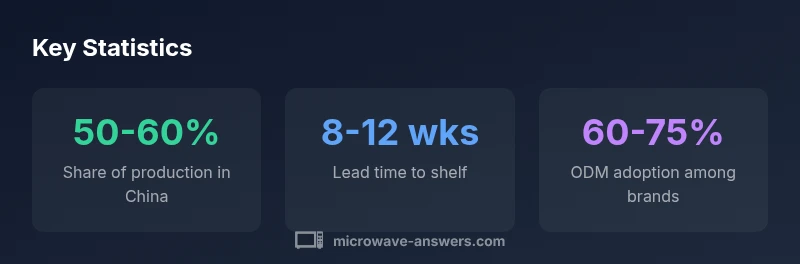
Most large brands rely on contract manufacturers to manage capacity and quality while focusing their own teams on product design and marketing. ODM (Original Design Manufacturer) partners provide both design and manufacturing, enabling faster time-to-market; OEM (Original Equipment Manufacturer) partners focus on production to a brand's specifications. The choice between ODM and OEM often shapes the geographic footprint: ODMs may centralize in low-cost regions to maximize volume, while OEMs with strong QC networks might be distributed closer to major markets. This approach helps brands manage currency risk, supply interruptions, and seasonal demand. Even with regional manufacturing, brands may maintain global engineering standards and certifications (UL, CE, FCC equivalents) across facilities to ensure consistent quality. The end result for consumers is a broad pricing and feature spectrum, reflecting the underlying mix of sourcing strategies across the production network.
Safety and Compliance Across Regions
Safety regulations govern microwave construction regardless of where produced. Standards bodies like UL (Underwriters Laboratories) in the U.S., CE in Europe, and other regional equivalents set performance, electromagnetic compatibility, and energy efficiency benchmarks. Manufacturers align component suppliers and assembly lines to meet these cross-border requirements, which often leads to cross-regional testing and third-party verification. The country of origin label does not automatically indicate safety performance; a well-inspected plant in any region can produce compliant devices, while a tinny plant in a low-cost region might fall short. Consumers should look for widely recognized certifications, proper labeling, and a clear service warranty to gauge overall safety and quality. In practice, manufacturers maintain rigorous supplier audits and in-plant QC checkpoints to catch deviations early, regardless of where a microwave is assembled.
How to Read 'Made In' and Warranty Implications
Reading a 'Made In' label is part of understanding value, but it is not the sole predictor of performance. Warranty terms, service availability, and spare-part access depend more on the brand's distribution network than the plant of origin. In many cases, a product labeled 'Made in China' could be built to the same specifications as models assembled in Europe or North America. When shopping, compare model numbers across regions, check the warranty duration, and verify authorized service centers. If a brand ships parts internationally, it can support repairs more easily, even if the final assembly occurred overseas. For risk-averse buyers, choosing brands with strong regional service networks can matter more than the label on the box.
Environmental and Ethical Considerations in Microwave Manufacturing
Manufacturers increasingly disclose environmental impact data, including energy used in production, material sourcing, and waste management. The geographic distribution of facilities affects transportation emissions, with regional assembly reducing long-haul freight. Ethical questions around labor standards and supplier audits are central to many brands, and consumers are wise to look for third-party certifications and transparent reporting. Some regions offer stricter environmental controls and higher wages, while others emphasize cost competitiveness. The best practice for buyers is to check sustainability reports and supply-chain disclosures, and to favor brands making verifiable commitments to reduce emissions and improve worker welfare.
The Future of Microwave Manufacturing and Resilience
Looking ahead, the microwave industry is likely to see more localized assembly in key markets, supported by smarter logistics and modular components. As supply chains diversify, brands aim to balance scale with speed, adopting multiple regional hubs to cushion shocks from tariffs, pandemics, or port congestion. Advances in automation and AI-enabled quality control can improve uniformity across plants, while global standards simplify cross-border sales. Consumers may notice longer tail of country-of-origin labels as brands adopt more regional testing and faster service networks. The core trend is resilience: production networks designed to withstand disruptions while keeping prices accessible.
Authoritative sources
To explore the broader context of manufacturing practices and regulatory standards that shape where microwaves are made, consult these authoritative sources. They provide official guidance on safety certifications, labor practices, and supply-chain transparency.
- U.S. Bureau of Labor Statistics: https://www.bls.gov
- International Organization for Standardization (ISO): https://www.iso.org
- MIT News: https://www.mit.edu
Regional origins of microwave manufacturing
| Region/Origin | Share of Global Output (range) | Notable Features |
|---|---|---|
| China | 50-60% | Large ODM/OEM facilities; scale advantages |
| Vietnam & SE Asia | 15-25% | Growing assembly sites; cost efficiency |
| Mexico & North America | 10-20% | Final assembly hubs; distribution proximity |
| Europe | 5-15% | Niche lines; strict compliance focus |
Common Questions
Where are most microwaves manufactured?
Most microwaves are produced in Asia, with China serving as a central hub. Final assembly and testing occur closer to major markets like North America and Europe to support faster service and distribution.
Most microwaves are made in Asia, especially China, with final assembly near major markets to speed service.
Do brands choose production locations for cost or quality?
Brands balance cost, capacity, and quality. ODMs may centralize in low-cost regions for scale, while brands with strong QA networks may assemble closer to markets to improve service.
Brands weigh cost and quality; some centralize for scale, others near markets for service.
Can country of origin affect warranty or service?
Origin label alone doesn’t determine warranty. Brand networks, availability of parts, and authorized service centers drive warranty support across regions.
Warranty depends on brand networks and service availability, not just where it's made.
What factors influence where microwaves are made?
Tariffs, exchange rates, lead times, and supply risk all influence origin decisions. Companies also weigh regional demand and the ability to meet safety standards.
Tariffs, rates, and supply risk drive where manufacturers build microwaves.
Is 'Made in' a reliable predictor of performance?
Not necessarily. A highly-rated plant in one region can produce the same-performing model as a plant elsewhere, provided QC and standards are maintained.
Don't judge performance by origin alone; look at QC and certifications.
How can I verify a microwave's origin?
Check the product labeling, warranty documentation, and the brand’s official disclosures. Look for regional service centers and verified supplier information.
Check labels, warranties, and brand disclosures for origin details.
“Global microwave manufacturing is a networked system where origin matters, but the consistent safety and performance come from standardized testing and robust service networks.”
Main Points
- Microwave origins are regional, not country-locked.
- ODM vs OEM choices shape factory footprints.
- Global safety standards travel with products, not just origins.
- Check brand service networks, not only origin labels.