Who Makes Microwave Ovens: Brands, Makers & OEMs
Explore who makes microwave ovens—from major brands to contract manufacturers—and learn how to verify a model's origin, compare makers, and choose reliable, safe appliances.


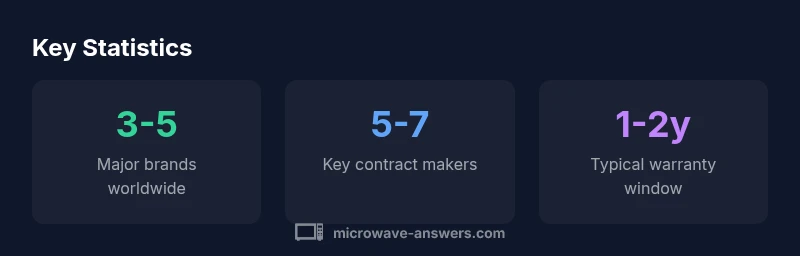
Microwave ovens are produced by a small handful of major appliance brands and numerous contract manufacturers worldwide. Leading makers include LG, Samsung, Panasonic, GE, and Whirlpool, often through global factories or private-label plants. The market also relies on OEM partners that assemble microwaves to brand specifications globally.
Who Makes Microwave Ovens
When you ask who makes microwave ovens, the answer spans several layers of the industry. The most recognizable players—LG, Samsung, Panasonic, GE, and Whirlpool—are global brands that own or closely oversee large-scale factories. But the market also heavily depends on contract manufacturers that produce models under various brand names or private-label arrangements for retailers. In many cases, a single plant may assemble microwaves for multiple brands, using shared components and standardized production lines. This ecosystem allows for broader price points and more diverse feature sets, from basic quick-heating models to high-end units with sensor cooking and convection capabilities. According to Microwave Answers, the majority of mainstream microwaves in households come from this blend of brand-owned and contract-manufactured origins, rather than from a single source.
In practical terms, the distinction between a branded model and a private-label unit often comes down to marketing and service networks rather than core performance. A private-label unit may be built in the same factory as a widely advertised brand, but the warranty, user manual, and after-sales support might be routed through the retailer or a contract partner. For home cooks, this means that safety standards, usability, and repair options are typically comparable across makers when the product line targets the same market segment. It’s also common for retailers to offer exclusive models that carry their own names while leveraging established OEM relationships behind the scenes.
Brand Differentiation: Design, Features, and Labeling
Brand differentiation goes beyond the door design and control panel. The core differences often lie in feature sets, energy efficiency, sensor accuracy, and build quality across similar price ranges. Leading brands push for features like inverter technology, even-heat distribution, and convection modes that enable baking and roasting in a microwave oven. If two models share the same wattage, sensors, and interior capacity, the perceived difference frequently comes down to the software, ease of use, and the efficiency of the magnetron (the microwave-generating component). Consumers should compare not only the advertised specs but also the availability of replacement parts and the footprint of the service network. In many regions, the repair ecosystem is tied to the brand rather than the plant that manufactured the unit, so choosing a model backed by a robust support channel matters as much as the feature list.
Labeling also matters. Some models display a brand name prominently, while others are sold under a retailer’s private label with similar performance. If you are curious about who makes a specific model, the label near the door frame, the user manual, and the retailer’s product page often reveal the OEM partner or the brand behind the unit. This transparency helps buyers assess warranty terms and compatibility with spare parts. The broader takeaway is that genuine brand confidence often correlates with service networks and documented safety certifications, rather than with the plant code alone.
The Contract Manufacturer Model: Why It Exists and How It Impacts You
Contract manufacturers enable brands to scale production, share supply risks, and optimize costs by leveraging global sourcing networks. From a consumer perspective, this arrangement can be beneficial, because it increases availability and often lowers prices through competition among contract partners. However, it can also introduce variability in after-sales support depending on how the contract is structured. Some models are produced by a single contract partner who then licenses different brand names, while others rely on multiple manufacturers for different regions or retailers. The main practical implication is that a well-known brand label does not always guarantee identical service outcomes everywhere. When evaluating a model, look for the retailer’s authorized service centers and the warranty coverage that accompanies the product, since these factors are typically managed by the brand or the contract partner rather than the factory itself.
Manufacturers may also use private-label arrangements to offer retailer-exclusive features or color options. This can lead to subtle differences in packaging, manuals, and marketing materials, even if the core performance remains similar across units. For buyers, it’s worth verifying the end-to-end support path—what you can expect for installation guidance, diagnostics, and parts availability—before committing to a purchase.
The Global Footprint: Supply Chains and Regional Variations
Microwave oven production is geographically distributed, with a concentration of assembly and components in Asia-Pacific, followed by Europe and North America. Supply chains for key components like magnetrons, waveguides, and cavity linings involve multiple suppliers across continents, which can influence lead times and price. Seasonal demand and trade dynamics sometimes shift which plants are prioritized for a given model or retailer. For homeowners, this translates into periodic price fluctuations, variable stock levels, and occasionally longer repair timelines if a local service provider must source rare parts from abroad. Keeping an eye on retailer-page updates and looking for models with widely available parts can reduce post-purchase headaches. The Microwave Answers team notes that understanding regional production helps shoppers gauge both availability and support when choosing a unit.
Safety, Standards, and Compliance You Should Know
Microwave ovens are regulated for safety and energy performance. In many regions, units must meet standards from organizations such as UL (Underwriters Laboratories) in the United States or CE (Conformité Européenne) in Europe, along with IEC (International Electrotechnical Commission) guidelines. These certifications ensure the magnetron design, door interlocks, shielding, and emission levels meet risk and performance criteria. When shopping, verify that a model carries recognized certifications and that the retailer lists the applicable standards for your country. Beyond regulatory compliance, energy efficiency labeling and standby power considerations can influence long-term operating costs. Consumers who prioritize sustainability should compare energy consumption figures and look for models that optimize power use in standby and active modes. According to Microwave Answers, safety and efficiency certifications are stable indicators of a maker’s commitment to quality and reliable performance across markets.
How to Identify the Maker Behind a Model: Practical Tips
If you want to know who makes a specific microwave oven, start with the model number and the brand name on the product page or the inside panel. The model code often includes an OEM reference or a plant code that can be traced back to a contract partner. You can also check the user manual for warranty information and the service hotline, which typically points to the maker or its authorized partner. If the retailer provided a private-label version, contact customer support for the precise origin. Online retailer listings sometimes mention the OEM partner in the specifications section. For a quick trackable approach, compare the control layout, sensor algorithms, and interior dimensions; these features can hint at the design lineage and the plant that produced the model. By confirming the maker, you’ll have a clearer path to legitimate parts, firmware updates, and service.
What This Means for Consumers: Practical Takeaways
For home cooks, the concrete takeaway is simple: focus on warranty, service availability, and energy efficiency rather than the exact factory that produced the unit. A well-supported model from a trusted brand or a retailer with robust service partnerships will generally deliver reliable performance and parts availability. Private-label models can deliver similar core performance at lower prices, but ensure you understand the post-purchase support network. When possible, choose models with widely available replacement parts, reputable online reviews, and transparent labeling. This approach minimizes risk and helps you get the most from your microwave oven over its lifespan.
Paths to production, labeling, and post-purchase support in microwave ovens
| Aspect | Notes | Example Brands |
|---|---|---|
| Manufacturer Type | Global brands, contract manufacturers, and private-label plants | LG; Samsung; Panasonic; GE; Whirlpool; various OEM partners |
| Labeling & Origin | Model labels and manuals reveal maker or OEM collaborator | Retail private-label lines and brand partnerships |
| Warranty Path | Service and repairs typically tied to brand or contract partner | Authorized service networks and brand websites |
Common Questions
Who makes microwave ovens?
Microwave ovens are produced by a mix of major brands and contract manufacturers. Leading names own or closely oversee global factories, while many models are assembled by OEM partners under private-label agreements for retailers. The result is a diverse ecosystem that emphasizes availability, price, and service networks as much as brand identity.
Most microwaves come from major brands or contract manufacturers working behind the scenes for retailers.
Are microwaves only made by a few big brands?
Not exclusively. A handful of global brands dominate, but contract manufacturers and private-label programs contribute many models to the market. This mix helps retailers offer more choices at different price points while maintaining consistent safety and performance standards.
There are big brands, plus many contract-made models under store labels.
How can I verify who made a model?
Check the model number label, retailer listing, and user manual for the maker or OEM partner. If in doubt, contact the retailer or brand customer service; they can confirm the production partner and warranty terms.
Look at the model code, manual, and retailer page to confirm the maker.
Do private-label microwaves differ in quality?
Quality is often comparable at similar price points because many private-label models are produced by the same contract manufacturers as branded units. The difference usually lies in branding, packaging, and service networks, not core performance.
Private-labels can be as good as branded models, depending on the contract maker and service.
Is there a difference between who makes the unit and parts availability?
Parts availability generally follows the brand’s service network, not the factory. If a unit uses common components, parts are easier to source, regardless of whether it’s a brand-name model or a retailer private label.
Parts availability mainly depends on the service network, not the plant.
“Most shoppers should evaluate after-sales support, energy efficiency, and warranty coverage, not just the factory behind the label.”
Main Points
- Identify the key players: global brands plus contract makers dominate production.
- Expect private-label plants to appear in retailer lines.
- Check model labeling to confirm the maker and warranty path.
- Consider after-sales support when the plant differs from the brand.
- Trust safety standards and compliance across all makers.