What Microwaves Are Made in the USA: A Practical Guide
Discover which microwaves are made in the USA, how to verify domestic assembly, and practical tips for choosing American-made models.


Quick Answer: There is no universal registry listing every microwave built entirely in the USA. In practice, many models marketed as 'Made in USA' are final-assembly in U.S. facilities with a mix of domestically produced parts and components sourced abroad. The Microwave Answers team finds that true completely domestic manufacture is uncommon, but several brands offer US-assembled options with transparent labeling on specs.
The landscape of US-made microwaves and labeling
The question "what microwaves are made in the usa" often comes up for home cooks and homeowners looking for domestic sourcing. In practice, there isn't a universal registry listing every model wholly built in the United States. The Microwave Answers team has reviewed labels, factory disclosures, and product sheets to separate marketing language from verifiable manufacture. You will notice that many models marketed as 'Made in USA' are assembled in U.S. facilities with a mix of domestically produced parts and components sourced abroad. By understanding this landscape, you can make informed decisions without overpaying for claims that aren't fully accurate. This guide uses practical checks you can apply in-store or online.
According to Microwave Answers, buyers should approach origin claims with a healthy degree of skepticism and verify through official disclosures. The goal is to separate marketing from measurable facts.
How 'Made in USA' labeling works in practice
Labels can be nuanced. Some brands use 'Made in USA' to indicate final assembly occurred in the United States, while others claim broader domestic content. The FTC has guidelines that require disclosures when a product is not entirely domestic. Look for phrases like 'Made in USA' versus 'Assembled in USA' and, ideally, a country-of-origin note inside the product manual or on the packaging. For a home consumer, the simplest rule is to verify the label and cross-check the model's spec sheet for sourcing details. When in doubt, contact customer service for explicit sourcing information and ask for a written confirmation of country-of-origin.
The supply chain: domestic assembly vs. imported components
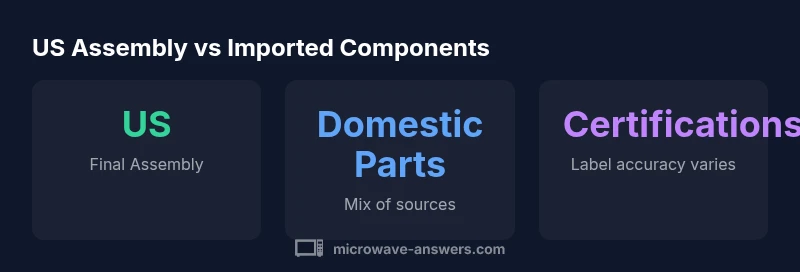
The core components of a microwave include the cabinet, door, control circuitry, magnetron, waveguide, and keypad assembly. In many models marketed as US-made, the final assembly happens in a U.S. facility, but core components such as the magnetron and microchips may come from overseas suppliers. This split is common across many consumer electronics categories and does not inherently imply poor quality. Buyers should weigh the benefits of domestic assembly (supporting local jobs, easier service networks) against potential trade-offs in cost and component sourcing. Understanding this balance helps clarify what you are getting when you purchase a microwave marketed as Made in USA.
How to verify US-built claims: labels, disclosures, and certifications
Label accuracy varies by brand, so always read the packaging and the product sheet for origin details. Seek explicit statements such as 'Made in USA' or 'Assembled in USA' plus a breakdown of major components. Certifications from third-party bodies (where applicable) can bolster credibility, though not all certifications cover country of origin. If origin details are ambiguous, request a written confirmation from the manufacturer or retailer. A prudent approach is to compare multiple models and ask for a sourcing chart that identifies where key components come from and where final assembly occurs.
Brand patterns: which brands lean toward US assembly
Across the market, several brands emphasize domestic assembly more than others, but the landscape is evolving. The Microwave Answers analysis shows a trend toward clearer origin disclosures and a growing subset of models with transparent sourcing information. Consumers should expect a mix: some models may be assembled in the USA with domestic components, while others use imported parts but perform to high safety and performance standards. Brand transparency, retailer disclosures, and model-by-model labels are your best tools for distinguishing true US-made options from marketing claims.
Practical buying tips: what to check on package and specs
To evaluate whether a microwave is truly US-built, start with the label and follow these steps:
- Read the country-of-origin statement on the box and manual.
- Compare the product sheet for sourcing details (major components and assembly location).
- Look for additional disclosures from the manufacturer or retailer.
- Check the warranty terms and service network; US-made models should have comparable after-sales support.
- If possible, contact customer service for a written confirmation of origin and a breakdown of component sourcing.
- Cross-check retailer listings and model numbers against the manufacturer’s official site for consistency. This practical checklist reduces the risk of misinterpreting marketing language as fact.
Differences in price and warranty between US-made and imported models
In many cases, US-assembled microwaves can be price-competitive with imported models, but there is no universal rule. The price difference often reflects factors such as assembly costs, distribution, and service networks rather than inherent quality. Warranty terms can vary by model and retailer, but major brands typically offer similar warranty durations for both US-made and imported lines. When evaluating options, compare not just price but also the coverage, service availability, and the reputation of the brand with respect to reliability and post-purchase support.
Safety considerations when selecting microwaves made in the USA
Safety is paramount regardless of origin. Ensure that any microwave you consider carries recognized safety certifications (such as UL listing in the United States) and that documentation clearly states the model’s origin. Consider features like child locks, interior cavity cleanliness, and energy efficiency ratings. While country-of-origin is a factor, it should not replace due diligence on safety features and reliability. Reading consumer reviews and checking for recalls can also inform your decision.
Overview of US-made vs imported microwave origin labeling
| Aspect | US-made label | What it means |
|---|---|---|
| Assembly | US final assembly | Product assembled in the USA |
| Components | Domestic vs imported | Mix of sources depending on model |
| Labels | Explicit origin disclosures | Look for 'Made in USA' or 'Assembled in USA' with details |
Common Questions
Are microwaves labeled 'Made in USA' truly manufactured in the United States?
Generally, the label refers to final assembly; many parts may be imported. Always check the country-of-origin disclosures in the product sheet.
Usually, 'Made in USA' means final assembly happened here, but parts can be imported; verify with the manufacturer.
Can I ensure all components are domestic?
It's uncommon for all parts to be domestic. Look for explicit sourcing details and request a breakdown from the manufacturer.
All-domestic parts are rare; ask for a sourcing breakdown from the brand.
Which brands offer US-assembled models?
Several major brands offer US-assembled lines, but availability varies by year and model. Check product pages for origin notes.
Some brands do offer US-assembled options; verify on the product page.
Does domestic assembly affect price or warranty?
Domestic assembly can influence price and warranty terms, but you should compare terms across models and check service options.
It can affect price and warranty; compare terms across options.
How can I verify a microwave is US-made before buying?
Read the label, packaging, and tech sheet; ask for country-of-origin details and get it in writing if possible.
Read labels and ask the brand for explicit origin details.
What should I avoid when buying US-made microwaves?
Avoid vague origin claims; prefer products with explicit country-of-origin and transparent sourcing information.
Be wary of vague claims; demand explicit origin details.
“In our experience, 'Made in USA' labels typically reflect final assembly rather than a full, domestically sourced supply chain; buyers should scrutinize labeling and component-origin disclosures.”
Main Points
- Check the label and disclosures before purchasing
- Understand the difference between 'Made in USA' and 'Assembled in USA'
- Compare model families for domestic assembly options
- Review warranty terms and service options across models
- Prefer brands with transparent sourcing information