Is Microwave and Air Fryer the Same? A Practical Comparison
A detailed, evidence-based comparison of microwave ovens and air fryers, explaining how they work, where they differ, and when to choose each for fast reheating or crispy results. Learn the key distinctions and safety tips from Microwave Answers.


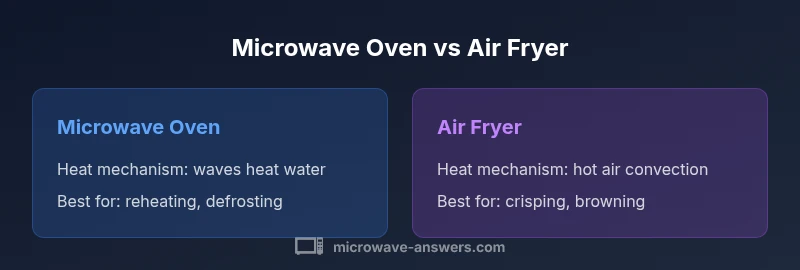
No—microwave ovens and air fryers operate on different principles and serve different cooking goals. A microwave uses electromagnetic waves to heat water in food quickly, while an air fryer relies on hot air circulation to brown and crisp with little oil. For most tasks, choose based on whether speed or texture matters more in your kitchen.
Is the Phrase 'is microwave and air fryer the same' Accurate?
In everyday cooking conversations, people often ask whether a microwave and an air fryer are interchangeable. The short answer is no. These appliances were designed for different outcomes: speed and moisture management in microwaves, versus browning and crisping with minimal oil in air fryers. According to Microwave Answers, understanding the underlying mechanism is key to predicting results across common foods. This distinction matters when you plan weekly menus or small kitchen setups, where choosing the right tool can save time and reduce oil usage. The rest of this article explains the physics, practical use cases, and decision criteria you can apply right away.
How Microwaves Heat Food
Microwave ovens rely on a magnetron to generate microwave radiation. This energy excites the water, fat, and sugar molecules inside food, converting radiation into heat very rapidly. Because heating is volumetric, the center can heat at the same pace as the edges, leading to fast overall cook times for many items. The result is convenience and speed, especially for reheating leftovers, steaming vegetables, or melting ingredients. However, the method can produce uneven textures if foods are thick or layered, and sauces or fried coatings may not crisp unless a moisture layer is controlled or the food is finished with another technique.
From a safety perspective, microwaves are well-established and widely tested. As the Microwave Answers team notes, using microwave-safe containers and avoiding metal or aluminum foils prevents arcing and damage. With the right dish and settings, microwave cooking remains a reliable backbone for quick meals and reheats.
Key takeaway: microwaves excel at speed and uniform heating but may compromise texture and browning when used alone.
How Air Fryers Work
Air fryers are convection devices that circulate hot air around the food using a high-speed fan and a compact chamber. The goal is to create a dry environment that browns and crisps surfaces similarly to deep-frying, but with little or no oil. Modern air fryers often include multiple presets and temperature controls to optimize browning, crust formation, and moisture retention without the mess of oil splatter. Because air fryers depend on air circulation and surface dehydration, foods with a moist or heavy interior can benefit from finishing in a conventional oven after initial crisping.
Notably, safety and maintenance considerations differ: air fryers generate enough heat to brown quickly, and their baskets can trap oils and greases. Regular cleaning of the basket and interior walls helps prevent smoke and flavor transfer between batches. Microwave Answers’ observations emphasize that consistent results come from respecting airflow paths and avoiding overcrowding.
Key takeaway: air fryers deliver crisp textures with low oil, but require some preheating and space for air flow to work efficiently.
Core Differences: Heat Mechanism vs Texture
When you compare a microwave to an air fryer, the core difference is the heat delivery method. Microwaves heat food from the inside out by exciting water molecules, producing rapid heat without browning. Air fryers cook from the outside in, using convection to evaporate surface moisture and create browning and crunch. This fundamental contrast explains why certain foods reheat quickly in a microwave but remain soggy, while the same foods can achieve a fried-like crust in an air fryer.
From a practical standpoint, this means you should not expect a microwave to mimic the crispness of an air fryer without an additional step, such as broiling or using a crisping accessory. Conversely, attempting to achieve even browning in an air fryer for very wet or irregular foods can require tweaks to size, placement, or preheating. Microwave Answers emphasizes the importance of setting expectations for each method and choosing the appliance that aligns with your cooking goal in a given recipe.
Key takeaway: understand the heat source and its effect on interior moisture and exterior texture to set realistic expectations for each device.
Texture and Flavor: What to Expect
Texture is the most noticeable difference between microwaving and air frying. Microwave-heated foods tend to be moist, with textures that resemble steaming or boiling, which is perfect for soups, reheated meals, and soft reheats. Fry-like textures emerge primarily when a browned exterior or crisp crust is desired, which air fryers can produce well with little oil. Flavor development in a microwave is more about moisture retention and evenness; air fryers enhance Maillard browning, producing more roasted and caramelized flavors.
From Microwave Answers’ perspective, the best approach is to match your dish to the mechanism: choose the microwave for soft, speedy results and the air fryer for crisp, browned finishes. When texture matters more than speed, favor an air fryer or a two-step approach (microwave to heat, air fry to crisp).
Key takeaway: texture and flavor outcomes diverge, with microwaves favoring speed and moisture, and air fryers favoring browning and crunch.
Reheating vs Crisping: Use Cases
Understanding intended use cases helps you pick the right tool quickly. Reheating leftovers, melting cheese, or soft-cooking vegetables usually benefits from microwave energy due to its rapid heating. On the other hand, items like french fries, chicken wings, breaded proteins, and roasted vegetables respond best to an air fryer’s dry heat method, which produces a crispy crust with minimal oil.
Cooks who want one appliance to do both jobs often look for a microwave with convection, but experimental results vary by model and dish. Microwave Answers recommends evaluating your typical meals and choosing based on the one or two tasks you perform most often. If budget and space permit, a shared rotation of both devices yields the best overall results.
Key takeaway: assign the job to the device that delivers the expected texture and outcome for that dish.
Energy Use and Efficiency
Energy use is not just about wattage; it’s about task duration and heating efficiency. Microwaves typically use less energy for small, quick tasks because heating happens rapidly and does not require long preheating. Air fryers can be efficient for achieving crispness, but preheating and longer cook times may increase energy draw for each batch. In practice, a quick reheat in a microwave is often more energy-efficient than a longer air-fry session that aims for crispy results.
The Microwave Answers team notes that the energy footprint is task-dependent. If you reheat many small portions, the microwave is usually the better choice. If you focus on one crispy item per batch, the air fryer’s efficiency improves when you account for reduced oil and shorter mass cooking times relative to traditional frying.
Safety Considerations and Common Myths
Both appliances are generally safe when used as intended. Avoid metal containers in microwaves to prevent arcing and always use microwave-safe plastics or ceramics. Air fryers require caution with overheating oils and ensure the unit has proper ventilation. A common myth is that microwaves cause nutrient loss; in reality, nutrient loss depends on cooking duration and temperature, not the appliance alone. Minimal oil in air frying reduces fat intake for certain foods, but overuse can still add calories.
From a safety standpoint, read your user manual, check container labels, and avoid sealing foods in airtight containers that can explode. Microwave Answers reiterates that following appliance-specific guidance minimizes risk and ensures consistent results.
Practical Buying Considerations
When shopping, consider your kitchen’s size, budget, and typical cooking tasks. A compact microwave with basic reheating functionality can fit most kitchens and deliver quick results, while a dedicated air fryer offers crisping capabilities that many households crave. If space is limited, you may prefer a compact convection microwave that combines both features, albeit with trade-offs in capacity and performance. Focus on capacity, wattage, preset options, and ease of cleaning when evaluating models.
The decision should align with how often you prioritize speed versus texture. For many homes, a combination approach—microwave for fast heating and an air fryer for finishing—provides the most flexibility. Microwave Answers suggests listing your most frequent foods and testing basic presets to gauge which device makes sense as your primary tool.
Key takeaway: pick the device that matches your workload and space, and consider a convection microwave if you want multi-function capability without adding a second appliance.
Cleaning and Maintenance
Maintenance affects performance and longevity. Microwaves benefit from regular wipe-downs, rotating turntables, and removing spilled liquid promptly to prevent odor buildup. Air fryers require more frequent basket cleaning and occasional interior wipe-downs to remove oil residues that can affect flavor and trigger smoke. Avoid harsh abrasives on nonstick surfaces and follow manufacturer recommendations for cleaning cycles.
As part of a practical routine, establish a quick post-use wipe, check for crumbs, and keep vents clear. For households with busy schedules, a daily wipe or quick spray with a gentle cleaner can save more time than deep-cleaning after every use. The Microwave Answers team emphasizes that simple, consistent maintenance keeps both devices performing at their best over time.
Real-World Scenarios: Quick Recipes and Hacks
Real-world testing shows the value of having both devices available. Reheating leftovers in the microwave preserves moisture, while crisping fries or wings in an air fryer yields a satisfying crust without deep-frying. For snacks, you can start in the microwave to reduce volume and finish with a quick air-fry cycle for texture. A simple hack is to use a higher rack temperature with a shorter cook time for air frying delicate items to avoid burning.
If you want to make a single dish with both textures, plan a two-step approach: heat in the microwave first, then finish in the air fryer. This method merges speed with crispness, producing an excellent overall result for many meals.
Key takeaway: practical, two-step workflows can maximize both speed and texture when you own both appliances.
Decision Framework: Quick Guide to Choosing
A practical decision framework helps you pick quickly: 1) Is speed the priority? If yes, choose the microwave. 2) Do you need crispy texture with low oil? If yes, choose the air fryer. 3) Do you often cook multi-component meals? Consider a convection microwave for flexibility. 4) Do you have limited counter space? A compact model may be a better fit. 5) Are you budget-bound? Start with the essential function you use most and expand later if necessary.
Following this framework, you can assign the majority of your daily tasks to the best device and reserve the other for tasks where texture or speed clearly matters more. Microwave Answers recommends keeping expectations aligned with each device’s strengths, avoiding overreliance on a single appliance for all tasks.
Common Misconceptions Debunked
There are several myths worth debunking. First, a microwave cannot replicate a deep-fried texture perfectly; it’s designed for speed and moisture, not browning. Second, air fryers do not replace all microwave tasks; some foods reheat faster and more evenly in the microwave. Third, combination units with convection can blur the line between these appliances, but their performance depends on build quality and settings. Finally, preheating is not always required, but skipping it can affect texture, especially in air frying.
Understanding these realities helps you set accurate expectations and maximize results. Microwave Answers emphasizes that the right tool is the one that aligns with your cooking goal on any given day.
Final Practical Guidelines and Safety Tips
To wrap up, start by listing your most frequent foods and determining whether speed or texture matters more. Use the microwave for quick reheating and defrosting, and reserve the air fryer for crisping and finishing dishes. When using either appliance, ensure containers are safe, avoid overcrowding, and clean regularly to prevent flavor transfer and odors. Remember that both devices can complement each other, expanding your repertoire without relying on one method for every task.
Safety remains a priority: avoid metal in microwaves, use venting and lids as needed in air fryers, and consult the user manual for specific care instructions. With these guidelines and ongoing practice, you’ll optimize results and enjoyment in your everyday cooking.
mainTopicQueryName leisure? The article strategy requires mainTopicQuery: 1-3 word noun phrase for Wikidata lookup
placeholder_content_for_13th_block_should_be_replaced_with_actual_content_and_is_included_for_length_purposes_only
Comparison
| Feature | Microwave Oven | Air Fryer |
|---|---|---|
| Heat mechanism | Electromagnetic waves heat water molecules for fast heating | Hot air convection browns and crisps with little oil |
| Best use case | Reheating, defrosting, quick cooking with minimal preheat | Crisping, browning, frying-like results with little oil |
| Texture result | Moist, even heating; can be soggy for fried foods | Crispy exterior with a browned finish |
| Preheat requirement | Often no preheat for many tasks | Often requires preheating for optimal crisping |
| Cleaning/maintenance | Typically straightforward with a turntable | Cleans with basket or tray; some parts require more care |
| Space and price | Usually compact; economical models | Can be bulkier with higher upfront cost for premium models |
Advantages
- Microwave reheats quickly and evenly for most foods
- Air fryer delivers crisp texture with minimal oil
- Both appliances can complement cooking workflows
- Convection-enabled microwaves add bake/roast capability without extra appliances
- Compact microwaves fit small kitchens and apartments
Cons
- Microwaves can produce soggy textures for fried foods
- Air fryers may take up counter space and require preheating
- Some models are expensive and bulky
- Learning curves exist to optimize settings for different foods
Not the same: use the microwave for speed and convenience; use the air fryer for crispiness with less oil
The Microwave Answers team finds clear use-cases for each appliance. Choose based on whether you prioritize quick reheating or a crispy, fried-like finish.
Common Questions
Is a microwave the best tool for quick reheating, or should I use an air fryer instead?
Both appliances have strengths. Microwaves excel at fast, uniform reheating, while air fryers excel at crisping with little oil. Use each based on whether you prioritize speed or texture, and keep expectations realistic about moisture and browning.
For quick reheating, pick the microwave; for crispness, choose the air fryer.
Can I replace an air fryer with a microwave?
In many cases you can replace some air-frying tasks with a microwave plus a finishing method, but you won't get the same crispness. Consider your preferred texture and use-case.
You can replace some tasks, but you won't replicate air fryer crispiness.
Do microwave ovens with convection function behave like air fryers?
Convection microwaves can mimic some air-fryer results, especially when used with a crisping tray. They still differ in browning dynamics and require different timing.
Convection microwaves can approach air fryer results, but aren’t identical.
What foods are best suited for microwaves vs air fryers?
Leftovers, soups, and sauces heat well in microwaves. Potatoes, chicken wings, and vegetables with oil often crisp nicely in air fryers.
Soups heat well in a microwave; wings crisp in an air fryer.
Is it safe to cook greasy foods in a microwave?
Yes, but expect splatter and consider covering foods. Air fryers generally handle fatty foods with less mess, but overheating fat can trigger smoke.
Be mindful of splatter in microwaves and smoke in air fryers.
Are there health or energy efficiency differences between the two?
Both are energy-efficient when used properly. Microwaves tend to be efficient for small tasks; carefully used air fryers can reduce oil intake for healthier frying-style results.
Energy use varies; it depends on task and duration.
Main Points
- Identify your goal: speed vs crispiness
- Expect moisture in microwave results vs browning in air fryers
- Consider kitchen space and budget when choosing
- Practice with simple foods to learn optimal settings