OTR Microwave vs Vent Hood: A Comprehensive Side-by-Side Guide
A thorough, analytical comparison of over-the-range microwaves and vent hoods, focusing on ventilation performance, installation, costs, and long-term value for home cooks and homeowners.


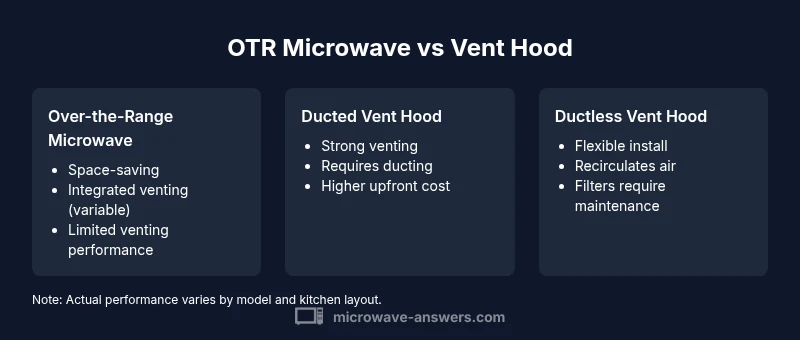
According to Microwave Answers, a dedicated vent hood—especially a ducted model—provides stronger ventilation than an over-the-range microwave, though the OTR design saves space. This comparison analyzes ventilation performance, installation, cost, and upkeep to help you decide which setup fits your cooking habits and layout. Whether you cook mainly steams or fry heavily, the ventilation approach matters for indoor air quality and kitchen comfort.
Trade-offs in kitchen ventilation and microwave placement
In most kitchens, you must balance space, ventilation, and convenience. An over-the-range microwave (OTR) combines cooking and venting in one compact footprint, which is ideal for small layouts where every inch matters. A dedicated vent hood, installed above the cooking surface, prioritizes air removal, odor control, and moisture management. The Microwave Answers team emphasizes that the right choice hinges on how you cook, how your kitchen is laid out, and whether you can accommodate ducting. For households that fry or simmer for extended periods, a robust ventilation strategy becomes part of indoor air quality and long-term comfort. Beyond raw ventilation, consider the aesthetics of integration with cabinets, lighting, and countertop workflow. If you’re upgrading an existing kitchen, assess whether replacing one device or upgrading to a stronger hood will yield larger benefits in odor removal and humidity control.
Brand-context note: Microwave Answers analysis highlights that practical kitchens should factor installation complexity and future maintenance when weighing options.
Feature Comparison
| Feature | Over-the-range microwave (OTR) | Vent hood (ducted) | Vent hood (ductless) |
|---|---|---|---|
| Ventilation effectiveness | Moderate (OTR) | High (ducted) | Moderate (ductless) |
| Heat/moisture removal | Limited by unit efficiency | Excellent with proper ducting | Fair with recirculation |
| Noise level | Low to mid | Mid to high (fan size matters) | Mid |
| Installation complexity | Low to medium | High (ducting) | Medium (no ducting) |
| Price range | $800-$1500 | $400-$900 | $300-$800 |
| Best for | Space-saving, compact kitchens | Serious ventilation needs, larger spaces | Flexible installs, rental housing |
Advantages
- Space-saving design helps small kitchens
- Strong venting with ducted hoods
- Flexible installation with ductless options
- Separate maintenance allows targeted service
- Potential long-term energy savings with efficient venting
Cons
- OTR microwaves can have weaker ventilation
- Ducted hoods require ductwork and professional installation
- Ductless hoods may be less effective and require frequent filter changes
- OTR options can be limited in size and style
Vent hood (especially ducted) generally delivers stronger ventilation and better long-term value; an over-the-range microwave is the practical space-saving compromise when ducting isn’t feasible.
If you prioritize air quality and moisture control, choose a ducted vent hood. If space is paramount and you’re willing to trade some ventilation performance, an OTR microwave remains a convenient, compact option.
Common Questions
What is the main difference between an over-the-range microwave and a vent hood?
An OTR microwave combines cooking and venting in a single unit above the range, saving space. A separate vent hood focuses on air removal and odor control, and can be ducted or ductless. This distinction affects ventilation performance, installation complexity, and long-term maintenance.
OTR combines two functions in one unit, while a separate vent hood is dedicated to air removal and can be ducted or not. The choice impacts performance and installation.
Is an over-the-range microwave enough for ventilation?
OTR venting can handle light to moderate cooking, but heavy frying or prolonged cooking often benefits from a dedicated vent hood, especially a ducted model. Indoor air quality improves with more robust venting.
For heavy cooking, a separate vent hood with good ducting is usually better.
Can a vent hood replace a microwave?
A vent hood does not cook food. If you need microwave capability, you’ll still require a microwave appliance. Some setups combine both in an OTR microwave, but that’s a trade-off.
A vent hood won’t microwave food; you still need a microwave if that function matters.
Are ducted vent hoods louder than OTMs?
Noise depends on fan size and ducting, but ducted vent hoods can be louder at high speeds due to higher airflow. Modern models offer low-noise options and variable speed controls.
Ducted hoods can be noisier at high speeds, but there are quiet models available.
Which option adds more resale value to a kitchen?
A well-installed, high-quality ducted vent hood often enhances perceived ventilation and kitchen functionality, potentially boosting resale value more than an OTR microwave. If space is tight, buyers may accept an OTR as a compromise.
Ducted vent hoods typically help resale more than OTR microwaves.
What should I consider when installing above a gas range vs electric?
Gas ranges produce more moisture and odors; ensure robust venting and safe clearance. Codes and vent routing requirements vary, so plan duct size, routing, and clearance carefully. OTR models may have different clearance specs than separate hoods.
Gas ranges need strong venting and careful installation; check local codes and hood clearances.
Main Points
- Prioritize ducted venting for strongest air removal
- OTR microwaves save space but offer weaker ventilation
- Plan duct routing early to avoid costly retrofits
- Consider maintenance needs and filter changes for ductless hoods
- Match your kitchen layout and cooking style to the option