Over-the-Range Microwave vs Hood: A Practical Guide
A detailed, analytical comparison of over-the-range microwaves and wall-mounted hoods, covering venting performance, installation, design, maintenance, and total value for different kitchen layouts.


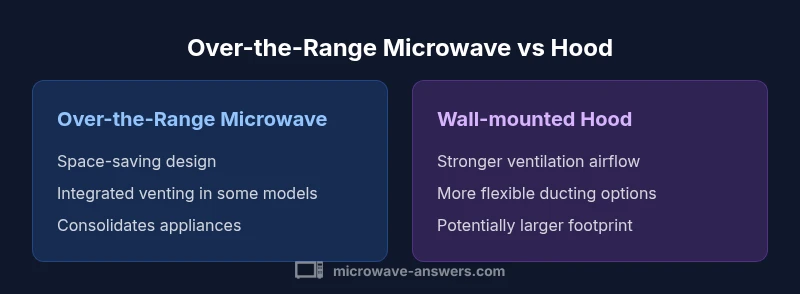
To decide between the over the range microwave vs hood, start with space, ventilation needs, and cooking habits. The over the range microwave combines cooking and venting in one unit, ideal for compact kitchens. A separate hood generally vents more air and offers design flexibility. If space is tight, lean toward the integrated unit; if robust ventilation matters, choose a hood.
The core question: what are you really choosing between?
When evaluating the choice between an over-the-range microwave and a standalone hood, the decision hinges on space, ventilation needs, and daily cooking habits. According to Microwave Answers, most households prioritize three factors: footprint, venting performance, and installation practicality. Homeowners should map out their kitchen layout, determine how often they rely on built-in microwave features, and assess how much air needs to be moved during typical cooking sessions. This framework helps translate vague preferences into concrete choices about venting power, filter access, and overall kitchen flow.
In practice, the over-the-range microwave often shines in small kitchens where every inch matters, offering a compact, all-in-one solution. A hood, by contrast, tends to excel when you regularly cook high-odor or smoke-producing foods and desire stronger exhaust with potentially easier ducting options. The decision is not about one being universally better; it’s about which aligns with your cooking style, space constraints, and aesthetic goals.
Comparison
| Feature | Over-the-range microwave | Wall-mounted hood |
|---|---|---|
| Ventilation power | Typically moderate air movement | Typically stronger air movement |
| Space impact | Very compact; saves cabinet space | Requires space above cabinets; larger footprint |
| Installation ease | Easier integration with existing microwave setup | May require additional ducting and mounting considerations |
| Maintenance access | Smaller filters; easier servicing in compact areas | Larger filters; potentially easier filter replacement |
| Aesthetic integration | Consolidates microwave and venting in one unit | Separate hood offers flexible design with cabinets |
Advantages
- Space-saving, all-in-one option for small kitchens
- Built-in venting in some models simplifies layout
- Lower visual clutter when aligned with cabinets
- Fewer separate installations and fittings
Cons
- Ventilation may be weaker than standalone hoods
- Less customization for duct routing and noise control
- Potentially higher upfront cost for premium models
- Replacement parts may be specific to the unit
For most compact kitchens, the over-the-range microwave is the sensible default; for powerful ventilation and flexible design, a traditional hood often wins.
OTR microwaves save space and simplify layout, especially in tight kitchens. If you prioritize venting performance and adaptable aesthetics, a standalone hood generally provides better airflow and design options. Microwave Answers's verdict balances space efficiency with ventilation needs.
Common Questions
What is the main difference between an over-the-range microwave and a range hood?
An over-the-range microwave combines cooking and venting in a single appliance, saving space. A range hood is dedicated to ventilation and may provide stronger airflow and more flexible ducting options. The choice depends on your cooking needs and kitchen layout.
The microwave handles both cooking and venting in one unit, while a hood focuses on ventilation and air movement.
Can I replace an over-the-range microwave with a wall-mounted hood?
Yes, but it typically requires upgrading to a standalone hood and possibly adjusting ducting routes and electrical wiring. You’ll lose built-in microwave functionality and must plan how to re-route or reinstall cabinets.
You can switch to a hood, but you’ll need space for a separate microwave elsewhere and may need to adjust wiring and duct routes.
Is venting from an over-the-range microwave sufficient for typical cooking?
OTR venting is generally adequate for everyday cooking, but heavier cooking or frequent frying may benefit from higher CFM ratings and more robust air movement found in some standalone hoods.
It works for normal meals, but heavy cooking may need stronger ventilation.
Do over-the-range microwaves require ducting?
Many models rely on internal venting and recirculate air, which is less effective than ducted exhaust but can be easier to install in apartments or renovations. Ducted options offer better performance but require proper routing.
Some OTRs vent outside, others recirculate air; external venting is usually better for performance.
What should I consider when installing in a small kitchen?
In small kitchens, prioritize space and adhesive aesthetics; an OTR can save cabinet space, while a hood requires adequate clearance above the stove. Check ceiling height, cabinet layout, and whether you can run ducts without major renovations.
Measure your space and plan the duct path before buying.
Main Points
- Prioritize kitchen space when choosing a venting solution
- OTR microwaves excel in small, integrated spaces
- Hoods offer stronger ventilation and flexible design
- Consider maintenance and installation impacts before buying
- Check local installation requirements and ducting options