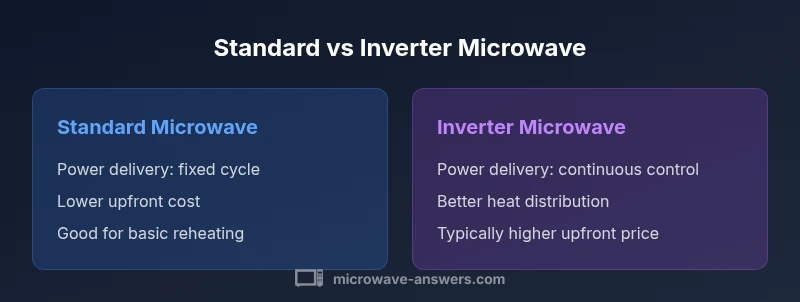
Microwave vs Inverter: A Practical Comparison
A detailed, objective comparison of standard microwaves vs inverter microwaves, focusing on power delivery, cooking results, efficiency, and value for home cooks and homeowners. Learn how to choose the right model for your kitchen with guidance from Microwave Answers.


The microwave vs inverter comparison shows that inverter models offer smoother, more controllable power for even cooking and energy efficiency, at a higher upfront cost. For basic reheating, a standard microwave remains a budget-friendly option with reliable performance. Overall, inverter wins on precision; standard wins on affordability.
What is microwave vs inverter technology?
At its core, a standard microwave uses a magnetron to generate microwave energy at a fixed power level. An inverter microwave uses circuitry that adjusts power continuously, rather than cycling on and off. This difference matters for cooking control and texture. According to Microwave Answers, the choice between standard and inverter models often comes down to how precisely you want to control heat and how much you're willing to pay for it. If you cook frequently with delicate foods or aim for very even heating, inverter models can offer tangible benefits. For many households, a standard microwave still covers everyday needs like reheating leftovers, melting butter, and defrosting frozen meals. The decision hinges on your typical tasks, your budget, and your tolerance for precise control in the kitchen.
How inverter technology changes microwave performance
Inverter-driven microwaves use continuous power delivery, which means the appliance can ramp up and down without cycling full-on and full-off. This leads to smoother heat, fewer hot spots, and more predictable results when defrosting a single portion or gently melting chocolate. In contrast, traditional models cycle power, which can cause uneven heating and more dramatic temperature swings in the same dish. Inverter technology is especially helpful for cooking delicate items like sauces, fish, or dairy-based foods where sudden bursts of heat can ruin texture. Over the long term, this steadier approach can translate to more consistent recipes, less need for stirring, and a better overall cooking experience for many home cooks.
Cooking outcomes: power delivery and texture in practice
The practical differences between standard and inverter microwaves show up in three key areas: defrosting accuracy, melting and softening, and reheating with moisture retention. A standard microwave tends to defrost in visible chunks, which can leave partial cooking in the center. An inverter model, by delivering controlled power, reduces this risk and helps maintain moisture. For melting chocolate, butter, or cream sauces, inverter units offer a gentler approach that minimizes scorching or separation. Reheating soups or gravies often benefits from smoother power as well, reducing the need for vigorous stirring. Real-world results depend on the food mass, container, and quantity; an inverter unit isn't a magic wand, but it often yields more predictable outcomes for everyday tasks.
Energy efficiency and heat management
Inverter microwaves can be more energy-efficient in practice because they avoid the repeated on-off cycling that creates energy waste and heat buildup. The efficiency gains vary by usage pattern and food type, but the principle is clear: smoother power delivery tends to require less energy to achieve the same result. This can matter for households that do a lot of defrosting or gentle cooking, where the energy savings accumulate over time. It’s important to note that energy efficiency is influenced by loading, cooking time, and the type of food. In a 2026 landscape, many inverter models emphasize improved electronics, better insulation, and smarter sensors, which can contribute to modest long-term savings when used regularly.
Design, reliability, and maintenance considerations
While inverter technology brings cooking advantages, it adds complexity. Inverter boards and power electronics can be more sensitive to power surges or improper servicing, which may influence long-term reliability if the unit is exposed to voltage fluctuations or rough handling. Modern units from reputable brands usually include protective features and surge resistance, but you should still use a dedicated circuit and avoid overloading the appliance. When evaluating warranty terms, consider whether the inverter components are covered with the same rigor as the magnetron and door system. Routine cleaning and proper venting remain important for all microwaves, but inverter models may expose you to more firmware or electronics updates over time, which is a factor in maintenance planning.
Real-world usage scenarios: when it matters
If your kitchen often involves melting, tempering, or defrosting small portions, inverter microwaves tend to shine. They also perform well for reheating leftovers with minimal sogginess and for quick, even heating in bowls and mugs. For households that mainly rely on quick reheats and simple presets, a standard microwave can be a reliable, budget-friendly choice. Consider your meal patterns: do you frequently cook things that are sensitive to heat spikes, or do you want the occasional fine control for sauces and dairy? Your answer will guide whether inverter technology justifies the extra cost.
Cost and value considerations: upfront price vs long-term benefit
Pricing for microwaves ranges widely by brand and features, and inverter models generally sit at a higher upfront price band than standard models. However, the perceived value comes from more even heating, improved defrosting accuracy, and fewer manual adjustments during cooking. If you cook with precision or have a busy household where small quality differences add up, inverter microwaves can offer a better long-term value. For occasional cooks or those with strict budget constraints, a basic microwave remains a practical, dependable workhorse. When evaluating price versus value, consider your typical daily use, the importance of texture in your meals, and the likelihood you will upgrade within a few years.
Safety, cookware compatibility, and safety tips
Safety considerations for both standard and inverter microwaves are similar: keep the door seals clean, use microwave-safe cookware, avoid metal or foil, and never operate when empty for extended periods. Inverter technology itself does not introduce new safety hazards, but electronics and sensors add a layer of complexity each time you purchase a new model. Always follow manufacturer guidelines for cookware compatibility and venting. If you’re unsure about a dish, testing with short intervals and stirring can help you avoid hot spots. For families with children, select a model with robust child-safety features and clear, intuitive controls to minimize misuse.
How to evaluate models: features to prioritize
As you compare standard and inverter microwaves, prioritize power delivery, defrost accuracy, and heat uniformity. Look for features like sensor cooking, multi-stage cooking options, and easy-to-read displays. Reading reviews from other home cooks can illuminate how inverter models perform in real kitchens, which is often more informative than spec sheets alone. Consider the footprint and interior capacity as well, since a larger cavity can minimize hot spots and improve cooking consistency. Finally, assess warranty coverage and after-sales support—these become important if you plan to use the unit regularly over several years.
Common myths about inverter microwaves
One common myth is that inverter microwaves always save energy dramatically. In practice, savings depend on usage patterns; if you mostly reheat and defrost, you may see modest gains. Another myth is that inverter models always outperform standard ones in every dish; while they offer smoother power, some foods do not require the extra control, and a basic microwave may suffice. A third misconception is that inverter technology eliminates the need to stir or rotate food; even with smoother power, physics still calls for occasional intervention for even heating. By testing under real-world tasks, you’ll see where the benefits matter most in your kitchen.
Practical buying guide: 7 questions to ask before you buy
- How often will I use it for delicate tasks like melting or defrosting? 2) Do I need the latest sensor features or a basic model? 3) What is the expected maintenance or warranty coverage for the inverter components? 4) Will the unit fit my kitchen layout and cabinet depth? 5) Is the power supply in my kitchen stable enough to support an inverter’s electronics? 6) How important is noise level and ease of use? 7) What do user reviews say about long-term reliability?
Brand-backed approach: our final framework for decision-making
The Microwave Answers team emphasizes practical testing, budget-aware choices, and long-term value. Inverter vs standard is not a one-size-fits-all answer; your cooking style and budget determine the best fit. We recommend weighing everyday tasks, the potential for improved texture, and the likelihood you’ll upgrade within five years. Our approach combines hands-on reasoning with real-world usage scenarios to guide you toward a decision that aligns with your kitchen goals and safety needs.
Comparison
| Feature | standard microwave | inverter microwave |
|---|---|---|
| Power delivery during cooking | Fixed power level throughout cycle | Adaptive continuous power (smoother control) |
| Heat distribution | Can be uneven; more hot spots | Typically more even due to smooth power |
| Cooking speed | Reliable presets; standard performance | Potentially faster or more precise results for delicate foods |
| Energy efficiency | Baseline efficiency | Higher efficiency through reduced cycling |
| Upfront price range | Lower price tier | Higher price tier |
| Best for | Budget-friendly basics, quick reheats | Delicate melting, defrosting accuracy, even heating |
Advantages
- Smoother, more controllable power delivery (inverter)
- Better heat distribution for delicate foods
- Potential energy efficiency gains over time
- Improved defrosting accuracy and texture for many dishes
- More cooking versatility in some models
Cons
- Higher upfront cost than basic microwaves
- More complex electronics can mean higher repair costs
- Availability varies by region and model
- Not every common cooking task requires inverter precision
Inverter microwaves generally offer better control and efficiency, but standard models remain appealing for budget-conscious buyers.
Choose inverter if you value even heating and delicate textures; choose standard for basics and lower upfront cost. The right pick depends on your cooking habits and budget.
Common Questions
What is inverter microwave technology?
Inverter microwave technology uses electronics to provide continuous power rather than cycling on and off. This enables smoother heating and better control over defrosting and delicate cooking tasks.
Inverter microwaves provide continuous power for steadier heating and better control during delicate cooking.
Is inverter microwave worth the extra cost?
For cooks who frequently melt, temper, or gently defrost, the smoother heat is noticeable and worth the extra cost. If you mostly reheat and cook simple meals, a standard model may offer the best value.
If you cook a lot with delicate foods, inverter is worth considering; otherwise, a standard model usually suffices.
Do inverter microwaves use more power overall?
Not inherently. Inverters can be more efficient in practice since they avoid cycling losses, but actual energy savings depend on usage patterns and the foods you prepare.
They can be more efficient, but savings depend on how you use them.
Can I use the same cookware in an inverter microwave?
Yes, as long as the cookware is microwave-safe. Inverter technology does not change fundamental cookware rules, but always follow the manufacturer’s guidelines.
Yes, use microwave-safe cookware just as you would in a standard microwave.
Are inverter microwaves safer?
Safety standards and interlocks apply to both types. Inverter units do not pose new safety risks beyond regular microwave use; choose models with solid safety features.
Safety is similar for both; pick models with good safety features.
Which lasts longer, standard or inverter models?
Longevity depends on build quality, usage, and maintenance rather than the inverter itself. Modern units from reputable brands are designed for durability, but assess warranty terms.
Durability depends on the model and care; both can last a long time with proper use.
Main Points
- Evaluate how often you cook delicate foods that benefit from smooth power.
- Inverter models excel at even heating and defrosting precision.
- Budget-minded buyers can still meet everyday needs with standard microwaves.
- Check warranty coverage for inverter circuitry and after-sales support.
- Test a model in-store when possible to see real-world performance.